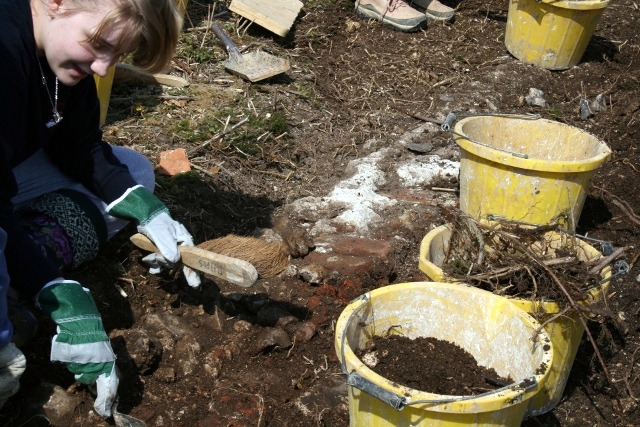
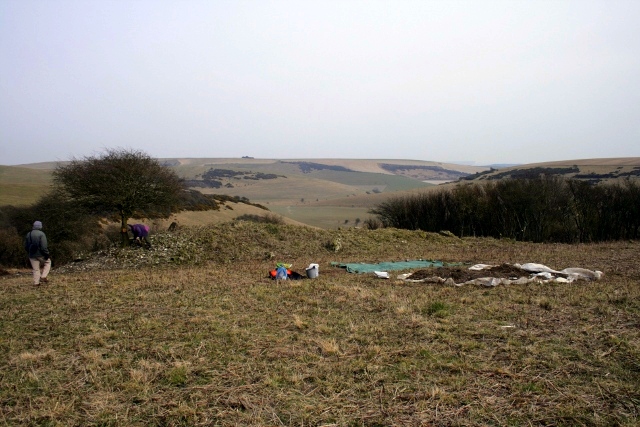
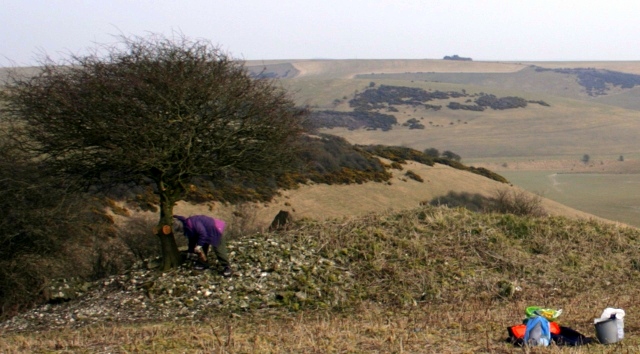
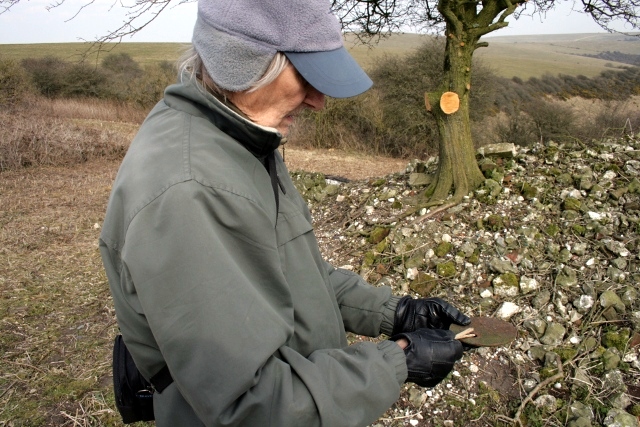
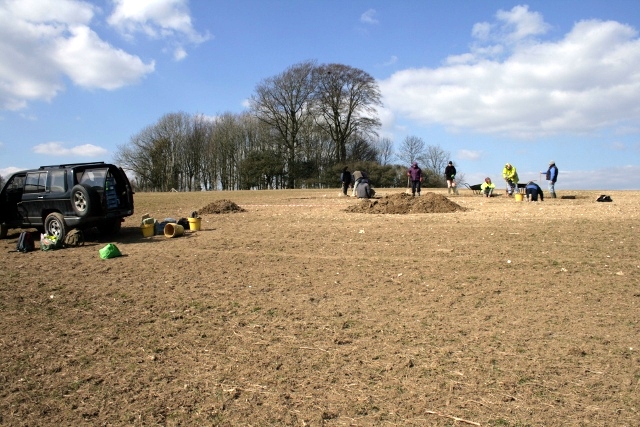
After a wet start, the weather cleared up just in time for the arrival of 7 volunteer diggers, mostly from Brighton and Hove Archaeological Society. Access was made much easier for us, for Natural England has now inserted a small wire gate into the fence, for which we are very grateful.
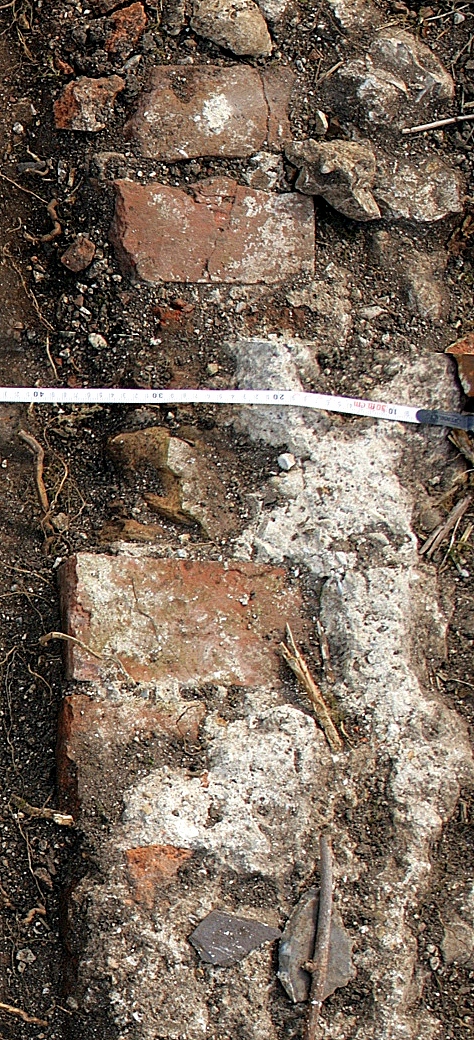
Damaged west wall of house.
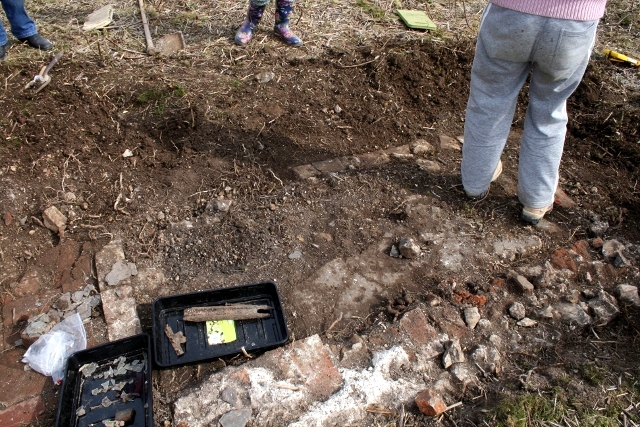
Having already dug the centre of the west side of the house last Sunday, we split into two groups, following the west wall of the house – searching for the returns to this wall – and we found them! It seems we were lucky last week, for the quality of the surviving archaeology towards the gable ends of house wasn’t quite as good as that in the middle. It may be that the WW2 shell damage demolition rubble was deeper in the middle of the house and so protected it from the bulldozer, which cleaned up the site in the early 1950’s.
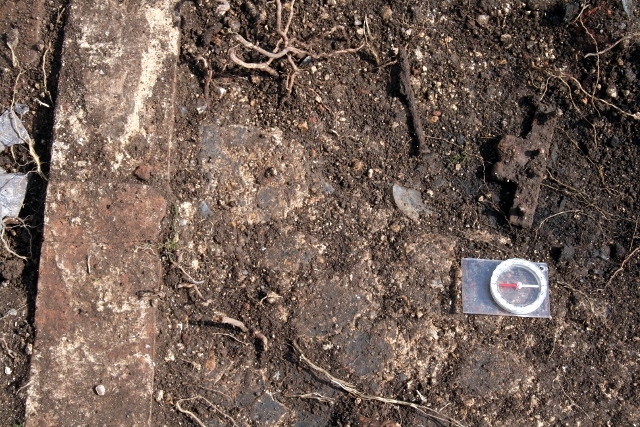
No more than a single course of the west house wall has survived above the old floor level. Its construction was of flints on the outside and header bonded brickwork on the inside. Alternating courses of headers and stretchers are characteristic of English bonded brickwork.
To the south of the house, on maps on and after 1898, a new extension is visible. Sadly the outside wall starts dipping down quickly where it has either been cut by WW2 artillery shelling, or the later bulldozer, so it is not yet clear whether there will be any sign of it in the archaeology. However, the original turn of the wall has been found, and immediately before that turn the imprint of a frogged brick in the mortar is clearly visible. Only one other frogged brick has been found on site. All others were frogless. The frogged brick that made this imprint almost certainly belonged to a later phase of construction and, as yet, is our only archaeological evidence of the extension. However, both Phippses and Lathams recall a sort of lean-to conservatory on the western half of the south gable end.
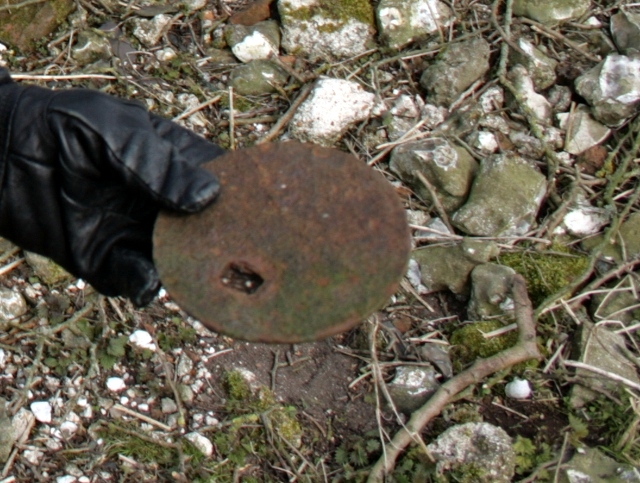
Since last week further memories of the oldest surviving Phipps and Latham ‘children’ were sought, and they confirmed both the coal store and pantry, the latter having a window which looked out onto the farmyard. The Lathams possessed some sort of an iron stove, whose lid we may have found on the north end of the rubble mound.
Cast iron lid of stove found on surface of rubble mound.
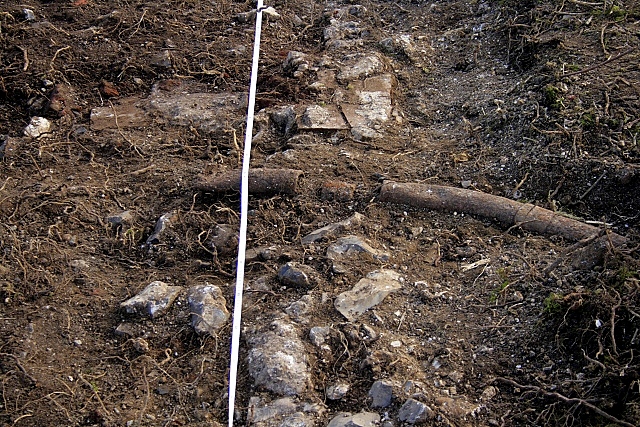
At the front gable end of the house the NW return to the wall was also found. A short distance to its north the metal detector found something with a strong signal which registered as having a non-ferrous component. Since such a signal could be from unexploded ordnance it was very carefully excavated, but fortunately it turned out to be rusty drain pipe. If it is in-situ it could have topped up a possible well, which the Lathams recall as being in front of their kitchen window, from rain water collected from the nearby barn roof. Or it might have fallen from the side of the house. Only further excavation will resolve this intriguing feature.
Rusty drain pipe to NW of house.
We have also aroused the interest of a number of walkers, some of whom came over to have a chat about what we were digging, and also about the history of this part of the South Downs in general. This project is not just about the digging of a 19th century farm labourer’s cottage, it is also about the interpretation of what we find and the communication of the results to as wide an audience as possible. Needless to say, there is still a lot more to dig, and – I am sure – a lot more stories to tell!
Yesterday I speculated about a probable coal store in Newmarket Cottage. Further research revealed this excellent article on the history of coal use in nearby Brighton, and the local entrepreneur James Corrall:
From this it appears that coal was significantly used as a fuel by the labouring classes of Southern England in at least 1830. This was a decade before the railways. Therefore the coal store in Newmarket Farm may well have been contemporary with the original construction of the cottage. Careful archaeological excavation may help determine whether this was so. Also, coal fireplaces require a grate to provide air flow from underneath. Wood burning fireplaces needed no grate. If we can locate the remains of the fireplace, might its design tell us something of the nature of the fuel the first tenants were expected to use?
Sunday was a great success. Eight volunteers turned up, including 3 from Brighton & Hove Archaeological Society and their ‘battle wagon’ full of useful tools. The day was sunny and almost warm! The ground was moist but dried once exposed to the drying sunshine.
Digging W side of Cottage.
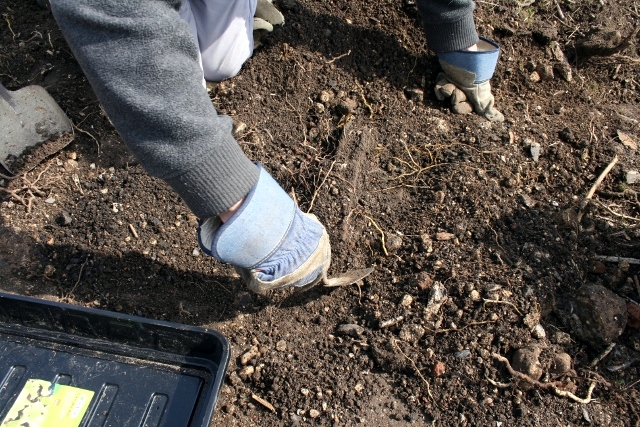
A digging hoe was used to cut through the bramble and nettle roots and did the job very well. An old tarpaulin was used to contain the spoil, so that it would be easier to shovel it all back at the end of the dig. The trenches need to be backfilled when we are finished to protect the archaeology from the elements.
Uncovering the W wall of the house.
I erroneously thought we were digging the SW corner of the house. I now know we were in the middle of the house, and soon came down on the partition wall dividing the two downstairs rooms.
Junction of internal wall with external house wall.
The partition wall exposed was a single course of a half brick, otherwise known as single leaf, stretcher bonded construction (see Wikipedia page on ‘brickwork‘).
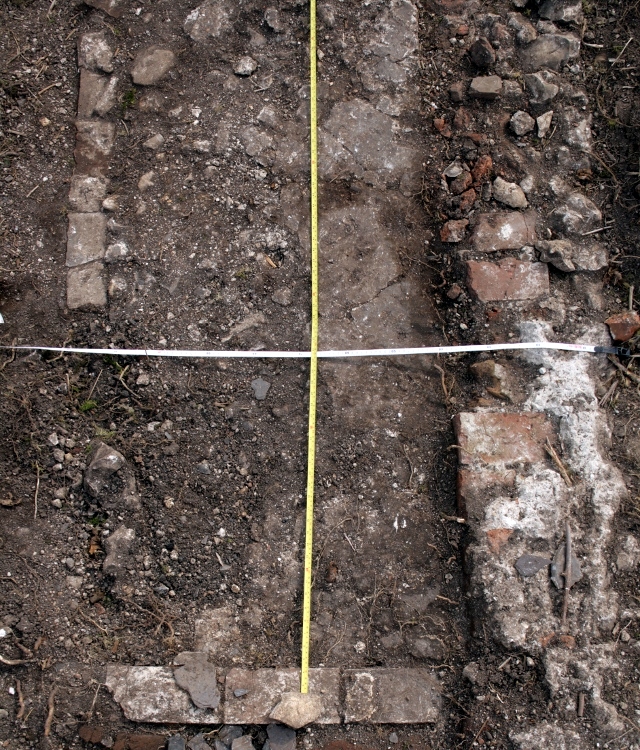
To its south a mortared floor was uncovered. Overlying it was a very dark coloured soil with both a number of rusted iron objects and small fragments of coal. This has been labelled as trench 1A.
Some iron finds from trench 1A.Iron object from trench 1A.Trench 1A showing un-mortared bricks edging its E side and exterior wall to its W.Trench 1A showing un-mortared bricks on E edge.Composite photo of Trench 1A.
This feature, now known to be within the building, may have been an indoor store for coal, in what used to be the kitchen. In Victorian times all cooking would probably have been over an open fire. With little or no wood available over the downs, relatively cheap coal delivered by rail would have been their main source of fuel. Therefore this feature may post-date the original construction of the house by more than a decade. To understand this feature in greater detail, surviving former occupants need to be questioned if they remember such a coal store. Also desk-based research on the local rail transport of coal and its domestic use in the area may prove useful. Further excavation may reveal details of its stratigraphy.
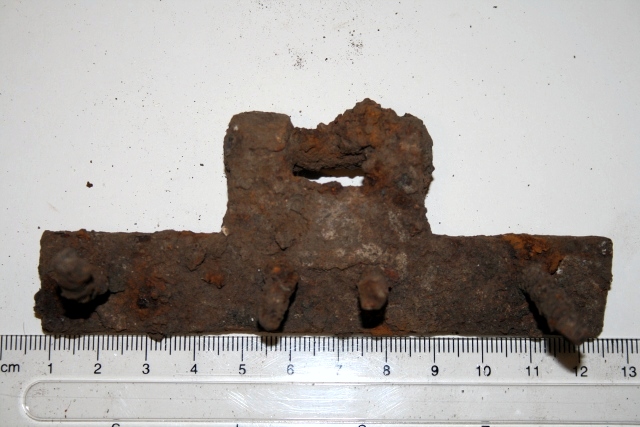
Iron hinge from trench 1A.
The finds from trench 1A included a rusty iron hinge, possibly from a door to this probable coal store.
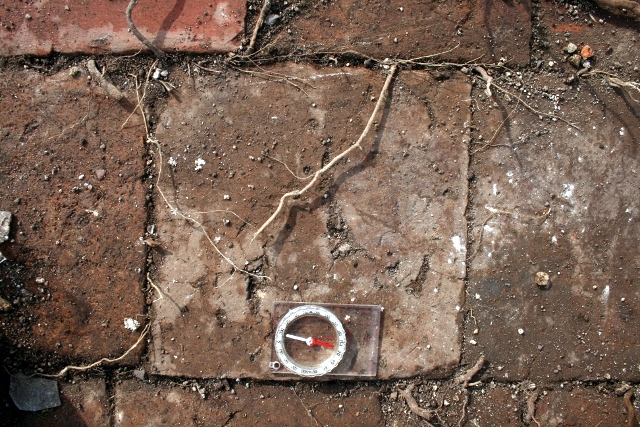
To the north of this feature a floor surface was revealed of very nice, roughly 23cm square, terracotta tiles.
Terracotta tiles in trench 1B, a possible pantry.
From on top of this floor, some in-situ mortared bricks were found; almost certainly collapsed wall from shell damage during the second world war (October 1942 when the house was requisitioned – 1945).
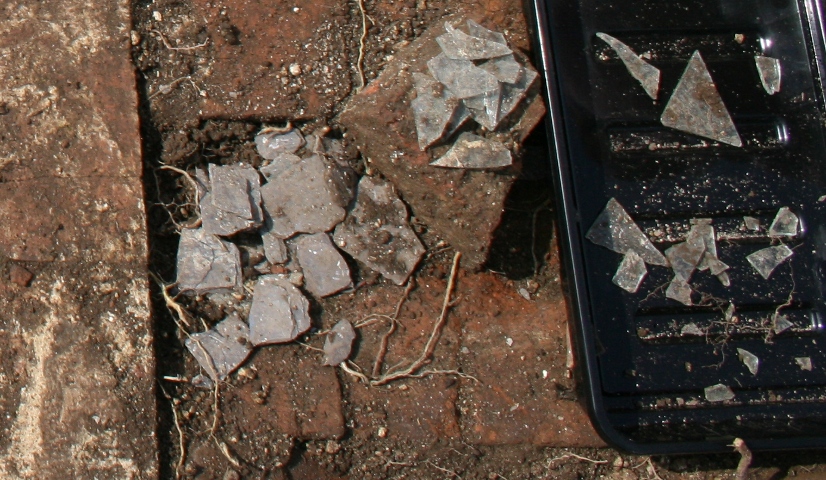
Window glass and slate finds from trench 1B.
In with this was a quantity of relatively modern looking window glass – indicating the pantry may have had a window overlooking the farmyard to its west. Also present was a quantity of blue slate tile, presumably from the roof.
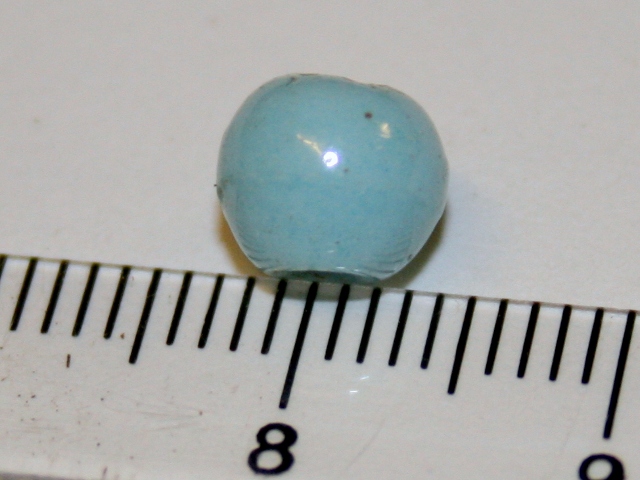
Lucite(?) bead from floor of trench 1B.Lucite(?) bead, on floor of trench 1B.
This small bead may be a very exciting find. It appears to be made of plastic. The earliest plastic beads were made from bakelite, but the colour range was very limited. The colour of this bead is too bright for bakelite. The next succesful type of plastic used for jewelry was an acrylic thermoplastic, which appeared under the trade name of Lucite. It was first used as an articificial glass under the name of Plexiglass in 1933, and has also been marketed under many different names such as ACRYLITE®, and Perspex. Because it did not shatter it was heavily used during WW2 for airplane windshields, canopies, and gun turrets. After the 2nd World War, many companies produced Lucite jewelry, but before this only the high end costume jeweller Trifari used it. Their costume jewlery was considered ‘a stylish and affordable‘ alternative to wearing precious gems and metals. However, this American company made a number of patriotic pieces in support of the war effort, including gaining exclusive rights to using the British RAF emblem. There is the possibility that an army officer was billeted with the Latham family, before they were forced to leave in about October 1942. Could this bead have been part of a gift to Peggy’s mother? The Latham family, like all their predecessors in Newmarket Cottage, were poor and could not have afforded to buy it themselves.
1919 halfpenny from trench 1B.
This 1919 halfpenny, badly corroded on its reverse, would have been worthabout 30p today. It may have belonged to the Moon family who lived there at the time of the 1911 census.
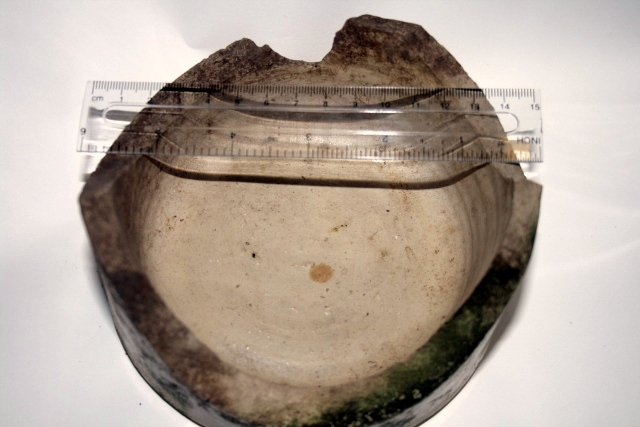
The demolished rubble of the house was bulldozed into a large linear mound just inside the east boundary wall of the garden. It is full of shards of pottery, metal, and other objects. Surface finds included:
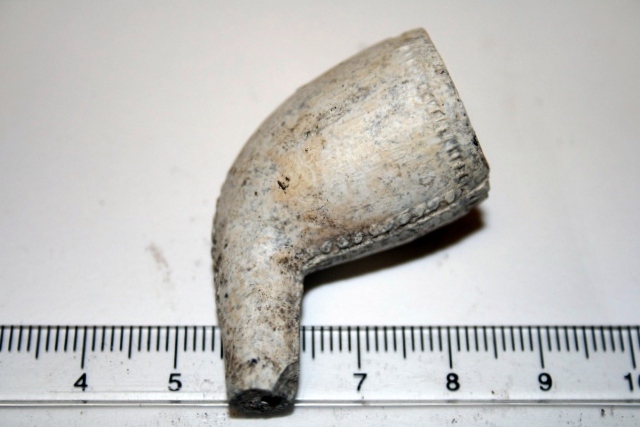
Stoneware jar base, from rubble mound.Decorated clay pipe bowl, 19th c.(?) from rubble mound.Another view of decorated clay pipe bowl, 19th c.(?) from rubble mound.
This pipe is almost certainly 19th c. because of the angle of the bowl relative to the stem, and the evenness of the moulding and finish.
Clay pipe stem with a star shaped makers mark on heel, 19th c.(?) from rubble mound.Tautz button from surface of rubble mound.
The button reads:
E. TAUTZ & SONS
485 OXFORD ST
E. Tautz & Sons were high class makers of riding breeches and other related clothing for “the hunting-field and military men“, occupying this address (opposite Selfridges) from shortly after 1867 till sometime before WW2. There was much hunting and military activity over Newmarket Hill. Was this a button lost by a gentleman out riding, and found by one of the many children who lived in Newmarket Cottage, or was it a hand-me-down from the well meaning wife of such a gentleman? Poverty with agricultural labourers was extreme. Occassionally there were those, such as the lodger in Newmarket Cottge in 1868, Martin Brown, who “acquired” the money to be able to buy quality garments that others in his situation would not have been able to afford.
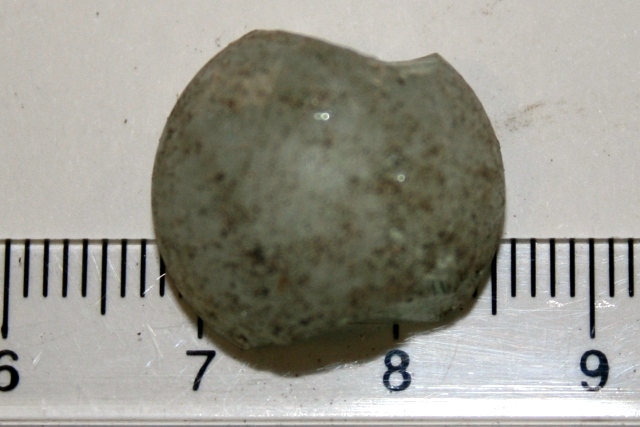
Half a broken marble from a Codd Bottle, from the surface of the rubble mound.
Codd-neck bottles of fizzy pop contained a marble in their neck. The pressure of its carbonated contents pushed it against a washer which produced a gas-tight seal. Needless to say, despite the deposit on the bottle, kids liked to smash them open to get at the marble inside. This one may have been from a stolen empty bottle. They date from 1873 till the 1930’s when they started going out of fashion for the more modern screw-top bottles introduced in the 1920’s.
I returned with my parents the next day to record the trenches in a little more detail, and to cover them with a tarpaulin to protect them from the rain.
Looking SE from NW corner of Farmyard at bulldozed mound of demolition rubble.North end of rubble mound.Cast iron lid of stove found on surface of rubble mound.
My Dad found the lid to a cast iron stove on the north end of the rubble mound.
Cast iron lid of stove found on surface of rubble mound.
What might the stove have been like? To which family did it belong?
It is all very well my reading loads of stuff on archaeological methods – whether technique or theory. The core skills of archaeology are gained by practical experience. So on a very cold but mostly sunny Saturday I joined the Brighton and Hove Archaeological Society on their first dig day of the season at Rocky Clump, in Stanmer Park.
BHAS at Rocky Clump, Stanmer.
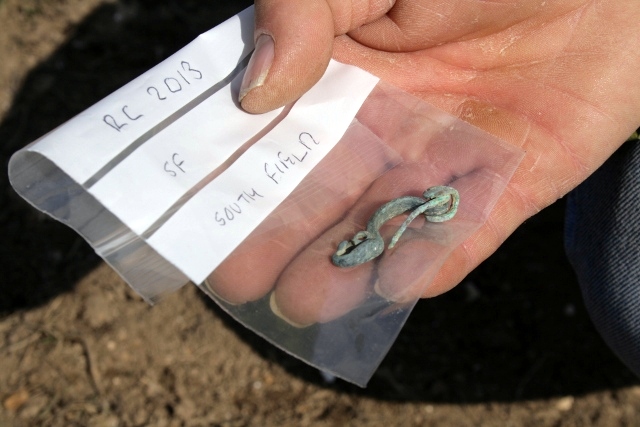
The field had recently been harrowed. And siting on top of the plough soil:
Romano-British Fibula Brooch.
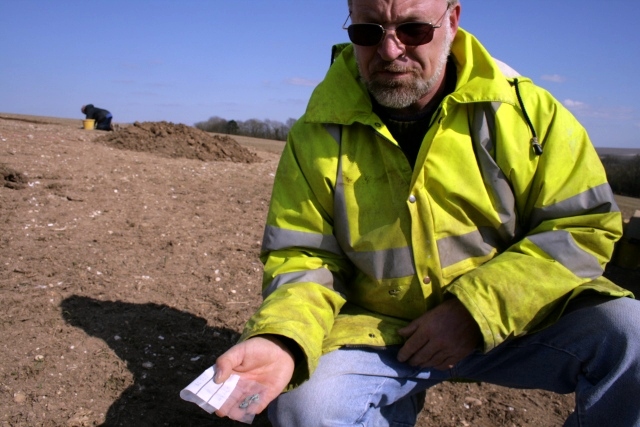
A happy archaeologist!:
Clive with brooch.
Meanwhille,
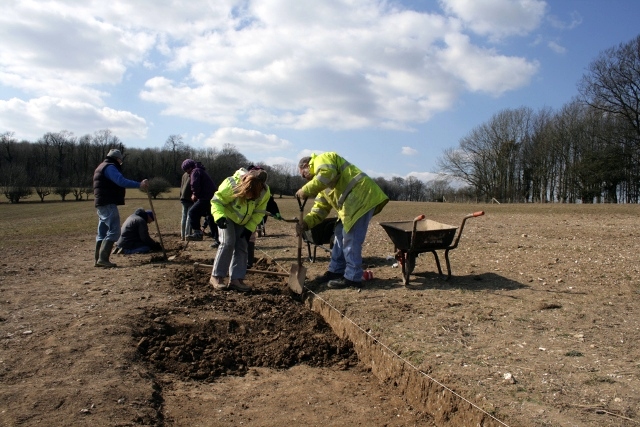
Archaeology at Rocky Clump.
The trench was being skilfully dug under the watchful eye of a number of experienced volunteers. Several finds turned up (including by me!): a nice mesolithic core, flint flakes, along with East Sussex Ware and fine tempered pottery.
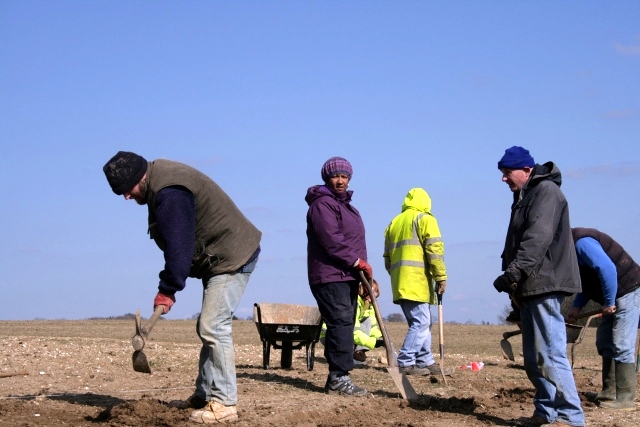
Did I say it was cold?
Cold archaeologists!
A very good day. I was definitely looking forward to my own dig the following day.
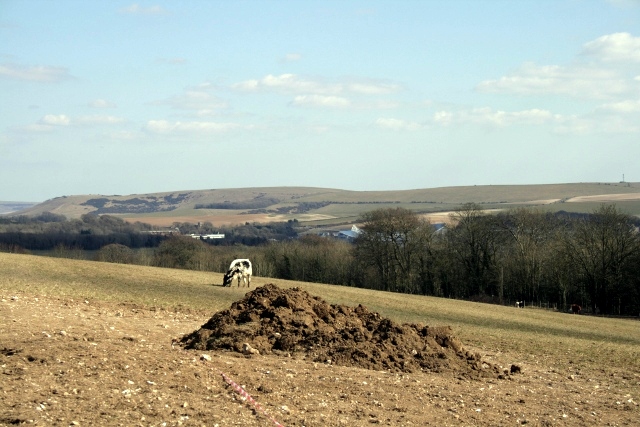
View from Rocky Clump SE to Newmarket Hill (far right) and Kingston Ridge (far left)
This is not just a view of a spoil heap and a cow in the field by Rocky Clump – in the far right of the picture is the TV aerial on Newmarket Hill, just a hundred metres or so from my own dig, and to the far left of the picture is Kingston Ridge, at the foot of which nestles the village of Kingston near Lewes to which Newmarket Farm used to belong.
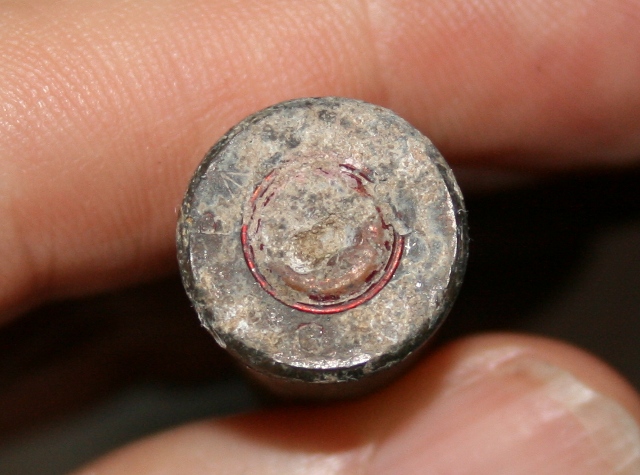
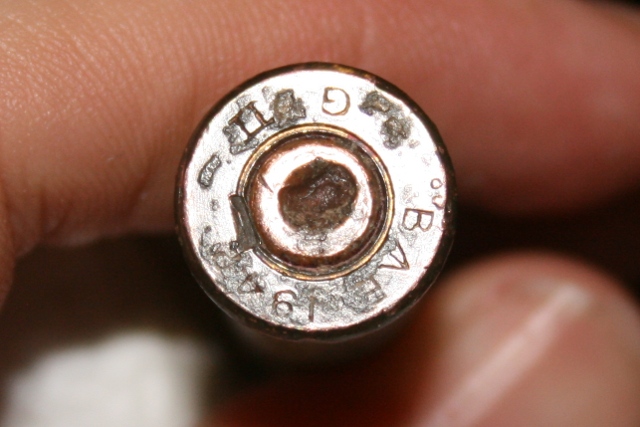
During the clearance work I found another .303 cartridge. The headstamp was pretty dirty and or corroded, and in my ignorance, I tried cleaning it with a brillo pad and some meths.
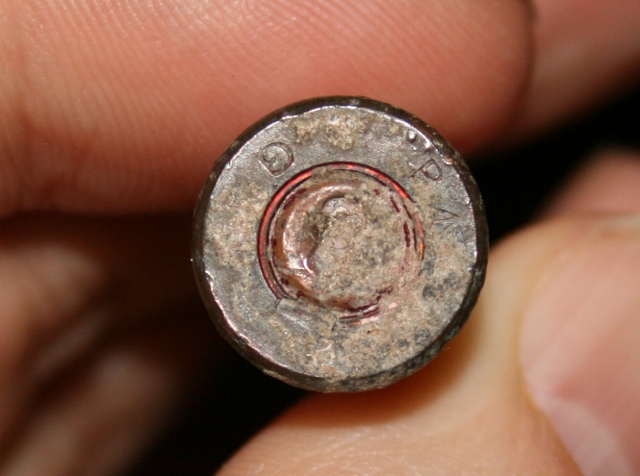
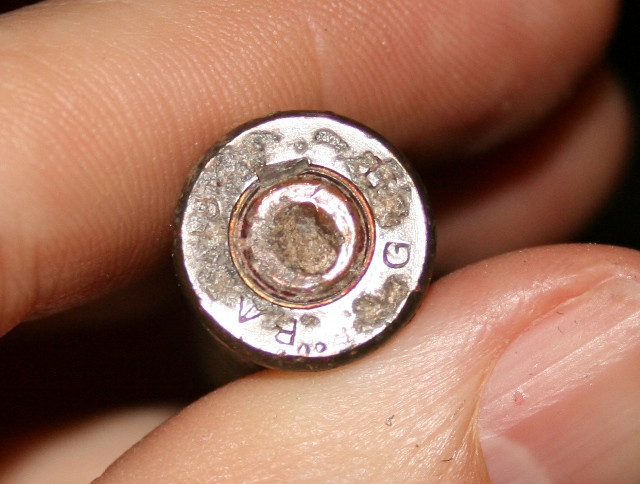
.303 cartridge. Note the red annular ring.Lettering on headstamp appearing.Red paint on annular ring disappearing as stubborn dirt is also being removed.Writing on headstamp just about fully revealed; red paint just about lost.
The last picture reveals the red paint has just about all been removed, however both the writing and the firing pin indentation are very much visible. Better conservation techniques may have enabled all its features to be revealed and conserved.
The headstamp revealed the lettering:
B /|\ E 1942 G II
This identifies it as the cartridge of a .303 tracer bullet made in 1942, in the Royal Ordnance Factory the Royal Ordnance Factory in Blackpole (not Blackpool), in Worcester. The red paint (before it got removed!) confirms it was a tracer bullet.
The oval shaped indent in the middle was from a firing pin of the same shape – which means it was fired from a bren light machine gun. Every half dozen or so bullets was a tracer to help keep the gunner on target.
A Bren gunner of 8th Royal Scots at Moostdijk, 6 November 1944. (Photo credit: Wikipedia)
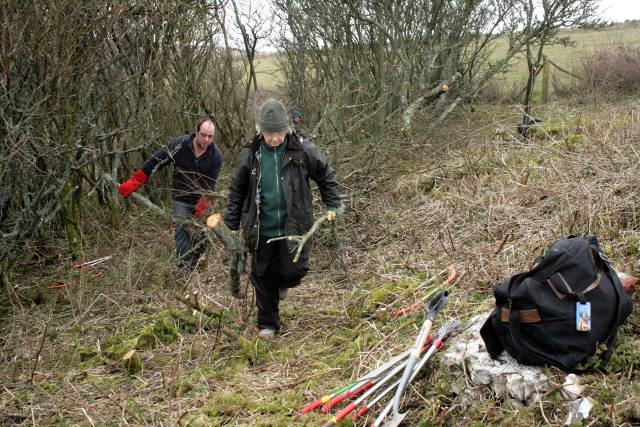
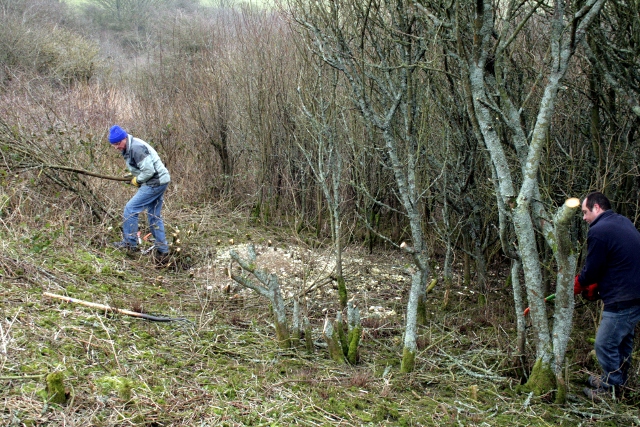
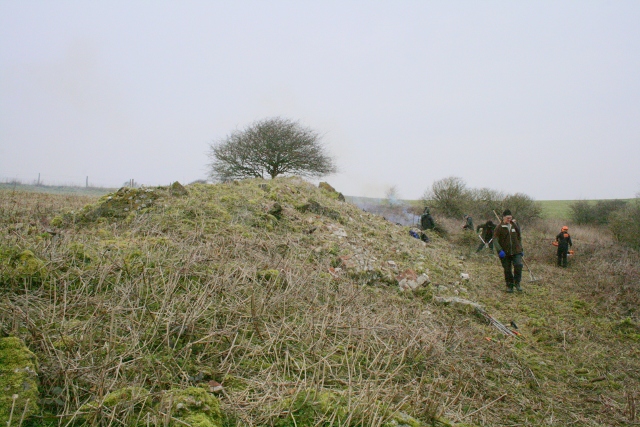
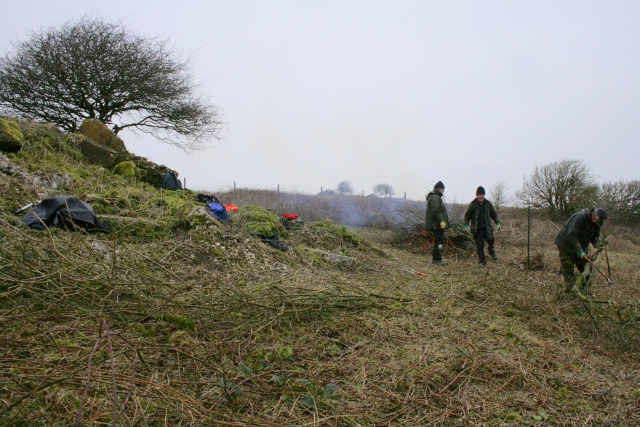
The South Downs Conservation Volunteers were back on site on the 21st of last month to finish the clearance of the Newmarket Farm Site – invited by the Castle Hill nature reserve managers. I was so busy planning and studying in preparation for last Sunday’s dig, I have only just downloaded the photos from my camera. I didn’t take many, but here they are at last!
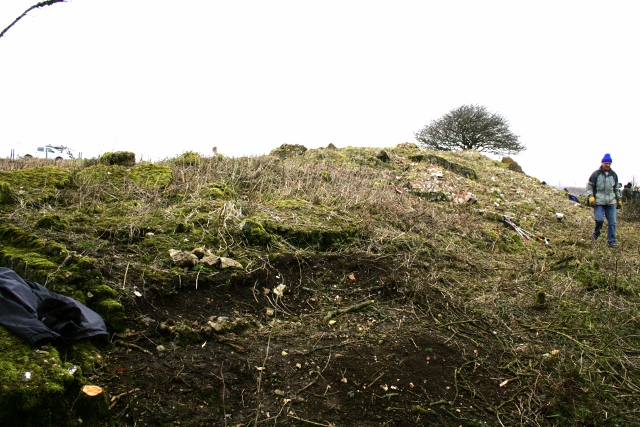
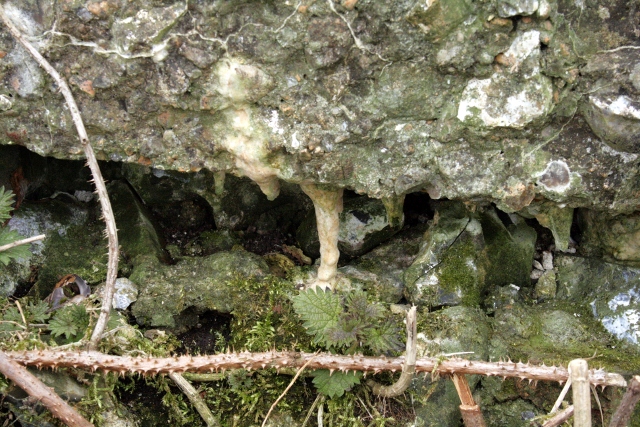
East side of Newmarket Farm, looking south. Clearing prunus scrub.WW2 shell crater revealed during clearance.SE corner of site looking N along bulldozed rubble mound.SE corner of site looking NNW along bulldozed rubble mound, showing small section of partially excavated garden wall.6o years of rain has created a stalactite from the lime mortar in a demolished block of masonry.NE corner of site, burning cut scrub.
The site now looks very different from when we started – perhaps I should do a before and after page. However, as soon as it gets warmer it will all start growing back again very quickly!
Our first volunteer dig day was planned for tomorrow, however there was a small snow blizzard yesterday evening, some sleet this morning, and more snow and freezing temperatures forecast for this coming night. Newmarket Hill is the highest hill in the area so it might not be a nice place to be on Friday.
Therefore it has been decided to postpone our start date till Sunday the 7th April – which is forecast to be a much nicer day! Our meeting place is the car park by the Falmer Rd, just north of Woodingdean at 10am. See you then?
The planning of my first ever archaeological dig has taken me far longer than I – er – planned! The good news is that I am feeling pretty optimistic that by next Friday the last few bits and pieces will all be in place – or will be very shortly. So I thought I would give a quick update of how things stand.
I have just finished my Project Design Document, which, weighing in at a huge 35 pages, I hope is not too big! It is standard archaeological practice to write such a report covering all aspects of the background to the dig, why it was planned, what is hoped to be achieved and – given the resources available – whether it is realistic, and also, whether the proposed methods, etc, follow accepted guidelines and standards. This being the first such document I have written, I followed English Heritage‘s advice that, when in doubt, it is better to write too much than too little. I also added several pictures, which may make it easier to read.
Last week the last of the site clearance work was completed, and vehicle access via a wire gate onto the site is hoped to be completed sometime in April. This is really good news. The not so nice but understandable news is that we can’t dig a compost toilet on site as I hoped.
On Monday I will be meeting with John Funnell of Brighton and Hove Archaeological Society, who has kindly offered us much needed help and support – as described in their Archaeology Report – Spring 2013. No matter how much background reading I have done, it can never replace practical experience.
I discovered this excellent article on openness in archaeology whilst considering copyright issues for the Newmarket Farm Dig documentation archive. I am a strong believer in such an approach – though not everyone agrees.