Blog

  • Sixteenth Dig Day – Friday 14th June 2013

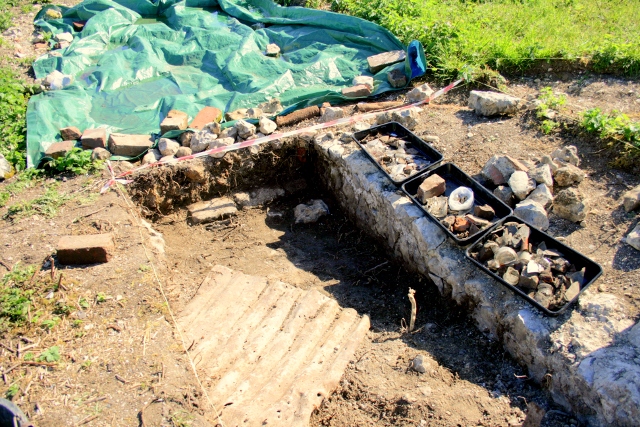
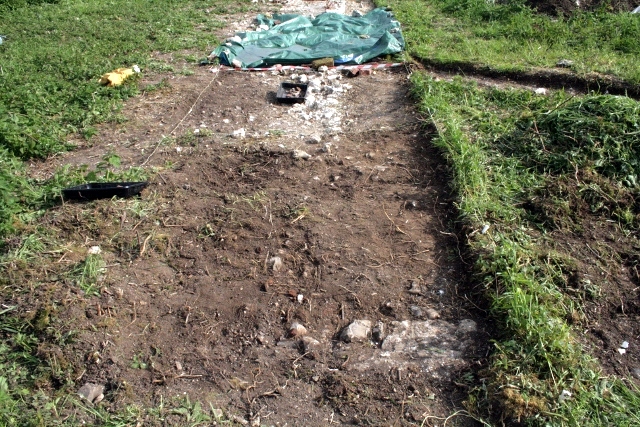
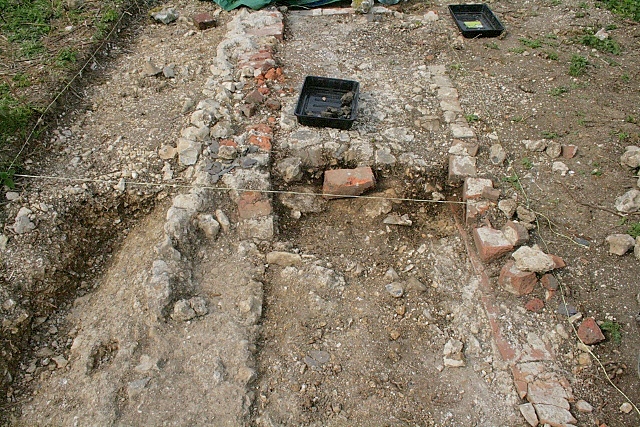
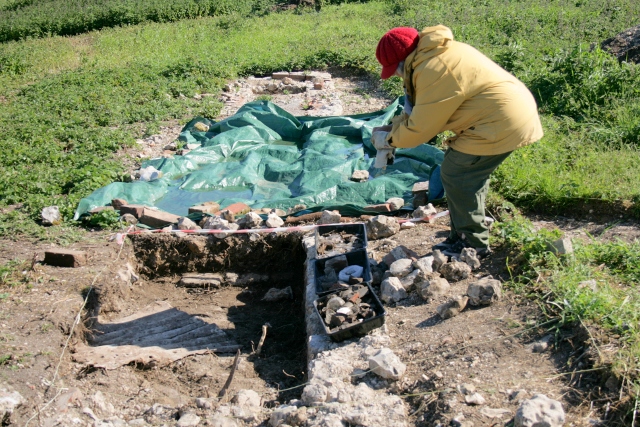
    Looking S towards front of house (under tarpaulin) from garden/farmyard wall
    Looking S towards front of house (under tarpaulin) from garden/farmyard wall

    Yet another amazing dig day; finds with practically every insertion of the trowel.
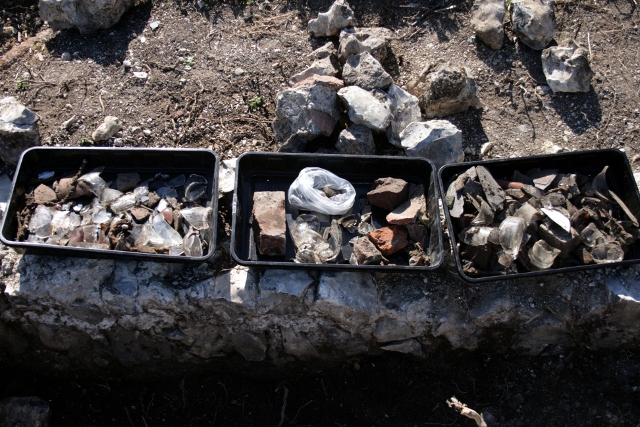
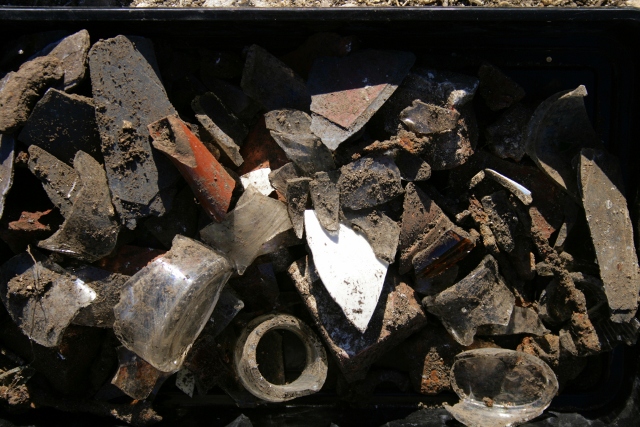
    Finds trays
    Finds trays

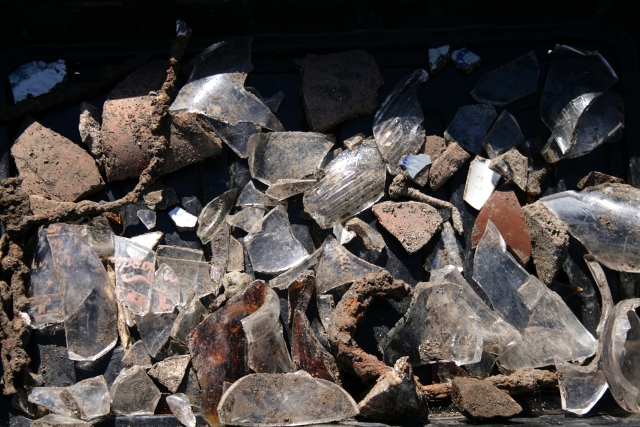
    Our small finds of shards of glass, ceramic, metal & plastic weighed over 4kg! The rain earlier in the week had dampened down the dust so it was much nicer digging than last week.

    Finds included:

    • Finds, including brown teapot spout
      Finds, including brown teapot spout.

      A fair quantity of ceramic shards, of various fabrics, with and without patterns, including our first teapot spout (in brown fabric & glaze) were found;

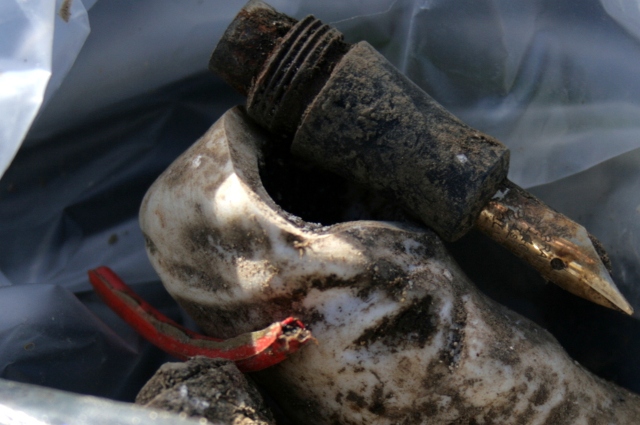
    • Limb of ceramic figurine, pen nib, light bulb, and piece of red plastic
      Limb of ceramic figurine, pen nib, light bulb, and piece of red plastic.

      Also, another limb from our ceramic figurine (no body or head as yet);

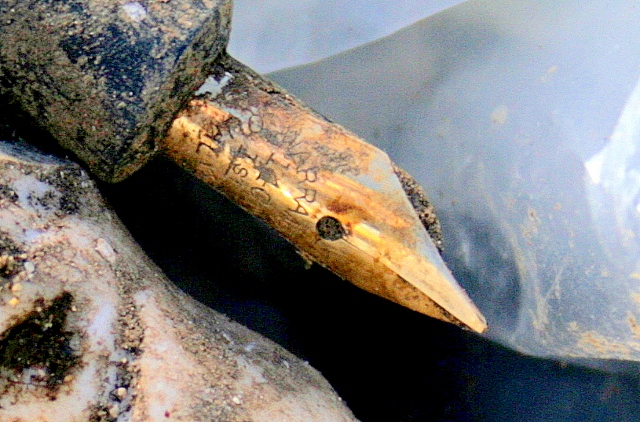
    • Fountain pen nib
      Fountain pen nib.

      A 14 ct gold fountain pen nib with screw threaded holder in dark coloured hardened rubber(?) in amazingly good condition (post 1920?);

    • Shippams fish/meat paste jar shards, and other finds
      Shippams fish/meat paste jar shards, and other finds.

      Several shards of the iconic Shippams meat paste jars (post 1905);

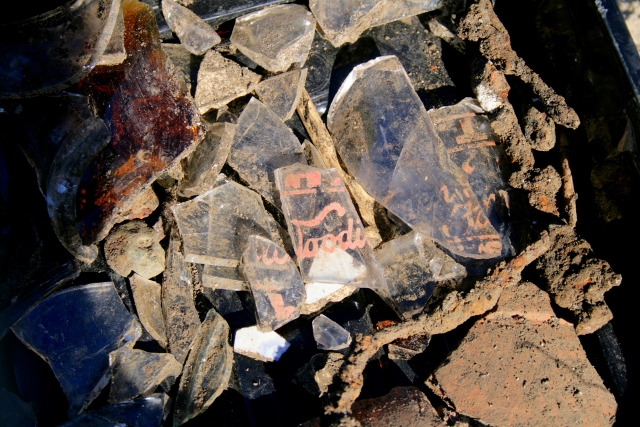
    • Milk bottle shards from Woodingdean Dairy(?) and other finds.
      Milk bottle shards from Woodingdean Dairy(?) and other finds.

      Milk bottle shards with red painted writing possibly from the Woodingdean Dairy (post 1920’s);

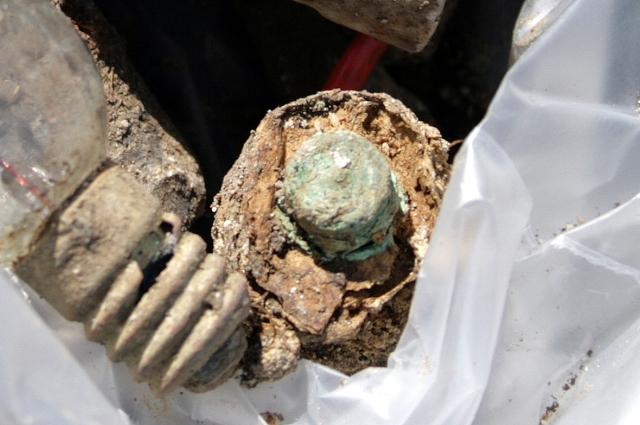
    • Electrode, and other finds
      Electrode, and other finds.

      More carbon electrodes(?) with waxed paper insulation around one of its ‘terminals’ (post 1920’s);

    • Red plastic wire insulation(?)
      Red plastic wire insulation(?)

      A small curved hollow piece of bright red plastic such as would be used to insulate small diameter wiring (1940’s?);

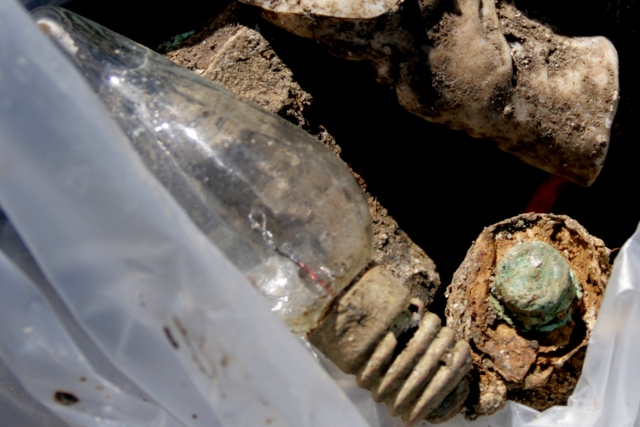
    • Light bulb - with intact filament!
      Light bulb – with intact filament!

      And my personal favourite, a completely intact (including the filament!) medium small screw fitting light bulb such as might be used for Christmas tree lighting.

    • Corrugated iron sheet and other finds.
      Corrugated iron sheet and other finds.

      Also found were a range of metal finds, including rusty nails, short pieces of barbed wire, a spanner-like tool for undoing a square nut, and a large sheet of galvanised corrugated iron in good condition (extends beyond trench so only partially excavated.

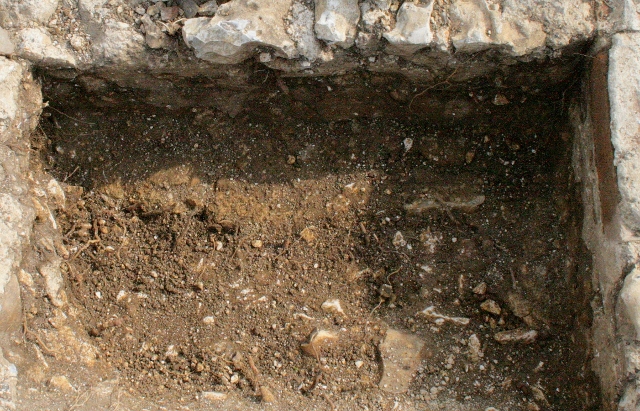
    Due to the depth at which they were found they were possibly deposited in a hole in the ground in the corner between the front door, the garden/farmyard wall, and the outside toilet. The top of this context was full of collapsed wall rubble, the lower part was of a garden soil. The extent of the context has been hard to determine since WW2 shelling has done much damage in its vicinity. The assemblage of finds suggests they may all belong to the 20th century, probably the second quarter, and from their context, before 1945 – though perhaps this just reflects a general increase in material goods (identifiable & otherwise) with the passage of time.
  • Fifthteenth Dig Day – Sunday 9th June 2013

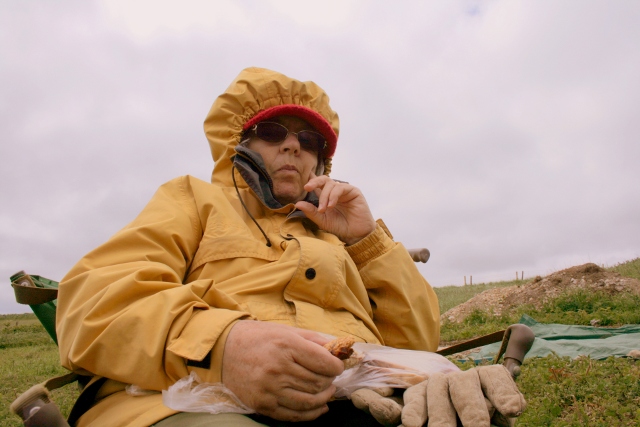
    Waiting for Summer!
    Waiting for Summer!

    Despite the cold windy weather and a severe lack of volunteers, my mother and I had possibly our best day’s dig yet!

    View looking S towards front of house (under tarpaulin) from garden/farmyard wall
    View looking S towards front of house (under tarpaulin) from garden/farmyard wall

    We excavated a relatively deep layer of demolition rubble in the corner between the front door of the house, the garden/farmyard wall and the outside toilet – and it must have been where they dumped some of their rubbish!

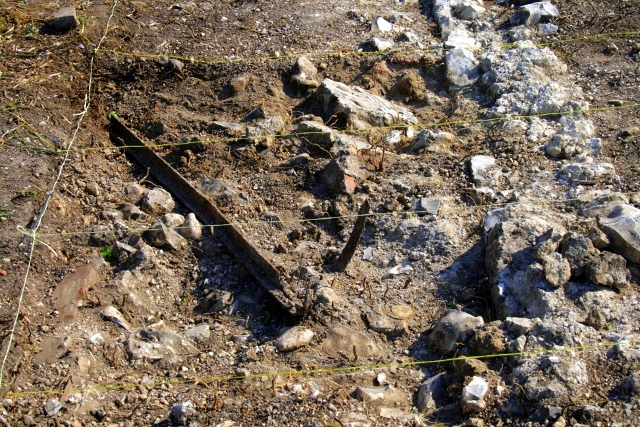
    Metal container in SE quadrant of grid square in front of house
    Metal container in SE part of grid square in front of house.

    A collapsed rusty container, which may have been perhaps 5-10 litres capacity, was excavated. It may have been rectangular, but due to its poor state of preservation, it is hard to tell what its original dimensions may have been.

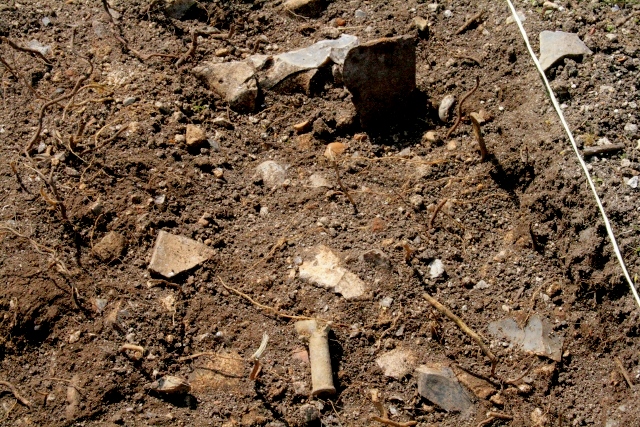
    Nearby were found what may have been the electrodes of a battery. They consisted of small green (copper?) topped metal rods, whose lower portions were encapsulated by what appeared to be (mostly broken) cylinders of carbon. A larger dark coloured ‘wine bottle cork’ sized cylinder came out of part of the rusty metal container. Was the metal container the casing for a battery? During the 1930’s battery powered radios required both 120V and 6V (rechargeable) batteries, etc – Newmarket Farm had no mains electricity! It may have either been used by those that lived there (the first cheap radio in the 1930’s cost a little over £6), or by the military when they took over the farm from 1942-45 for military training exercises – perhaps for a communications radio.

    View looking S towards house from site of outside toilet
    View looking S towards house from site of outside toilet.

    Also found:

    • the hind leg (with tail) of a tin horse;
    • the broken arm of a ceramic figurine – white folds of cloth on the upper arm and outer part of the shoulder, gold trim outlining the edge of the shoulder of a second cream coloured outer garment or perhaps a collar – the original figurine may have been about 30cm tall;
    • a wide variety of other ceramic shards – probably plates, cups, storage containers – including 2 small fragments of bone-china;
    • fragments of very thin window glass;
    • fragments of bottle glass;
    • some rusty nails;
    • a piece of metal tube, probably part of the water pipe which comes from the direction of the farmyard and heads across in front of the nearby house, where it has been cut by the bulldozer;
    • two sizes of bullet casings – .303 and a smaller;
    • and last, but certainly not least, a “shoulder title” (badge) with the lettering “16/5L” which apparently belonged to the 16th/5th The Queen’s Royal Lancers sometime between 1922-1945.

    The 16th/5th Lancers were a cavalry regiment based in India before they returned to England for the Second World War in 1940, where they swapped their horses for vehicles, including tanks. Further research is required to discover whether there are historical records of the regiment training in this area during WW2.

  • Fourteenth Dig Day, Friday 7th June 2013

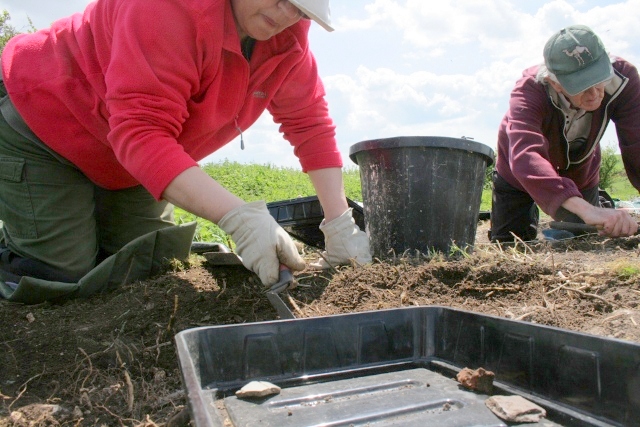
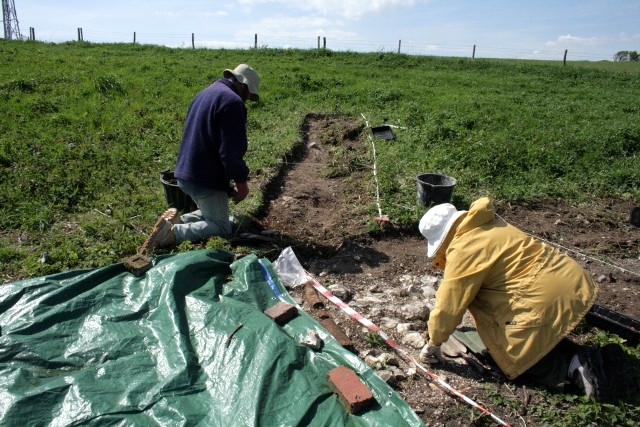
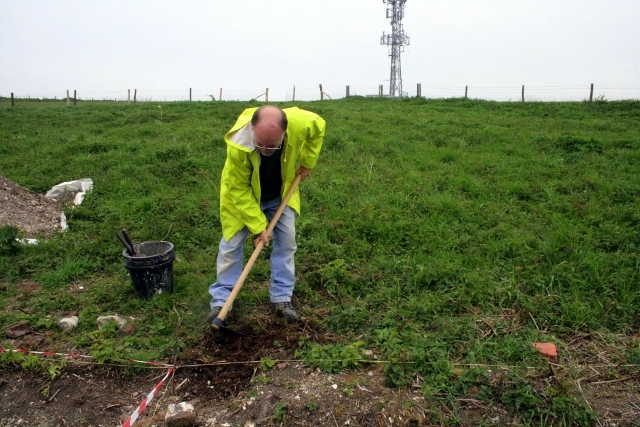
    Digging the site of the toilet!Digging the site of the toilet!

    A breezy day was spent digging through more demolition rubble in the vicinity of the site of the outside toilet.

    Pieces of iron in vicinity of outside toilet - photo slightly enhanced saturation
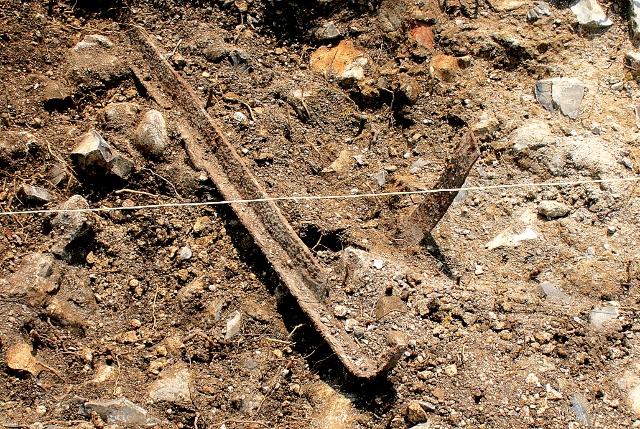
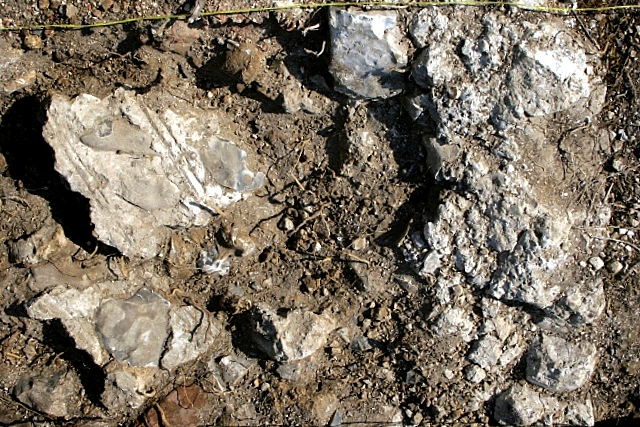
    Pieces of iron in vicinity of outside toilet; crumbly layer of mortar top right; photo slightly enhanced.

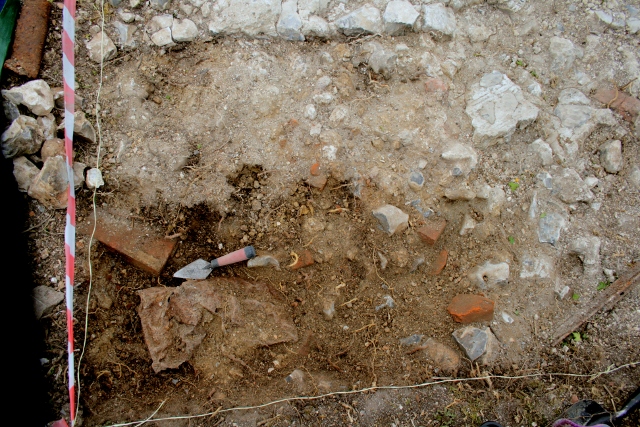
    A piece of iron had been found sticking up out of the ground on our previous dig day, in the vicinity of the outside toilet. A 50cm wide sondage was therefore started, to excavate the fill in which it was embedded. This revealed a second, larger piece of angle iron, lying approximately horizontally. Its context was unexpectedly found to be that of more demolition fill. However, it was of a different nature to that which overlaid it. Slate roof fragments were smaller and less frequent; there was an increased amount of crumbly, yellowish, mortar, especially in the vicinity of the nearby flint wall; and though the site is drying out and it was a windy day, it was much more dusty than expected. I therefore think it is likely to have originated from WW2 ordnance caused demolition rather than the bulldozer – the latter would have been the source of the upper layer of demolition rubble.

    The sondage was extended a further metre to enable the length of angle iron to be fully excavated. It was found to be about a metre long, and was such as might have been used as a post. It is very similar to the remains of an in-situ iron post right in the south-east corner of the garden, where an Ordnance Survey map showed a fence line once butted onto it, at or shortly before the time of Oscar Selbach’s ownership in the 1920’s.

    Atillery damage in vicinity of toilet
    Atillery damage in vicinity of toilet

    Further evidence that this was fill from artillery damage is that there is a piece of metal sticking up vertically though this fill which would otherwise have been flattened by the later bulldozer.

    Artillery damage in vicinity of toilet
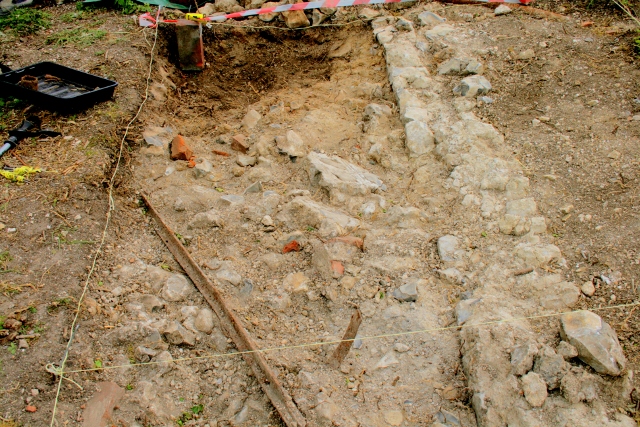
    Artillery damage in vicinity of toilet; note intact fragments of demolished flint wall at far end of sondage; photo taken looking south.
    Collapsed wall fragments
    Collapsed wall fragments.

    Next to it, some intact pieces of collapsed wall showed the characteristic horizontal lines inscribed in the mortar which divided each of the courses of flints, which are to be seen in situ elsewhere on the site. It is likely that if the damage caused was from one or more artillery shells hitting the west side of this wall – which divided farmyard from garden. The most likely location of the field guns which caused this damage to the farmyard side of the wall, would therefore be in the direction of Stanmer Park, about three miles away.

    Smaller finds included more nails, fragments of glass bottle, two halves of a small terracotta roof tile, and the hollow tip of a once live bullet.

  • Thirteenth Dig Day – Sunday 2nd June 2013

    Looking ESE past site of farmyard entrance towards site of garden to N of front of house
    Looking ESE past site of farmyard entrance towards site of the front garden.

    A mostly sunny day, and though digger numbers were low, the digging was good.

    Looking S across N boundary wall, down dividing wall between garden (left) and farmyard (right)
    Looking S across N boundary wall, down dividing wall between garden (left) and farmyard (right)

    We were digging just inside the north boundary wall.

    Digging site of outside toilet
    Digging site of outside toilet.

    This north-west corner of the garden was the location of the outside toilet!

    Flint fill in vicinity of site of toilet
    Flint fill in vicinity of site of toilet.

    Excavation revealed a relatively thick layer of unmortared flints under the topsoil.

    Farmyard/Garden wall, looking to N boundary wall
    Farmyard/Garden wall, looking to N boundary wall.

    Surrounding these flints were roof slate fragments, as well as small fragments of brick and mortar, typical of the site’s demolition rubble. Sadly, there was clear evidence that the site of the toilet had been struck by a WW2 shell. The 1950’s bulldozer levelled off the site. Where the wall was cut by the bulldozer, we find the remains of the wall close to the surface. When cut by WW2 ordnance, the hollow crater left was filled by the bulldozer with demolition rubble. The latter was observed in this case. The flints may have come, in part, from the farmyard. The surviving childhood memories of the farmyard are that it had a cobbled surface.

    The toilet seat would have been a wooden shelf with a hole in it with a bucket underneath. At least from about 1934-1938 it even had two doors! One for the people, which opened facing the house, and a smaller one to the side for the removal of the bucket.

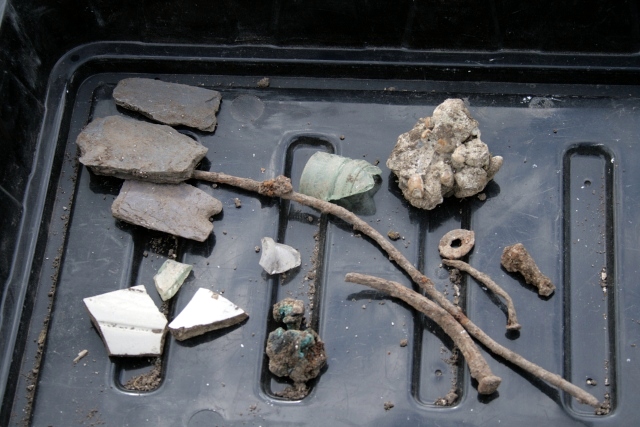
    Some finds from demolition layer in vicinity of toilet
    Some finds from demolition layer in vicinity of toilet.

    We found a few nails – perhaps all that is left of this important structure. A washer, a piece of wire, and few shards of glass bottle and pot were also found, but no bucket!

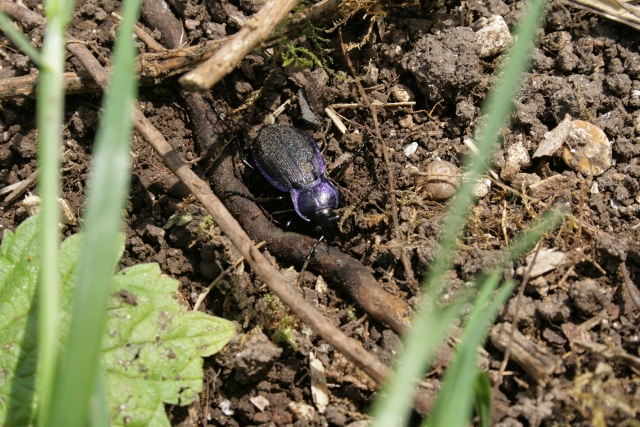
    Violet ground beetle
    Violet ground beetle.

    Our only visitor was a violet ground beetle!

  • Visitors

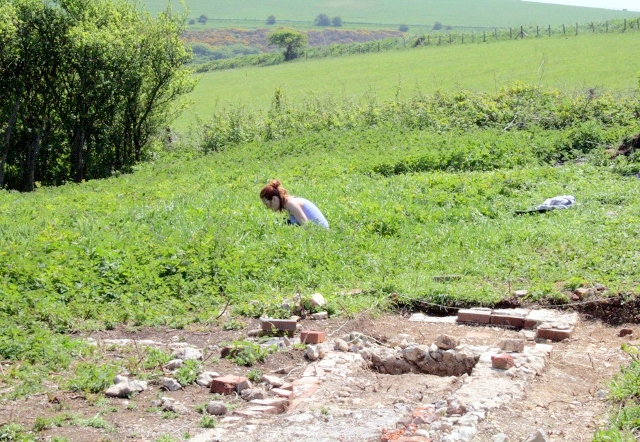
    Over the past few weeks we have had many visitors interested in what we were digging, and the history of the area in general. They included the local shepherd, passing families and individuals out walking, with and without dogs, both older people and young. We hope they felt welcome, for they are very much part of the reason for the dig.

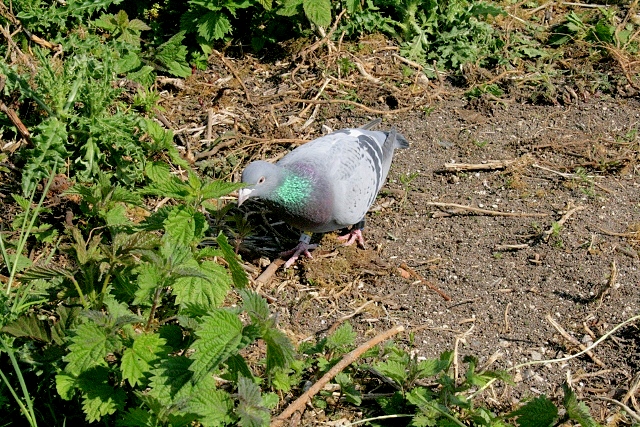
    Other visitors have included a tired looking racing pigeon:

    Racing pigeon visitor
    Racing pigeon visitor.


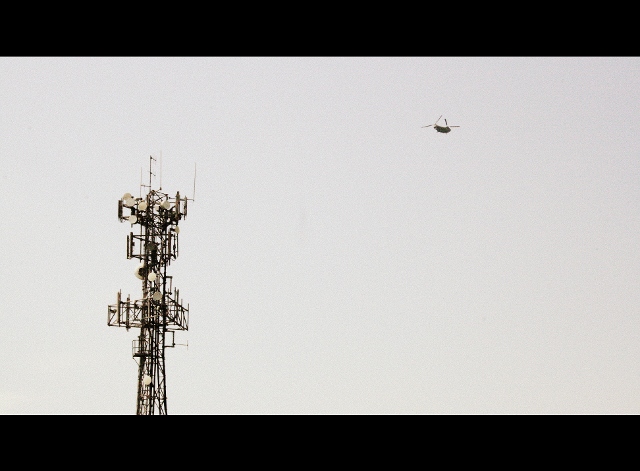
    In the sky above the nearby TV aerial, last Friday, passed a Chinook Helicopter:

    Chinook helicopter
    Chinook helicopter.


    And last week a good friend of mine, a local artist, Dominic Sladden sketched us whilst we were digging:

    Newmarket Farm Dig by Dominic Sladden
    Newmarket Farm Dig by Dominic Sladden.
  • Twelfth Dig Day – Friday 31st May 2013

    Spearmint (near water-tank) picked from amongst the nettles
    Spearmint (near site of underground water-tank) picked from amongst the nettles.

    Friday’s dig was another successful day. And the weather was really good as well!

    North boundary wall looking towards house; farmyard to right, garden to left.
    North boundary wall looking towards house; farmyard to right, garden to left

    Trench 1 has now been extended right up to the north boundary wall of the property. Enough of this north wall has now been exposed to estimate its course, only a couple of feet south of my earlier estimate based on a 1921 plan.

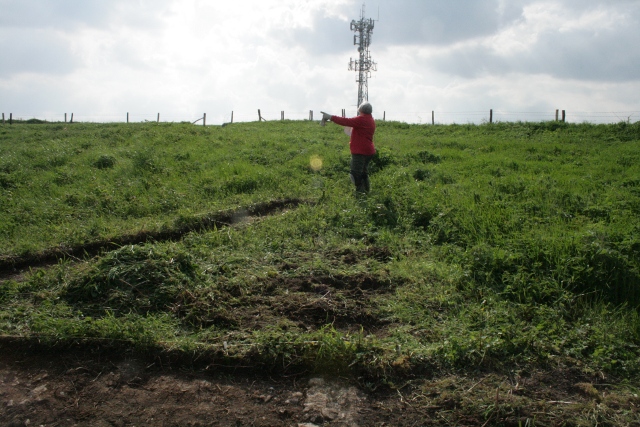
    Peggy showing probable location of near corner of barn
    Peggy showing probable location of near corner of barn.

    This photograph was taken standing on the site of the front garden gate looking west along the north boundary wall, past the site of the outside toilet which was located in the corner of the garden wall (just out of the photo), towards the entrance to the farmyard, and the barn with a large water-tank in its eastern end, the corner of which is being marked by Peggy (my mother, who was born in Newmarket Farm in 1942).

    This section of the north boundary wall is to be explored with a new 1 metre wide trench (trench 3). It will join with trench 2 (which runs diagonally in the above photo) following the course of the water pipe towards the north-east corner of the barn. I hope shortly that at the meeting of these two trenches, careful excavation will enable the purpose of this pipe to be understood. Did it stop at the barn (an overflow for a rain-water tank?), or continue on towards a reservoir planned to be built by Oscar Selbach in the early 1920’s on top of Newmarket Hill, to provide water for a proposed housing estate on the other side of the hill?

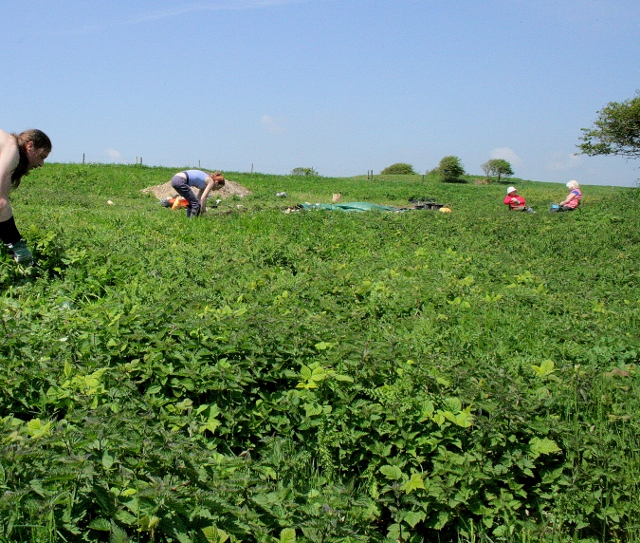
    Photo taken from the S end of the former garden of new growth of nettles being cut.
    Photo taken from the S end of the former garden of new growth of nettles being cut, while diggers take a tea break.

    I also managed to arrange for two friends to cut down some of the nettles on site. They did a great job – and didn’t mind much about getting stung – for it is supposed to be good for you! Access to the dig site is now very much easier. Sometime in the next few weeks Natural England hopes to be able to follow this up.

    The dig is every much as exciting as I hoped, and though finds in the vicinity of the farmyard have been limited, this has been more than made up for by the features. With assistance from Brighton & Hove Archaeological Society we hope soon to be back inside the house again, with a better chance of both features and finds!

  • Eleventh Dig Day – Sunday 26th May 2013

    IMG_5122-640
    Looking SE down line of water-pipe towards front corner of house.

    Just three volunteers on this sunny bank holiday Sunday.

    I was able to use my new homemade soil colour chart! I made it from Dulux colour swatches converted to the archaeologist’s standard Munsell colours using a free online colour converter. Munsell colour charts normally cost over the £100! The topsoil was Dulux’s Earth Glaze 1 or Munsell’s 10YR 4/4 – a mid-brown.

    Looking NW along line of water-pipe from NW end of house, towards NE corner of big barn
    Looking NW along line of water-pipe from NW end of house, towards site of NE corner of big barn.

    Last week’s new trench over an iron water pipe heading in the direction of a large barn in the farmyard was further excavated. Under the topsoil, fragments of brick, slate roof tile, and ceramic ridge tile indicates WW2 artillery debris from the barn and/or house, but the wall plaster fragment would have been from the house. Some fragments of green bottle glass and white pottery found in this layer are therefore not dateable based on their context.

    .303 rifle catridge
    .303 rifle catridge.

    To the north of the house, a 2x2m area of the garden/farmyard wall was also excavated, as yet, to just below the level of the topsoil. Another .303 rifle cartridge found was further evidence of military activity in the area.

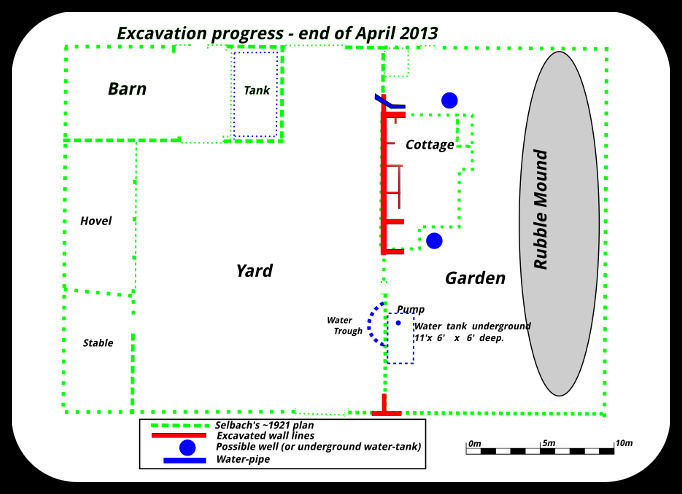
    Excavation progress; End April
    Excavation progress; End April. Base plan from ESRO.

    In the coming days, continuing northwards, it is hoped the location of the front boundary wall will soon be discovered. This will enable our only detailed site plan, from papers dating to 1921, to be checked for accuracy. If it is we can confidently mark out the outline of the whole site on the ground.

    Meanwhile, the past few weeks of sunshine and showers has brought on a fresh growth of nettles, which will need regular cutting down if they are not to become too great a nuisance. Visits from the interested public are an important part of the dig – they should not be limited to the intrepid and adventurous. And, of course, this very much applies to our diggers as well!

  • Tenth Dig Day – Sunday 19th May 2013

    A small but select few turned up to dig last Sunday, on a grey miserable looking day. Fortunately the weather cleared up and we had a good day’s digging.

    Trench 2 over water-pipe in farmyard
    Starting trench 2 over water-pipe in farmyard.

    Half of us opened a new 1m wide trench to investigate a metal pipe which had been found at the base of the demolition layer in front of the house. I had tracked its probable but faint course with a metal detector across the farmyard towards the corner of a former big barn which had contained a large water-tank. Initial excavation indicates the pipe is definitely in-situ and hasn’t just fallen from the side of the house.

    .303 cartridge
    .303 rifle cartridge

    A badly corroded .303 cartridge was found in the demolition rubble of the trench. The circlular firing pin indent in its base indicates it was fired by a rifle.

    Original SW end of house, S of 'coal cupboard'
    Looking N from original SW end of house, S of ‘coal cupboard’

    Towards the other end of the house, excavation continued in a probable built-in cupboard, adjacent to the ‘coal cupboard’. Excavation revealed that the mortar floor of the coal cupboard had been cut by either WW2 ordnance, later bulldozer, or both, at its southern end. A single brick which sat on top of the edge of this feature may or may not have marked a dividing wall between cupboards.

    Amongst some medium sized pieces of coal, right in the corner of the coal cupboard, our 2nd small plastic bead was found – black with 8 small facets round its middle. It was most likely made of bakelte, though I have yet to test the bead as yet. If I heat it – by vigorous rubbing – it should smell of formaldehyde. If it is, it will date to somewhere between 1909 and 1942 when the house ceased to be occupied. Bakelite jewelry was most popular in the late 1930’s – and was very much part of the Art Deco movement. Though some high end fashion houses used it, bakelite was very cheap to manufacture, and so may even have been affordable by the poor residents of Newmarket Farm. By contrast, the Lucite bead, which was found earlier in the dig, was made by one of the top fashion houses in the world and so was most likely to have been an extremely expensive gift.


    Foundations of inside of old SW corner of house
    Foundations of inside of old SW corner of house.

    At the other end of this ‘cupboard’, a small sondage down to the mortar foundations on the inside of the original SW corner of the house, revealed only a narrow bed of mortar. This contrasted with the steep sided wide wedge of mortar on the exterior of the west wall. This was probably to butress the base of the house wall – to anchor it in place.

  • Soil Colour Charts

    Archaeologists are expected to characterise soil colour for all relevant contexts. I understand that this is important for two reasons:

    1. To distinguish between contexts which differ by colour;
    2. To help identify the nature of the soil, which would help in an understanding of the preservation of the artifacts, as well as helping to understand the environmental conditions of the site in general.

    It is therefore really frustrating for me that I find describing colour difficult. The Museum of London Archaeolgist Service’s( MOLAS) 3rd edition (1994) ‘ARCHAEOLOGICAL SITE MANUAL‘ recommends the following characterisation:

    MODIFIER HUE COLOUR
    light pinkish pink
    mid reddish red
    dark yellowish yellow
    brownish brown
    greenish green
    bluish blue
    greyish grey
    white
    black

    I judged our soil to have a mid to dark orangy-brown colour. But this is not an option in this scheme. I am only allowed one option from each column. So is it mid or dark, reddish, yellowish or brownish, red, yellow or brown? I don’t know!

    Munsell's color system represented as a three-...
    Munsell’s color system represented as a three-dimensional solid showing all three color making attributes: lightness, saturation and hue. (Photo credit: Wikipedia)

    The alternative standard is the Munsell Colour Chart. Unfortunately it costs over a hundred pounds to buy – something which was noted by the financial director of The British Academy regarding British archaeological missions in Egypt. His suggestion was to forbid its use and to switch to using Dulux paint Colour Charts. This was understandably ridiculed by field archaeologists!

    But his idea may not be so stupid. The ICI/Dulux Colour Palette notation system is a propriatory colour system that can be cross referenced with the Munsell Colour System. So I went out and obtained an (almost) complete range of Dulux colour swatches from a hardware superstore.

    The colour of one sample of soil matched the ‘Sunflower Symphony 1‘ colour swatch (a mid-brown). Its ICI/Dulux colour notation is 10YY 12/300. Searching for Dulux 10YY 12/300 in the online Encycolourpedia enabled me to translate this into the approximate Munsell code 10YR 4/4. Comparing the colour of the printed swatch with the same colour on my Toshiba laptop screen, a relatively cheap uncallibrated screen, there was not a very good match. So I do need to use their colour swatches, or use a good quality colour callibrated printer.

  • Ninth Dig Day – Friday 17th May 2013

    SW end of house looking N
    SW end of house looking north.

    A small but keen group of volunteers turned up to continue working on the foundations of the south-west end of the Cottage. Last week’s sondage through the chalk rubble fill of the interior of the extension on the south end of the house was widened.

    Colour-enhanced photo of excavated extension
    Colour-enhanced photo of excavated extension.

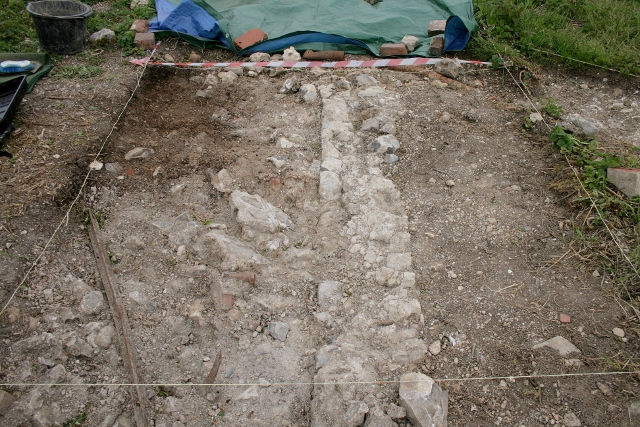
    It was found that the mortar foundation found underneath it (lower right quarter of above photo) extended right across the floor of the room. The original floor was lost to WW2 artillery and the 1950 bulldozer which cleared up afterwards. This chalk rubble was therefore most likely redeposited material which had been dug from the foundation trench. A single floor tile found on top of this rubble fill may be all that is left of this room’s original floor.

    Elsewhere, from the bulldozed mound of demolition rubble a further reminder of its WW2 history was found in the form of half a hand-grenade casing.