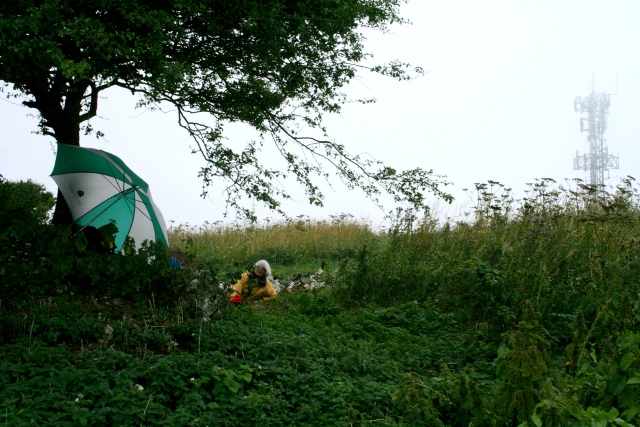
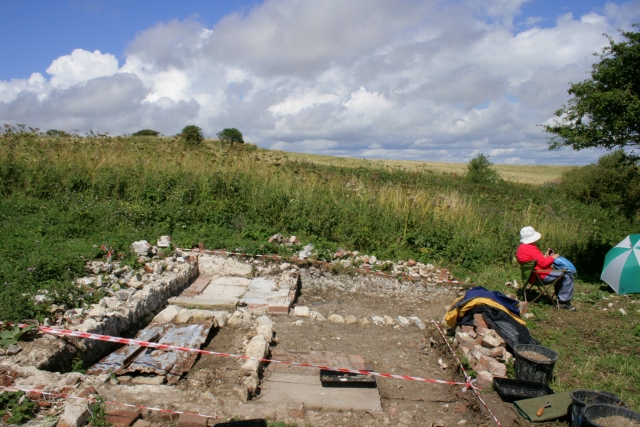
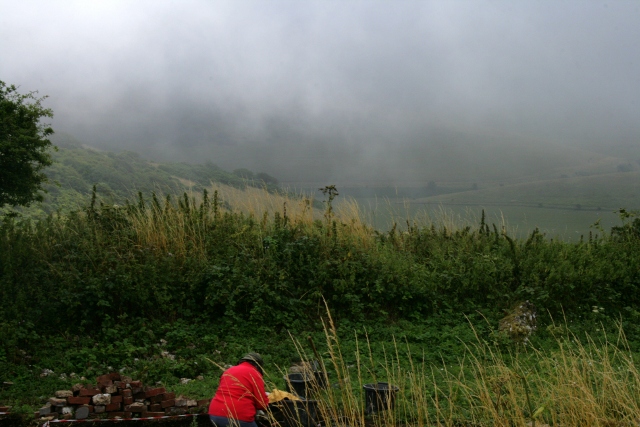
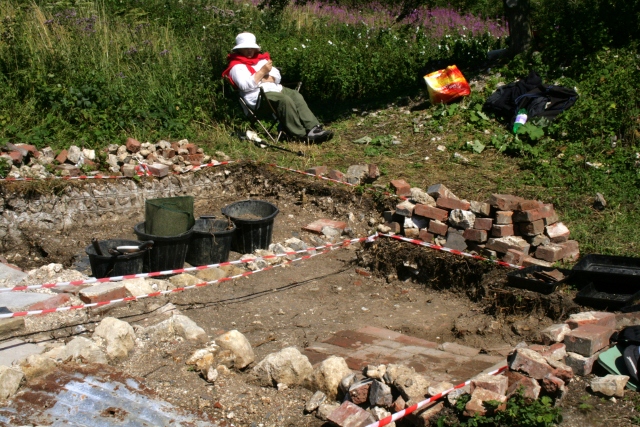
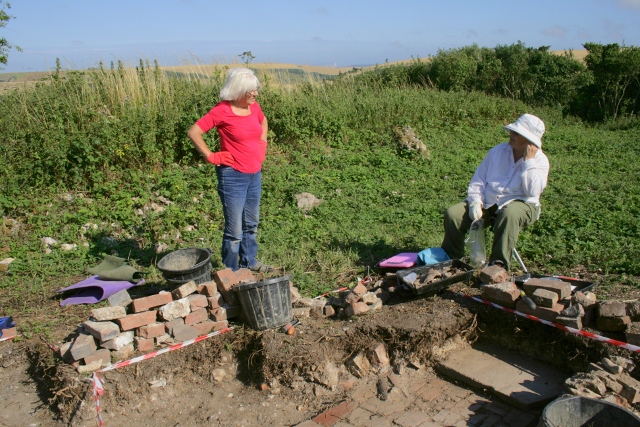
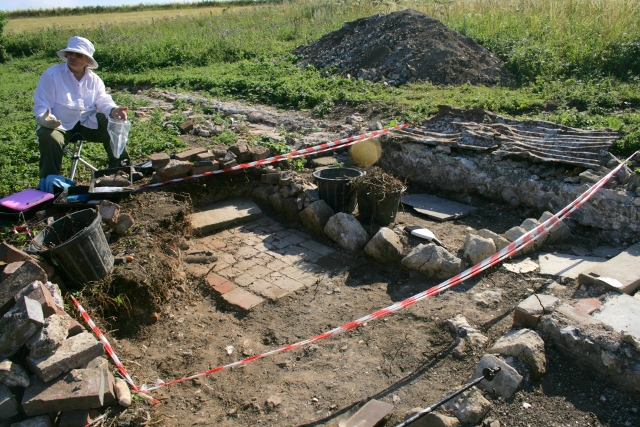
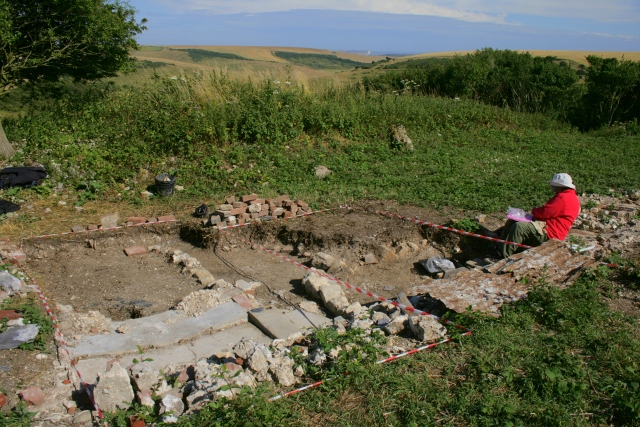
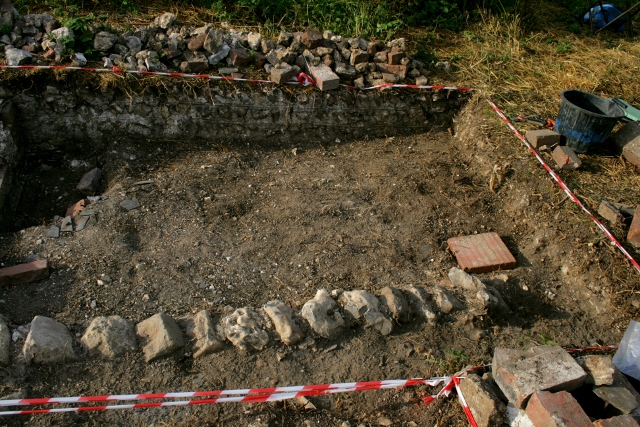
A damp drizzly day, but certainly not enough to stop our diggers!
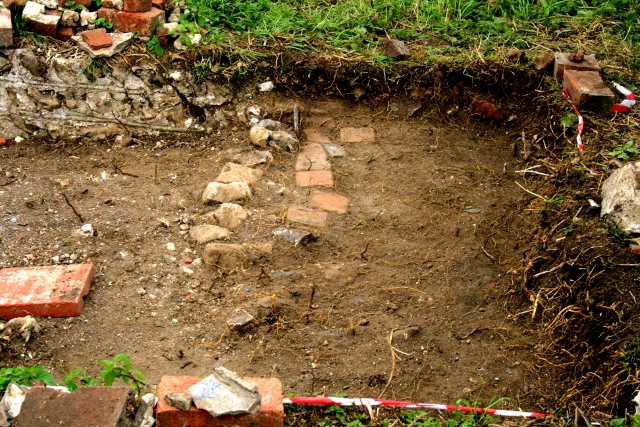
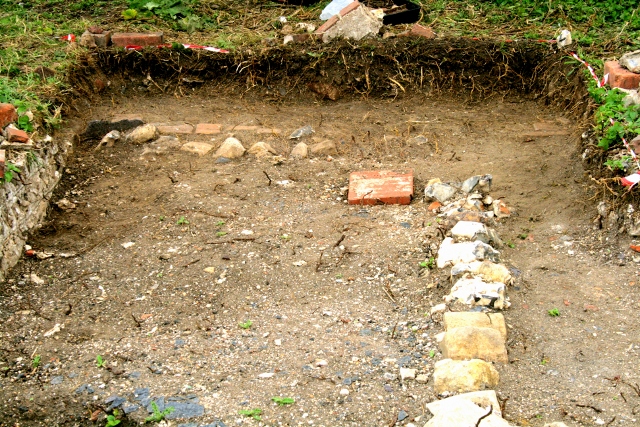
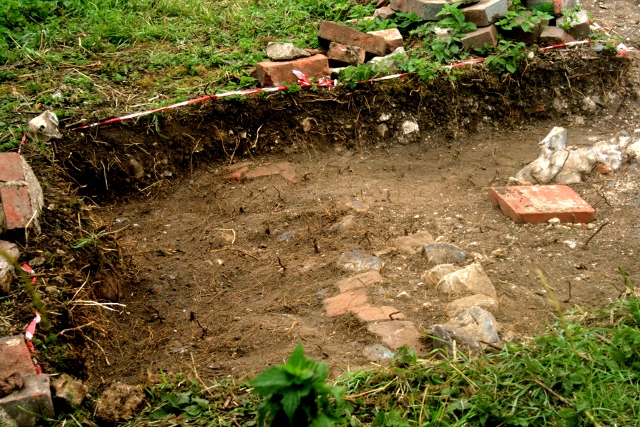
View to N of path to garden gate.View E from toilet at path turning to front garden gate.View S of garden path from garden gate.
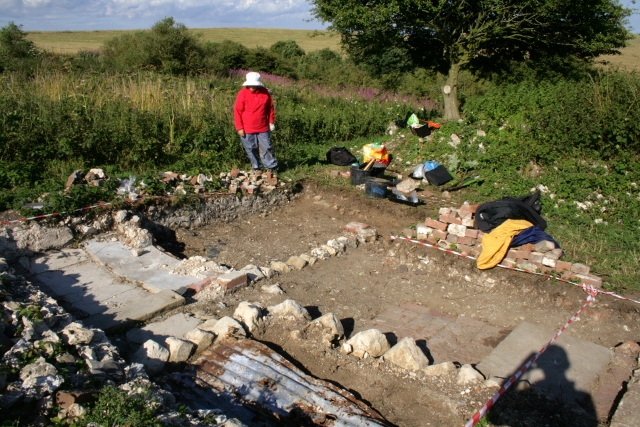
We have now succeeded in uncovering & cleaning up all but the far east side of the path to the front gateway.
View NNE from near front door towards front garden gate.
As the path approached the gateway, so it rose in height to meet the higher ground level outside the wall relative to the lower level of the front garden to its south & west.
View S from front gateway over path towards front of house
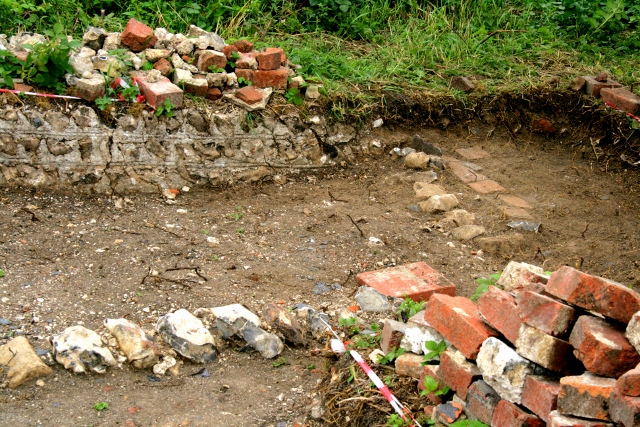
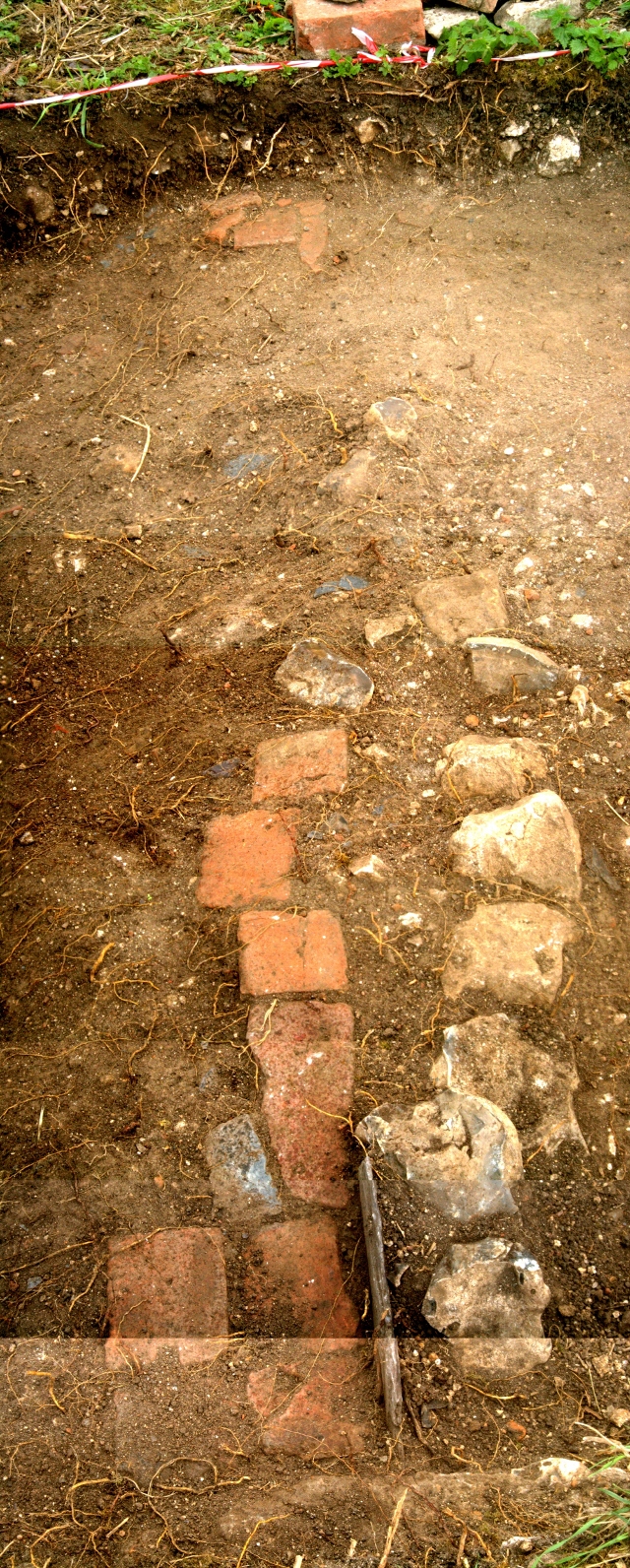
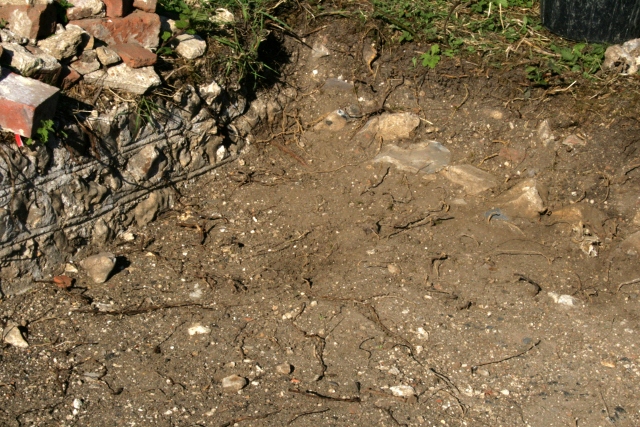
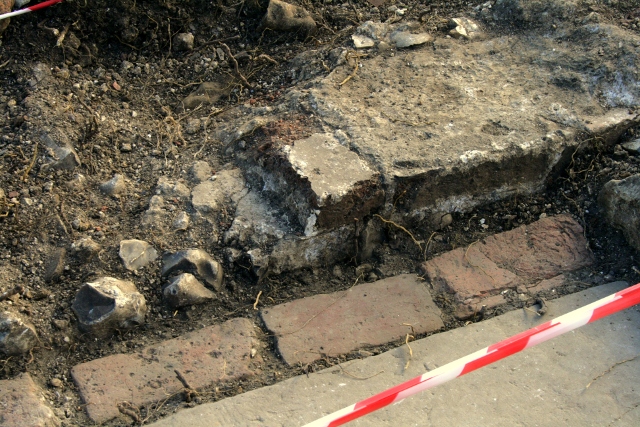
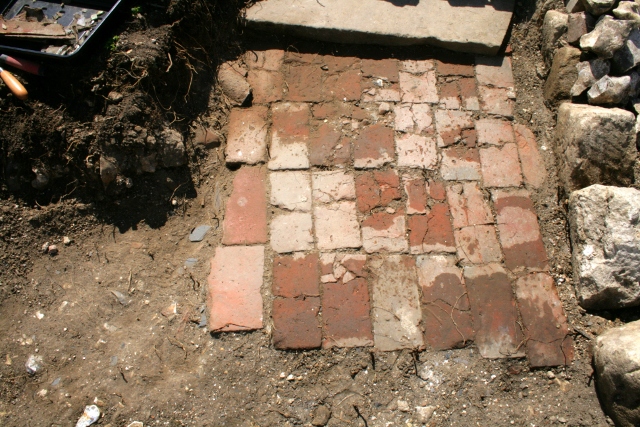
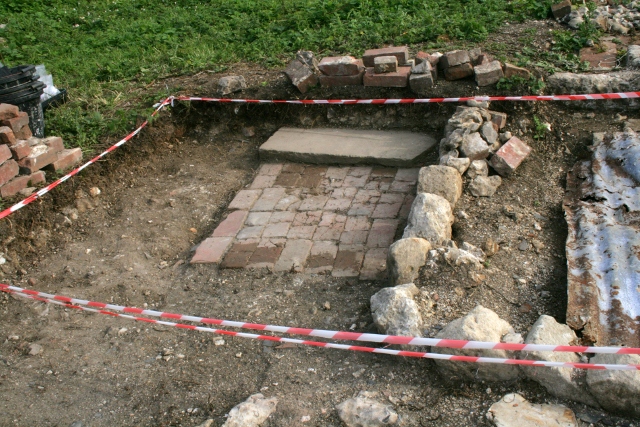
The edging stones on its western side were much smaller than elsewhere. Just inside of these stones were small areas of brick paving, but the centre of the path was of a compacted earth – the surface of which contained most of our finds.
Finds were not as plentiful as in adjacent grid squares, apart from perhaps nails and fragments of bottle glass, but quality is always better than quantity!
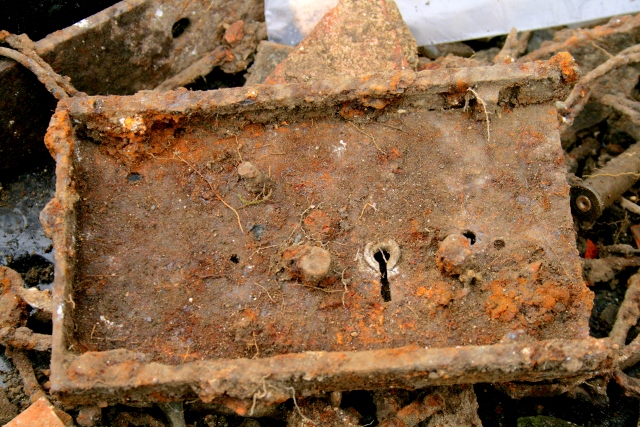
Mortice lock.Mortice lock.
The outer plate of a simple mortice lock was our best find – possibly from the wood shed built into the east side of the cottage & whose door was almost opposite the front gate.
Close up of decorated pipe stem.
A short length of 19th c. clay pipe stem with a decorative leaf design was similar to, or even the same as, that of 2 or 3 others found previously.
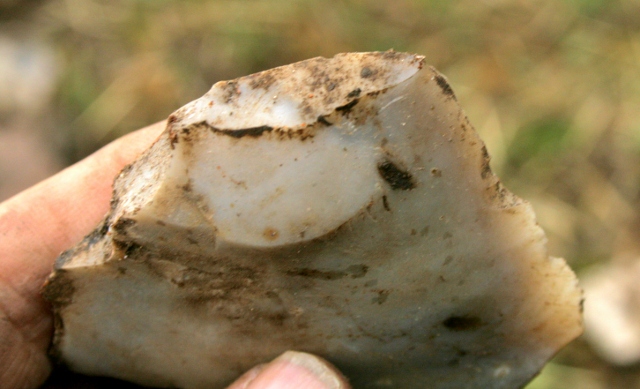
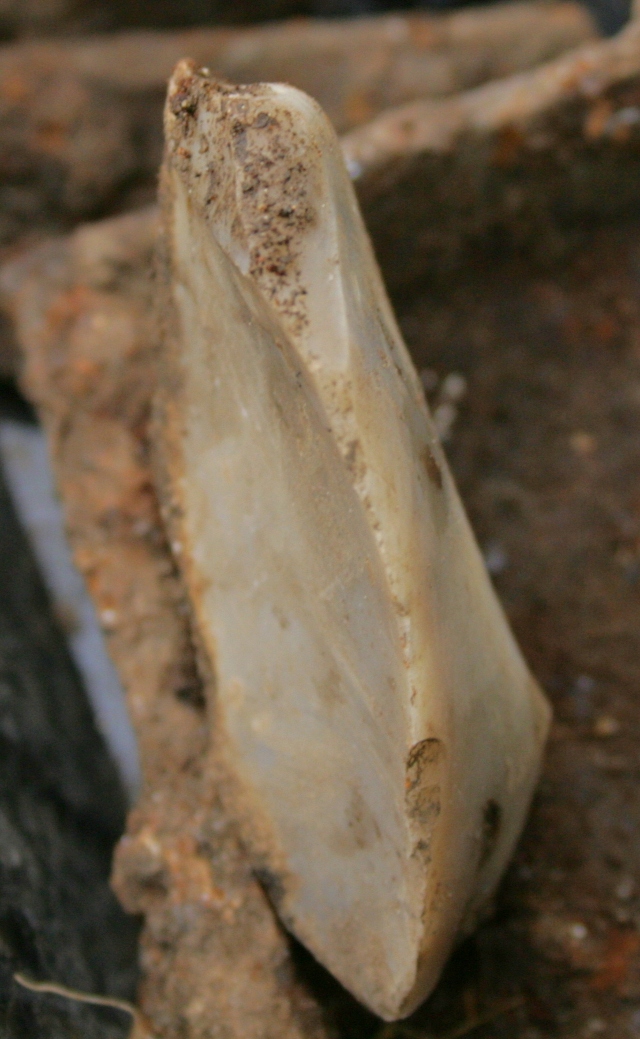
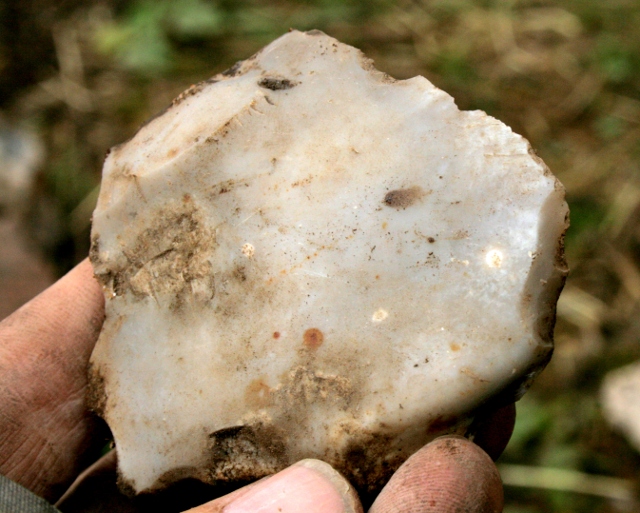
Platform and bulb of percussion of stone age flint scraper.Working edge of flint scraper.Flint scraper showing secondary working and minor wear and tear.
Oldest of all was a nice medium sized flint scraper – Bronze age or Neolithic.
.303 cartridge.
For those who prefer more modern history there were also the, by now almost inevitable, WW2 finds. We found .303 rifle cartridges (circular firing pin indent), smaller callibre pistol cartridges and a length of barbed wire.
Why not join us? We dig Fridays & Sundays, 10am – 4pm, and meet at the car park near the junction of Bexhill Rd & Falmer Rd. No experience necessary. Weather permitting!
Looking W across excavated area N of house from bulldozed rubble mound – in the rain!
View SW over front garden from N edge of rubble mound near NE corner of garden
Sunday started with some very heavy showers, but these soon grew lighter and wider apart – until even the sun came out!
Looking N from inside the house over front door and edging stones to paths to toilet (left) and front garden gate (right).Looking W across front wall of house.
We have now cleaned up the western most 3m of the front of the house, including the front doorway. The old scullery floor of 5cm thick terracotta floor tiles were cut by the 1950 bulldozer which revealed that they were laid on a levelling layer of relatively thin mortared tiles which sat on a layer of chalk rubble. The front wall had been cut away, such that at the end of our current trench the old ground level almost meets the shattered remains of the house wall.
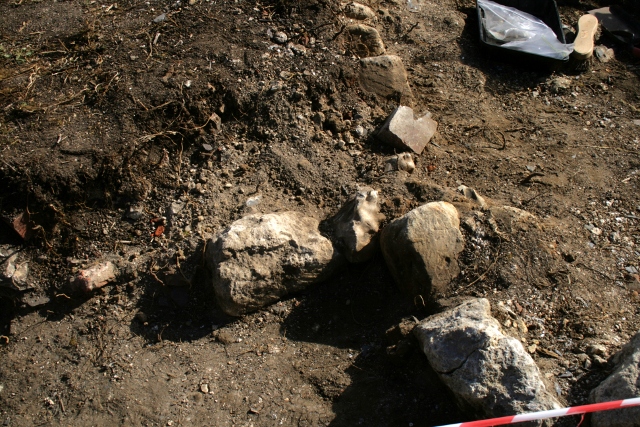
Edging stones to W of path to front garden gate.Edging stones N and W of path to front gate.
We then moved north-east to track down the illusive front gate – and we think we have found it – or at least some of the edging stones on the outside edge of the path to gate.
View NE from NW corner of house towards front garden gate.
Not so many finds though. The best were some very thick glass shards of what was probably a large mirror – although it had lost most of its silvering; an entire small glass jar such as may have contained cold cream; and 2 adjoining chunky shards of a commonly found green bottle glass which formed most of a base of which the sides bore the words ‘Limited’ and ‘Portsmouth’.
View ESE from site of big barn over site of cottage front door, demolition rubble mound, and Castle Hill in mist beyond.
Despite a damp start, good progress was made excavating over (and either side of) the front door step and the remains of the doorway to the house itself.
Looking S from garden boundary wall down path to front door
Its front door step was of a large stone slab, with a brick edge where it meets the house. Sadly, we have discovered that when the Newmarket Farm Cottage site was ‘tidied up’ by bulldozer, after its demolition by artillery shelling during WW2, the house floor and footings was cut through at an angle of about 10cm per metre from west to east.
Remains of front doorway.
All that is left of the doorway itself is perhaps 3/4 of a brick.
View of brick quoin (over door hinge?)
But under the western side of the doorway the base of the wall is of brick rather than flint – to support the weight of the door?
The range and quantity of finds – of metal, glass, ceramics and bone – were similar to those previously found; from 19th c. clay pipe stem to WW2 ordnance. However, from the area immediately to the west of the front door step, 2 medium sized ceramic beads were found.
Child’s cup or mug.
Yet more exciting, on the other side of the path, were 3 or more fragments of a child’s porcelain cup or mug decorated with a bright yellow crying fish standing up on its tail & wearing a red jacket, a blue waistcoat, a black bow tie and a tall white collared shirt, holding out its hands/fins towards the head and wings of a large very stylised fly! The piece showing what the fish was holding out was missing, but the words of the verse [part of them] tell us the story:
‘WHO SAW HIM
DIE ?
“I” SAID THE
FLY.
WHO CAUGHT HIS [blood?]
“I” SAID THE [fish, with my little dish]’.
Interestingly, we found a matching shard from a saucer a week or 2 ago, in a nearby grid square, with words from the opening lines of the verse ‘Who killed Cock Robin?’. Of note, all the ‘O’s of the ‘WHO’s had a dot in their centres. Hopefully research may identify the date and origins of this children’s set. Further digging, in an eastward direction between the house and the front garden gate, may reveal not only more shards of this iconic childrens’ tale, but a well – as well!
Looking NE from NW corner of house across path between front door, toilet to left and front garden gate to the right.
Sunday’s dig succeeded in finishing the excavation of the grid square over the path towards the front door, down to its former ground surface. No new features but plenty of finds.
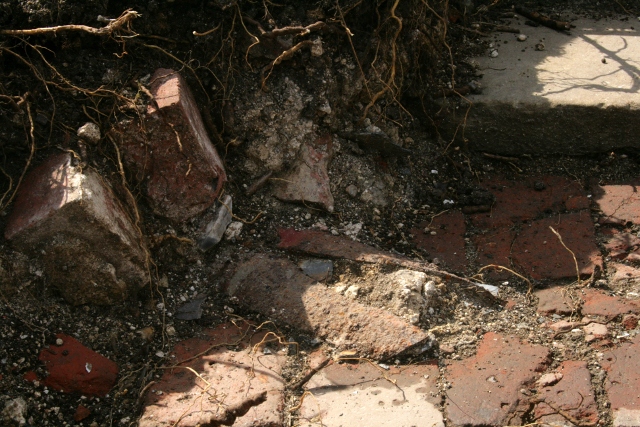
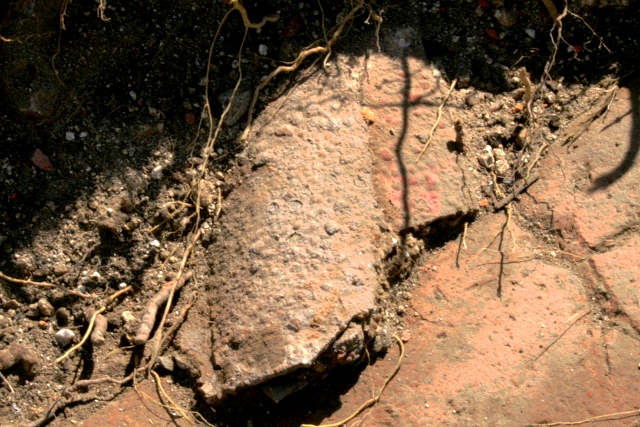
Cast iron gutter on brick paved path to front door.Collapsed cast iron guttering on path to front door.
The images above show parts of a length of collapsed cast iron guttering sitting upside down directly on the paved path surface. It was upside down and had shattered in situ, and so – based on the assumption that the paved path was kept clear of domestic occupation debris – it had almost certainly preserved, underneath it, a snap shot of the early stages of the demolition of the house; a relatively large quantity of broken window glass – of the thicker type – and some roof tile, all embedded in a heavily compacted layer of highly fragmented mortar. This indicates the path had been in active use shortly before the house was hit by artillery shells. Also clearly to be seen in the photos are areas of red lead paint which was most commonly used as a preservative for woodwork, but any such wood – to which the guttering may have been attached – has long since rotted away. Only a few rusty nails remain.
Photo of brick paved path taken from path junction; facing direction of front door (top), with toilet off to the right and front garden gate off to the left.
The above photo clearly shows the cleaned up brick path. Its north-east corner (bottom left) showed wear consistent with the possibility that both its northern (bottom) and eastern (left-hand) edges are original.
Looking S at two floor tiles used on NE corner of paved path.
This is further supported by the observation that two broken floor tiles (thick, heavy and hard-wearing) were used for the outer edge of this paved area.
Looking SE from corner of toilet at stone edged, brick and earth paths ( yard?).View N from front door across paved path, with possible earth floored yard to its right, toilet top left and garden top right.
The earthen ground surface to the east of the paved path surface, and to the south of the path’s eastward turn (on its way towards the garden gate), was more compact and stony than that of the garden surfaces on the other sides of the path. It was similar to the earth surface of the path itself – suggesting it was part of a yard – perhaps one in which the well (which Peggy’s older brother and sisters’ remember) was located.
Looking N from front door across stone step and brick paved path
The above photo shows that whilst the step heads slightly towards the right, the brick path turns, just slightly, to the left – towards one of the most important buildings on site, the toilet!
The ‘fill’ on top of the original ground surface was split into three parts: the topsoil; the upper part of the demolition fill; and the lower part of the demolition fill, including the ground surface on which it sat. The artificial division between the two parts of the demolition fill roughly coincided with that of the tops of the highest features in this grid square – that of the stone blocks which separated the garden from the path. Horizontally, each side of the edging stones is a different context – the west side having been previously excavated. Rightly or wrongly, the lower part of the demolition fill over the possible yard surface to the east of the path was not separated into a different context.
From these contexts a range of finds were unearthed. The topsoil was very dark with tiny flecks of mortar, and only one small shard of the relatively modern window glass was found in it. The upper part of the demolition fill contained a relatively wide range of finds, but were much fewer in quantity than that of the lower part. The ground surface itself contained the highest proportion of domestic bottle glass and ceramic shards. It was from this latter layer, that we found our first entire bottle – definitely the best find of the day and one of the best of the whole dig! It was about the size of a whisky miniature, though unmarked by any obvious decoration or lettering. Some nice ceramic shards were also found – including a relatively large number of unusual looking pieces which had matte green coloured inner and outer surfaces and which had rounded, right-angled, surface sculptings, and similarly sculpted corners. It was far from clear what it was – perhaps a square or rectangular green painted plaster container.
A large proportion of the plentiful glass shards were of a relatively modern looking window glass. The gable front of the house had three windows which overlooked the front of the site – the 19th century washhouse or scullery, and two upstairs bedrooms. Quite a few rusty nails of a variety of shapes and sizes, a long fragmented length of cast iron guttering, some other rusty finds of unknown origin, and a single WW2 .303 rifle cartridge made up the metal finds. Part of a bone (chicken?), a button, a strange flat about 3cm sized fragment of a rubber like substance, black on one side and reddish on the other, and a couple of fragments of coal made up the miscellaneous finds. There may have been one or two other finds gathered up in our finds bags, but these are the ones I can recall.
Despite the early morning thunderstorm, the weather cleared up and 3 volunteers did a great days digging.
Paved & stone edged path between front door, toilet & front garden gate
We excavated down through the demolition rubble in the north and west parts of the 2x2m grid square between the south-east corner of the outside toilet and a short distance from the front of the house.
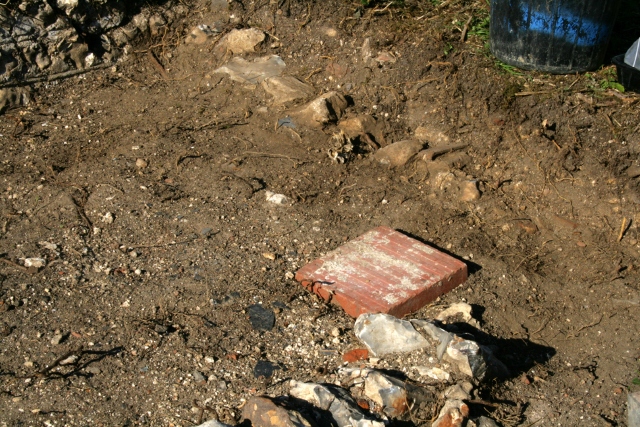
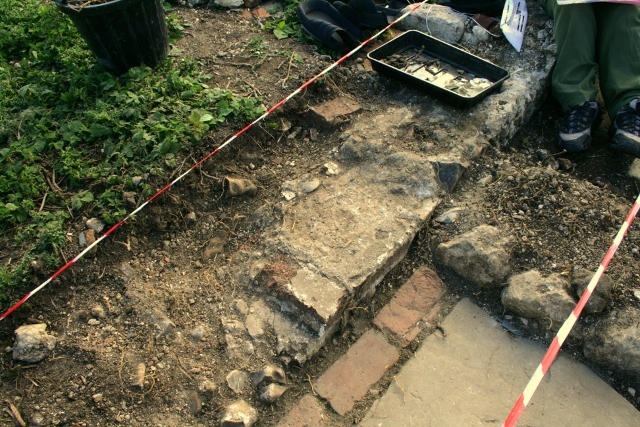
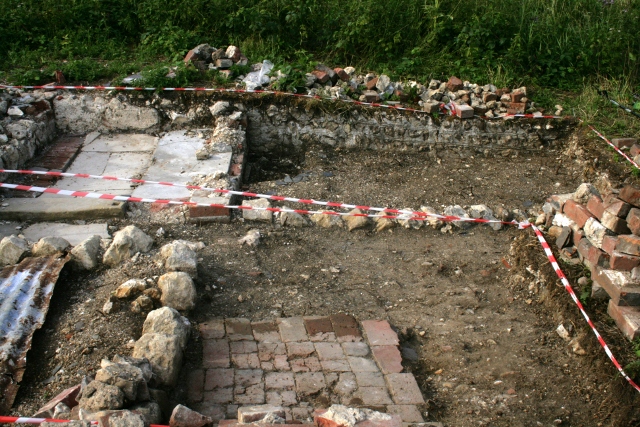
Lots more finds and features! More of the earthen path was exposed and cleaned up towards the front door. We discovered a brick paved surface, with a stone slab forming a shallow step at its far end, all edged on the west side by roughly squared stone blocks laid at an angle.
Whilst the upper part of the demolition rubble yielded few finds, the lower part of the demolition rubble revealed a relatively large number; a variety of WW2 ordnance, shards of window glass (thin older, and thicker more modern), a variety of bottle glass, a variety of ceramics, and bright blue painted wall or ceiling plaster. The military finds included the two halves of a hollow, but unfired, .303 cartridge, another – though badly decayed – screw threaded base of a mills bomb (hand grenade – see last Friday’s entry), and a screw threaded zinc safety cap for a WW2 mortar – with the words “remove before firing”. Interestingly enough, hardly any nails were uncovered, whereas adjacent areas had yielded a large number.
Sunday’s dig benefited from both the cooler temperatures and the rain from the day before – which softened the ground nicely.
Digging demolition rubble over path SE of toiletPath between front gate, front door, and the outside toilet.
Excellent progress was made excavating down through the demolition rubble over the path from the toilet towards the front garden gate in one direction, and the front door of the house in the other. More substantial edging blocks of stone were uncovered, as well as a wide area of a compacted earthen path surface.
Displaced edging stone.
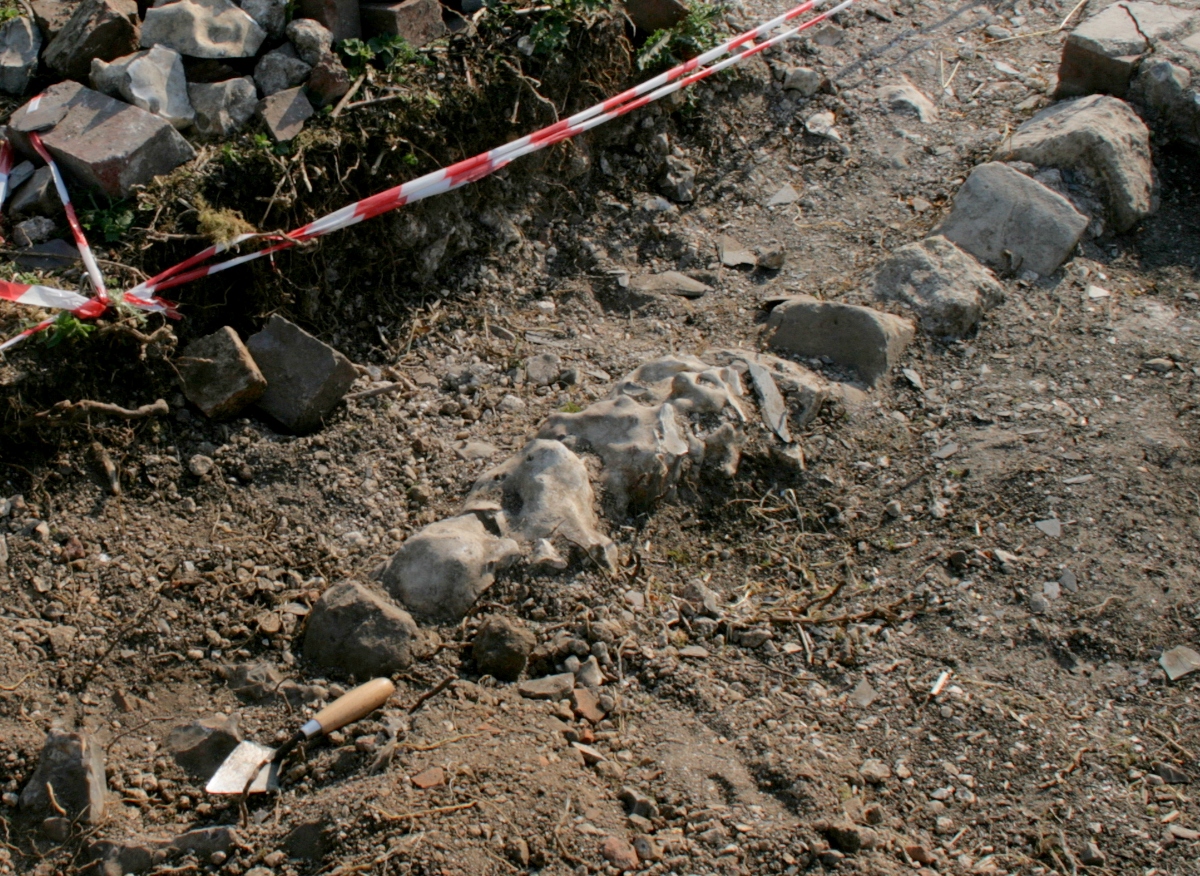
One of the edging stones was almost half a metre out of place, the gap being infilled by demolition rubble – possibly moved by the impact of WW2 ordnance.
Mortice lock in base of demolition fill over path to front door.Mortice lock in base of demolition fill over path to front door.
The best find was a relatively modern looking mortice lock – almost certainly for the front door. Another very nice but tiny find was a fragment of triple layered pink/white/clear glass, such as has previously been found, except that this particular shard was decorated with a delicate gold coloured pattern. Finds, in general, were fewer than those areas nearer to the walls, for example, only three .303 cartridges rather than the dozen or more from the previous Friday.
We are hoping for a good turn out this coming Friday – great progress has recently been made uncovering some important features at the front of the house – and extra volunteers should make a big difference uncovering this part of the site. Dig days are Fridays & Sundays, 10-4pm, and new volunteers are always welcome – no experience necessary.
Partially excavated path (yard?) towards front door.
Friday was a great day for finds as well as, I hope, for our 5 volunteers. We finished excavating the area in which we had previously been working and opened a new 2x2m grid square over the path to the front door of the house.
Path E of toilet.
After cleaning up the north side of the path, heading east from the toilet, and the garden between it and the north boundary wall, I am now as certain as I can be that we hadn’t got a turn heading diagonally towards the front gate (whose location definitely lies further east than we have excavated so far).
China doll face
What we did find in the fill above the path surface was part of the face, including her painted mouth, of a china doll. We also found a strange tubular metal pipe, about a foot long and an inch diameter with a hard black rubber externally screw threaded end, and strange rusty fixtures and fittings to its sides – possibly part of a stirrup pump. Another really nice find was two (adjoining) fragments of a fine ceramic saucer or bowl with the wording “cock robin?” and “sparrow” from the children’s rhyme ‘Who Killed Cock Robin?’
In the demolition rubble fill between the path and the wall a large quantity of finds were uncovered. A wide variety of ceramic fragments, bottle glass, nails, a length of barbed wire, and over a dozen .303 cartridges, half of which were read & all found to bear the date of 1942.
No. 36M Mills bomb base.
The most exciting of the finds from this part of the trench has been identified as the screw threaded base of a No. 36M Mills bomb, or hand grenade. Areas of both the path and garden surfaces showed some signs of burning, including fragments of charcoal.
Sunday our new 2x2m grid square SE of the toilet will be excavated – over the path to the front door, and the possible site of a well (which was supposed to be outside the kitchen window). Progress will be slow digging through the layer of demolition rubble, so extra volunteers are definitely welcome. The adjacent grid squares have all yielded some nice finds – so plenty of good reasons to join us – and no experience necessary, though it is always very much welcome.
All digs have their ups and downs – and Sunday was certainly one of them! Another hot day – almost too hot – but Peggy and I battled the heat in our continued search for the front garden gate. The previous grid square was extended 1m to the east, but still no sign of it; almost a metre & a half beyond its location on a plan dated 1921.
N edge of path E of toilet
The path edge still continues eastwards…
A set of junior hacksaw blades in their original plastic packaging was a very nice find from the upper levels of the demolition rubble fill we excavated, though the rest of this layer yielded very few finds; just the usual metal, glass, ceramics and .303 cartridges.
One of our highlights was a visit by the family of one of Lucy Phipps’ sons. Lucy had lived at Newmarket Farm as a girl from ’34-’38. They stayed for a nice picnic and shared their memories of Lucy, who had loved her childhood here so much.
Next week, apart from cleaning up Sunday’s trench, we will be moving back towards the front of the house; the path towards the front door, and the possible site of a well.
Despite the heat, Friday’s dig had a good crowd of 5 diggers and a visit from a former resident – Peggy’s bother Reg Latham – who was just 5 years old when they were forced to leave by the military. He found a short length of cast iron guttering in the bulldozed mound of demolition rubble, which was a perfect fit for the guttering brackets we found in the demolition rubble being excavated (context 72), just east of the outside toilet. The demolition rubble also yielded some fragments of lino – unexpected as none of the ‘children’ who lived there during its last decade can recall their two families being able to afford any floor coverings. It almost goes without saying by now that this layer possesed the usual few .303 catridges, and a variety of metal, glass, and ceramic fragments.
Also excavated was a small sondage into the finds rich garden soil below the demolition layer (context 105). A large quantity and variety of ceramics and glass were found, as well as 2 tiny horse shoes – from a very small pony or donkey, amongst other metal finds.
On Thursday we had a site visit from Simon of SeSurveying.co.uk – for an estimate of the cost of installing and mapping some survey control points; and he offered to sponsor us with a free hi-tech 3-d laser scan of our archaeology for the end of the dig – capable of resolving individual bricks! This can be used for a video fly-through of a digital reconstruction of the site.