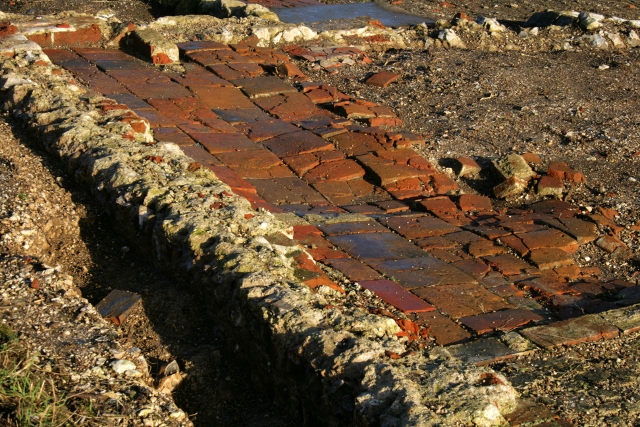
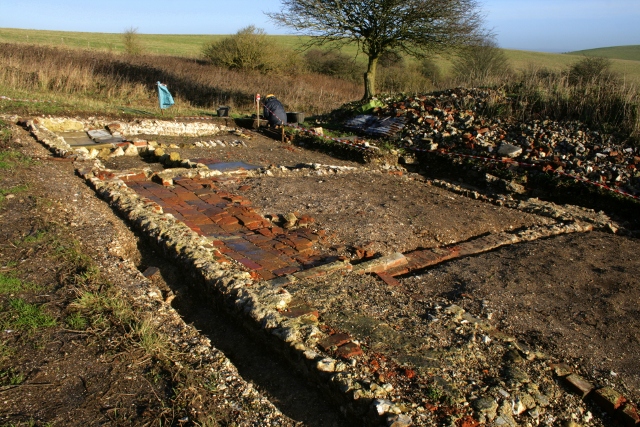
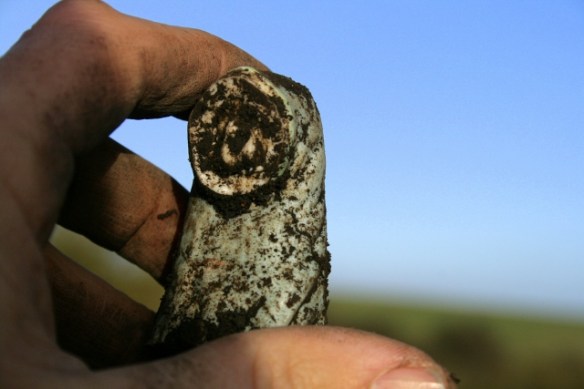
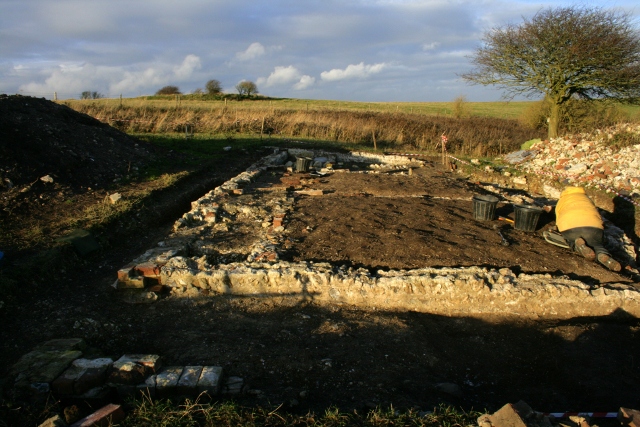
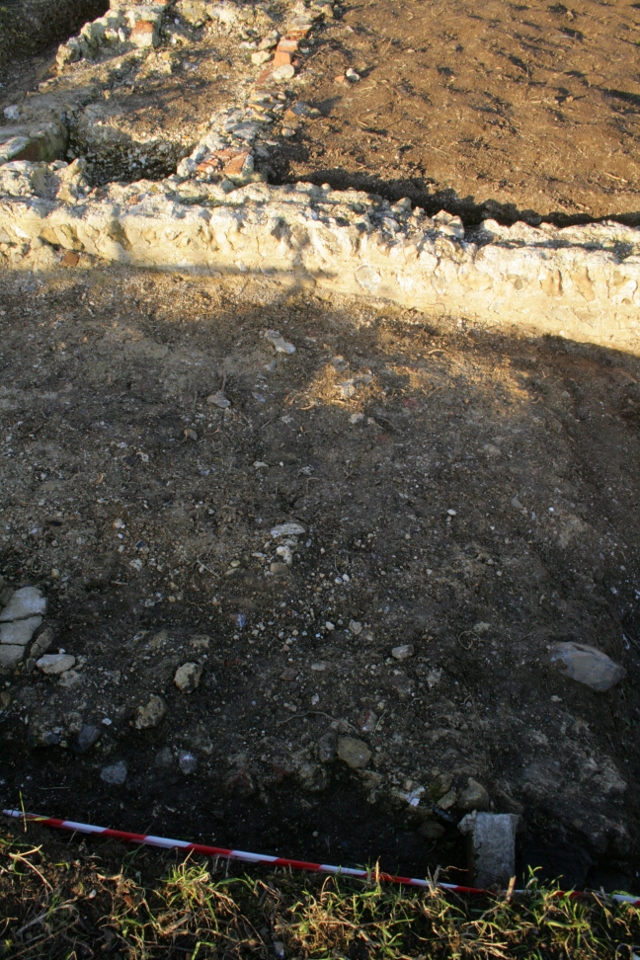
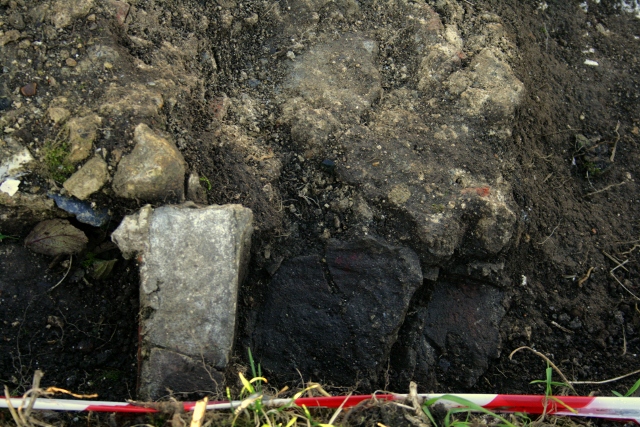
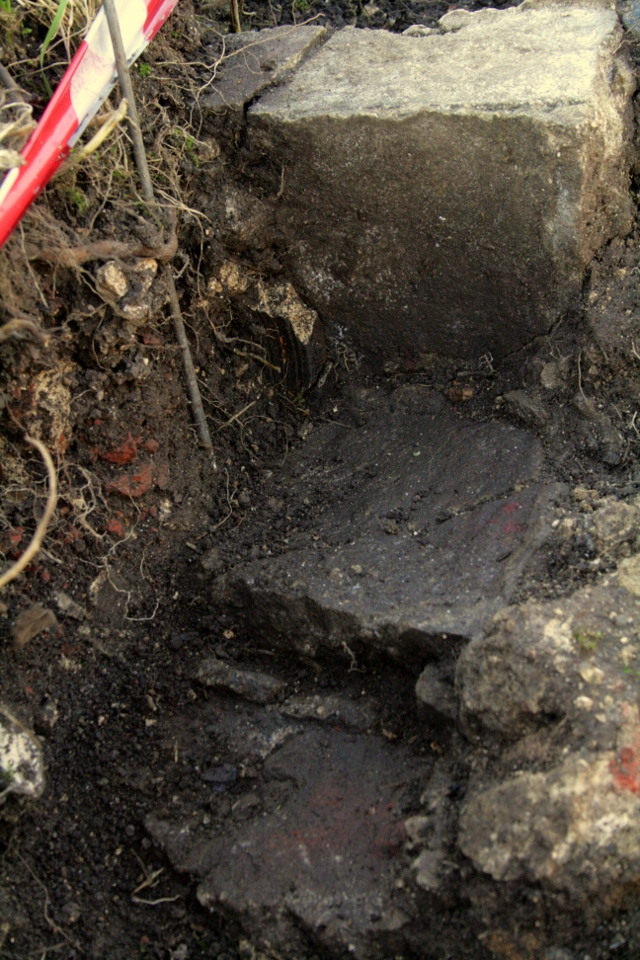
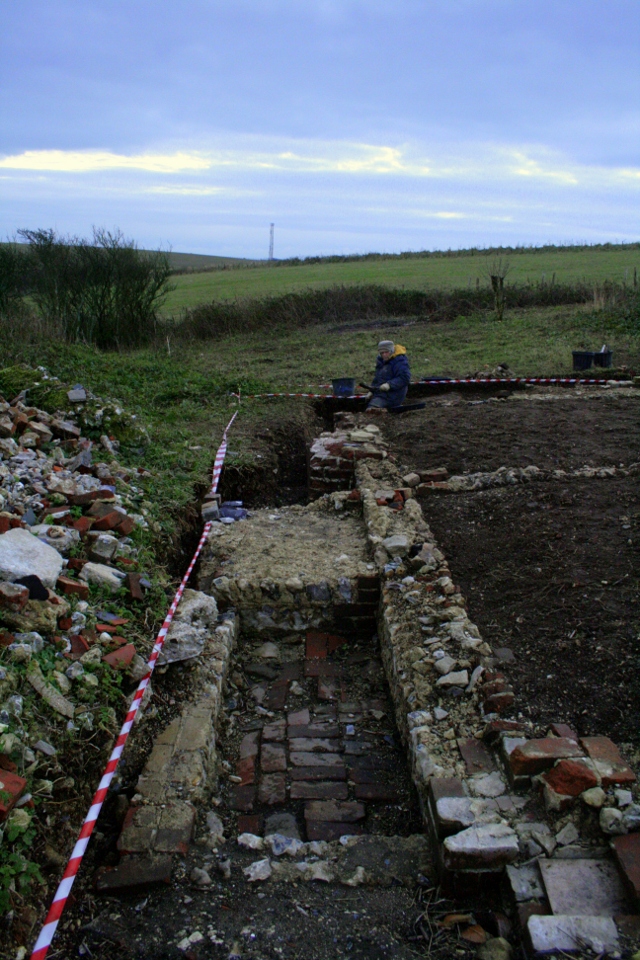
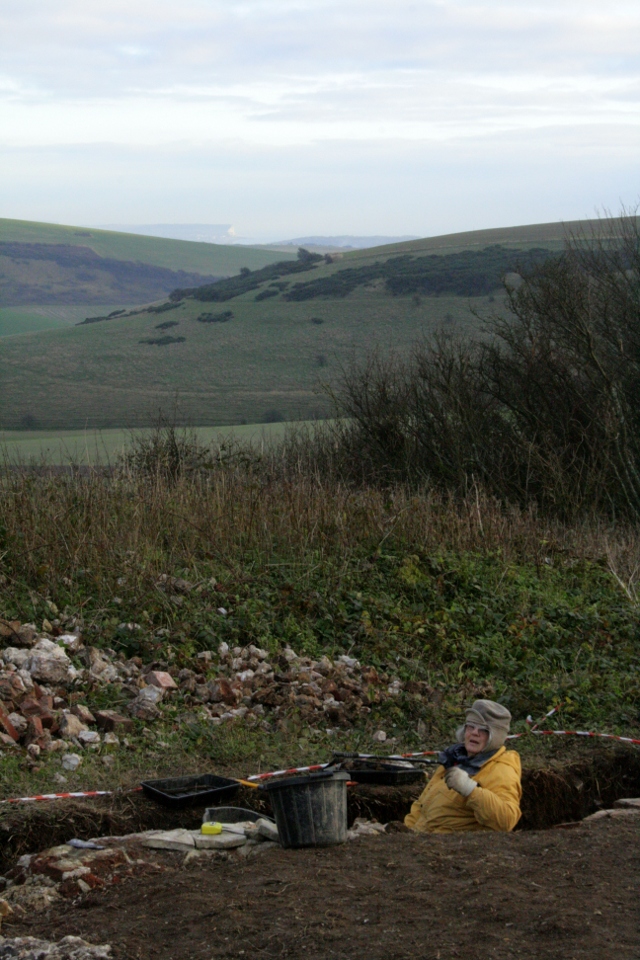
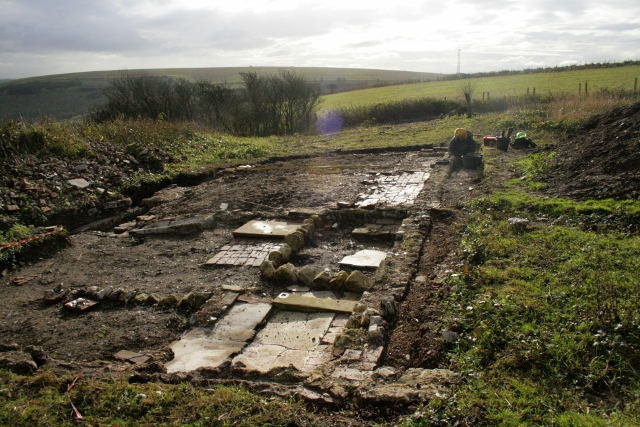
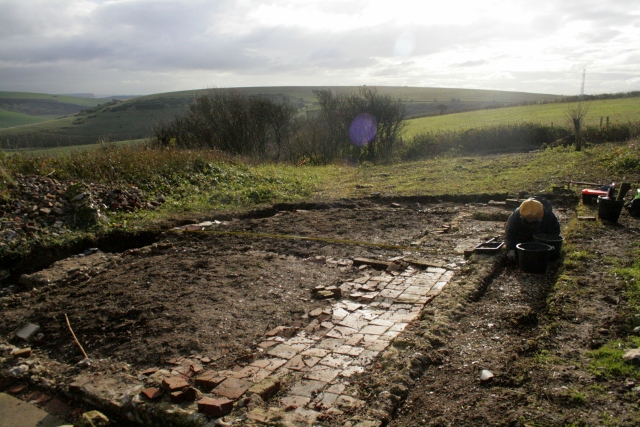
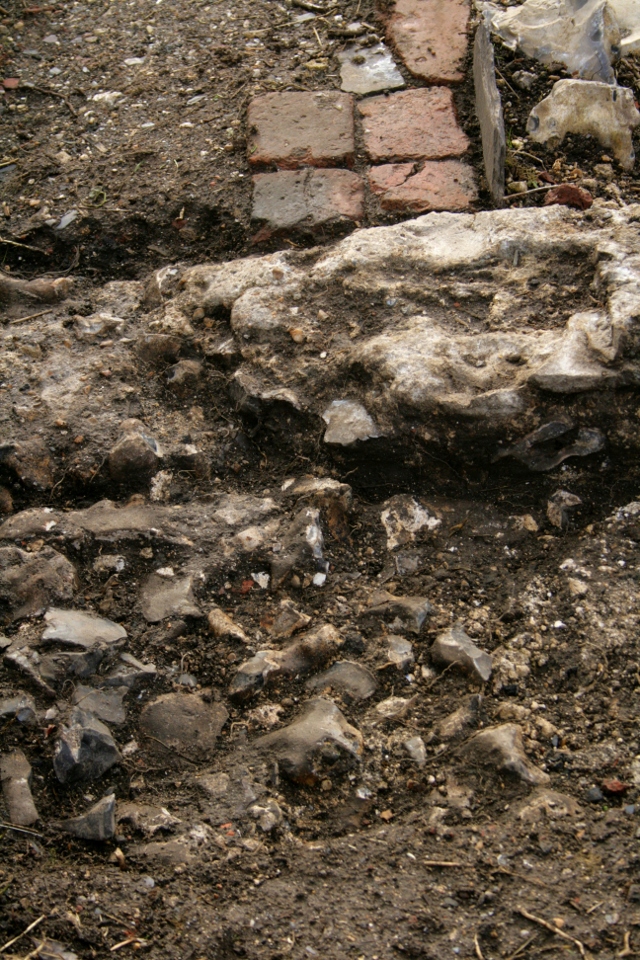
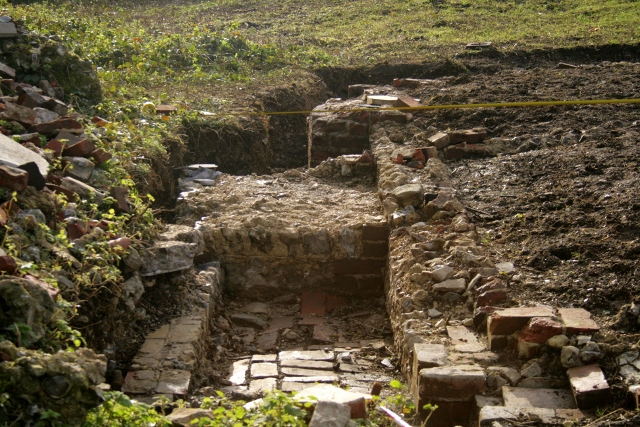
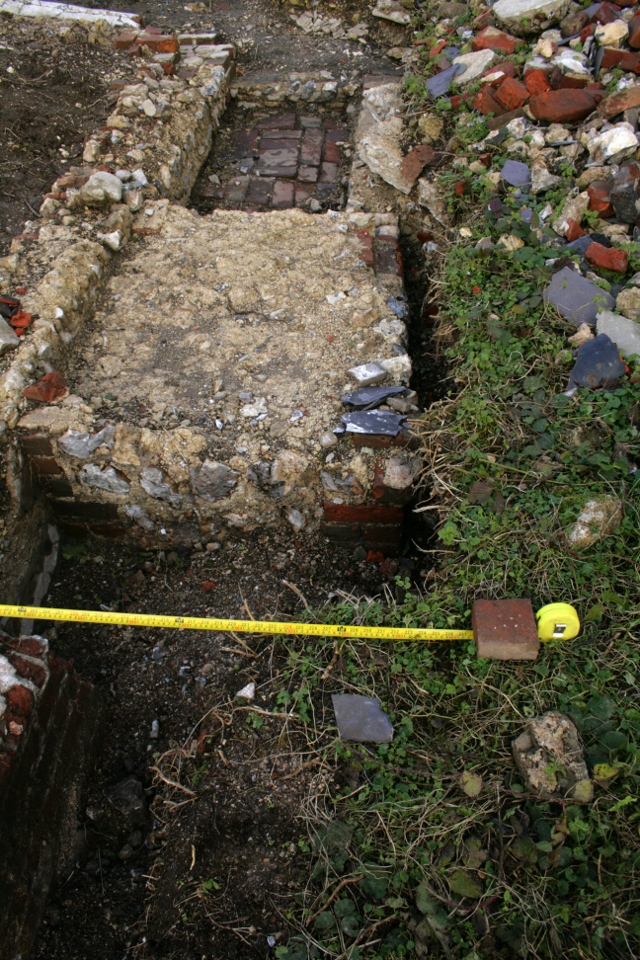
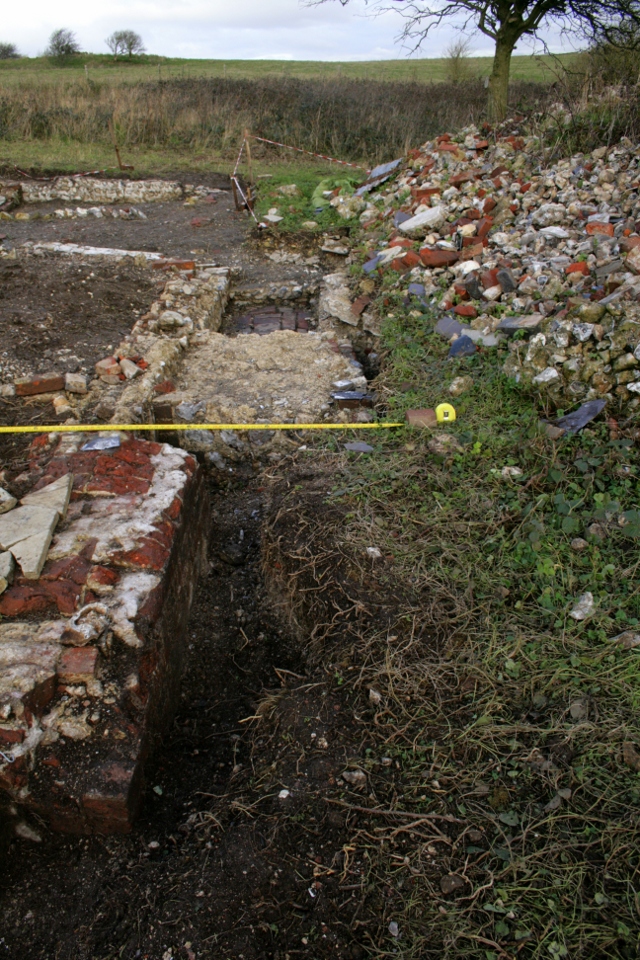
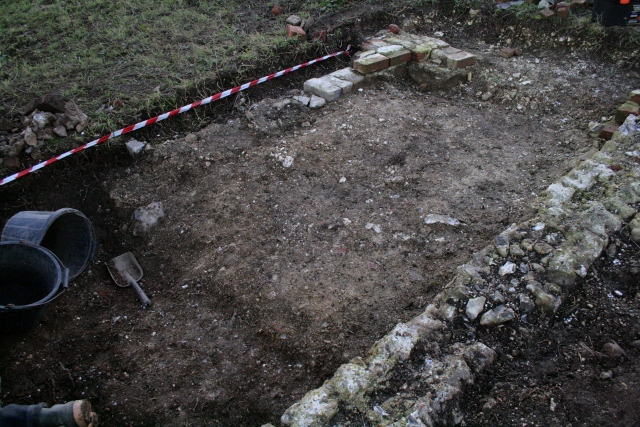
Looking NE at terracotta floor in N room of cottage.
Friday turned out to be a really beautiful sunny day, following some very heavy overnight rain, which resulted in the cottage’s beautiful terracotta floor tiles looking at their very, very best!
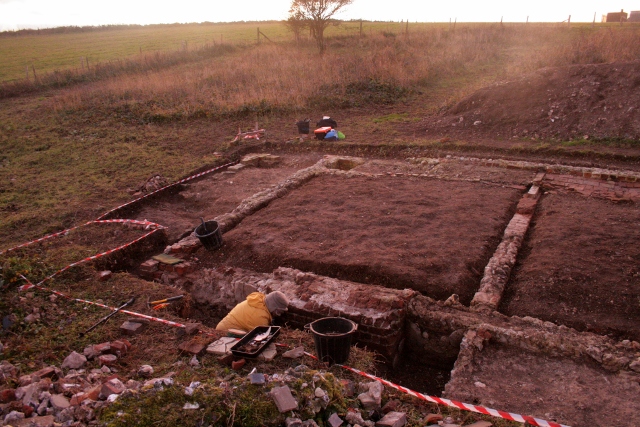
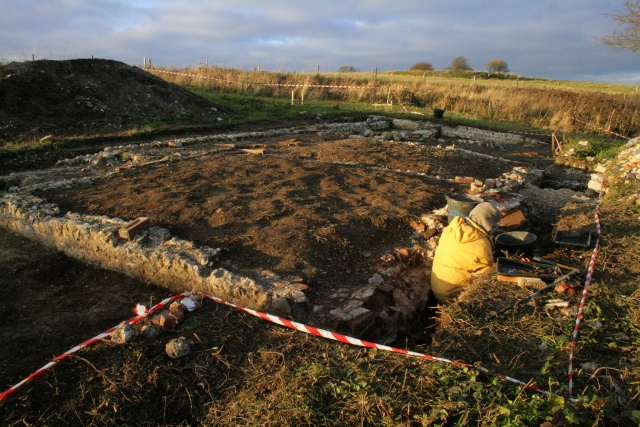
Looking NE at Newmarket Farm Cottage
The site as a whole was able to be photographed looking incredibly shiny & clean.
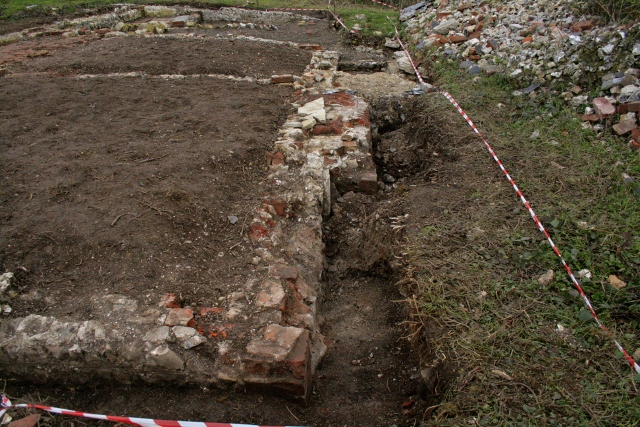
Looking E at front garden gateway.
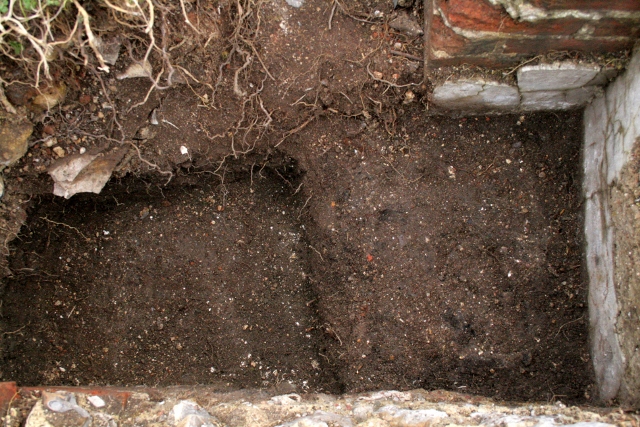
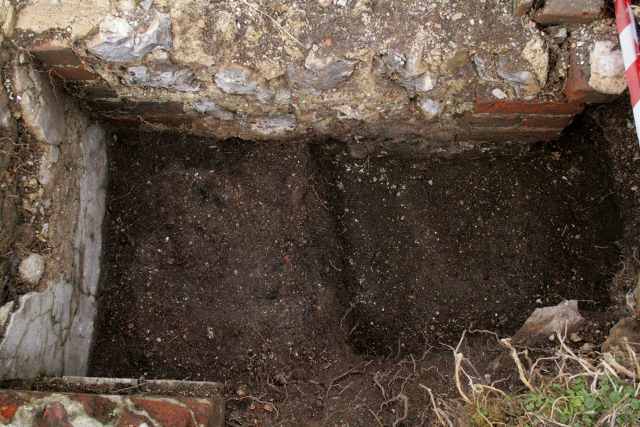
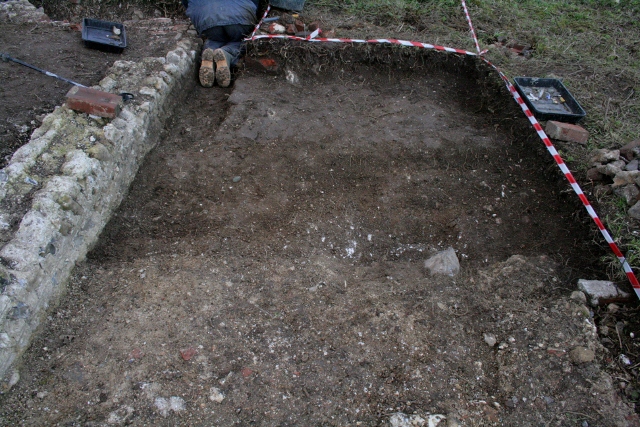
The ongoing one metre square being excavated over the north-east of the front garden gateway was at last completely excavated and cleaned up. We had hoped it would be uninteresting and so quick and easy to excavate – but how wrong we were – it became one of the most exciting of the dig! We had found an in-situ midden, on the down-slope side of the entrance, and full of exciting finds.
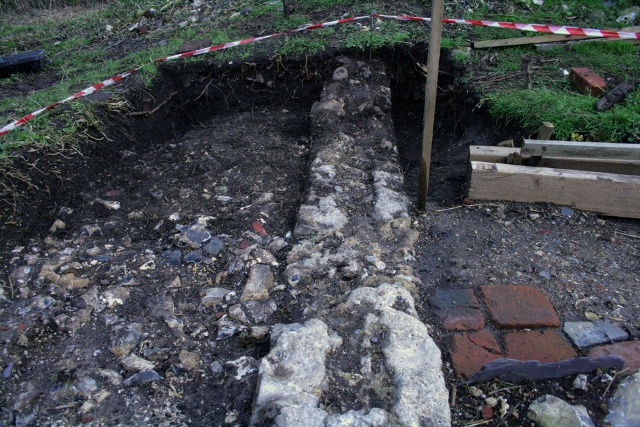
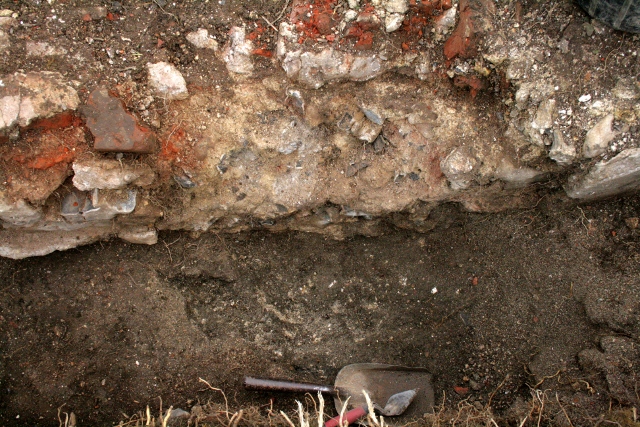
Partial section through top of midden deposit
It’s slightly compacted upper surface was characterised in places by a layer of pale yellow-ish brown burnt soil. The midden fill showed many signs of burning – including char-staining on some ceramic shards – though the heat had not been that intense, for the fill contained several pieces of unburnt coal and charcoal.
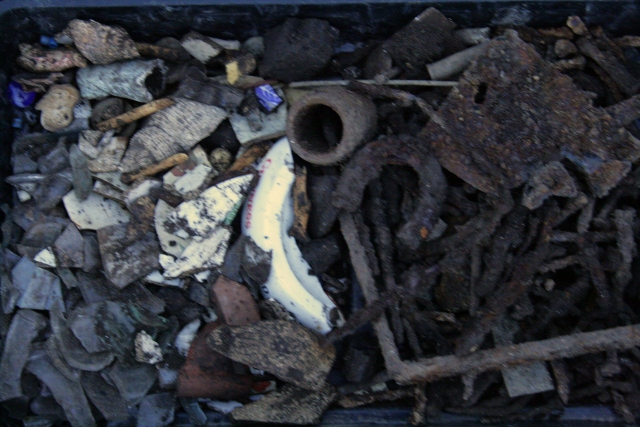
Finds included:
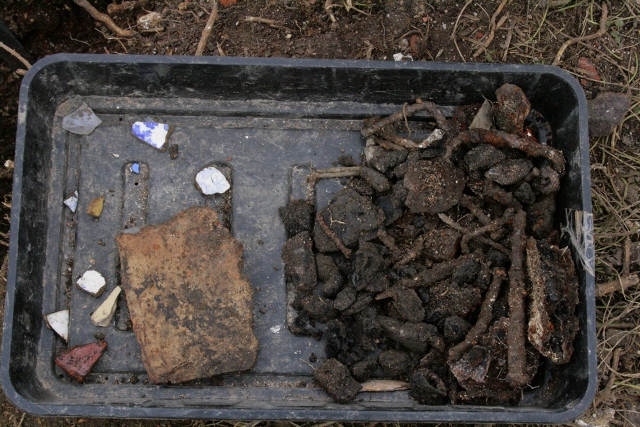
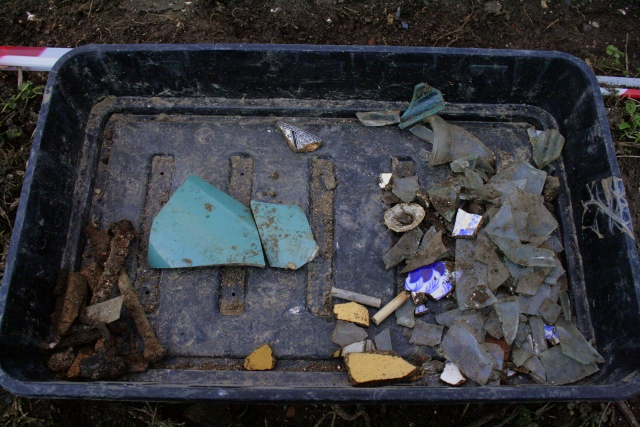
Finds from 1 x 1m grid square over NE part of front garden gateway.
These included;
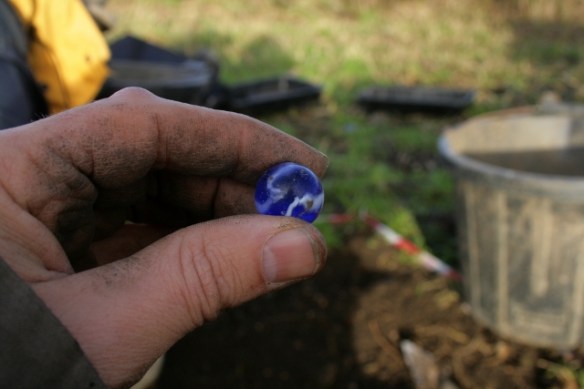
Blue and white marble
Our first blue and white child’s marble;
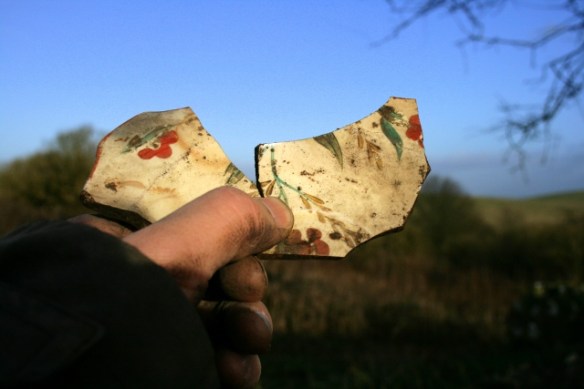
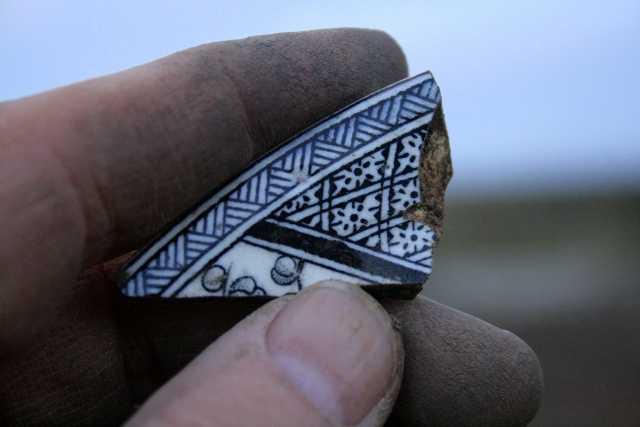
Large shards of a small decorated plate
Several large shards of a red flower patterned small plate;
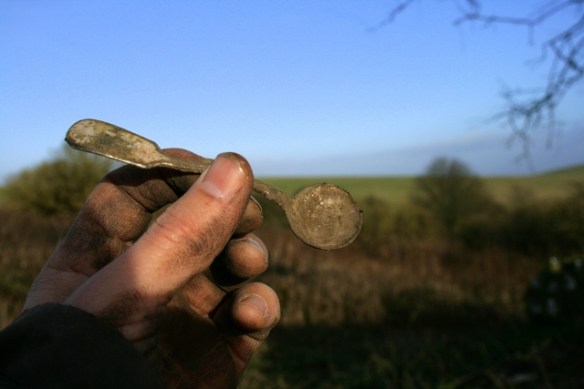
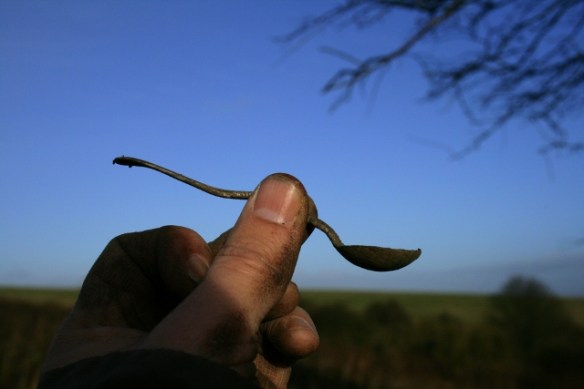
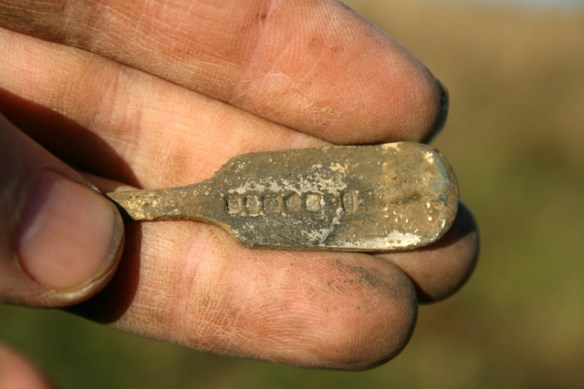
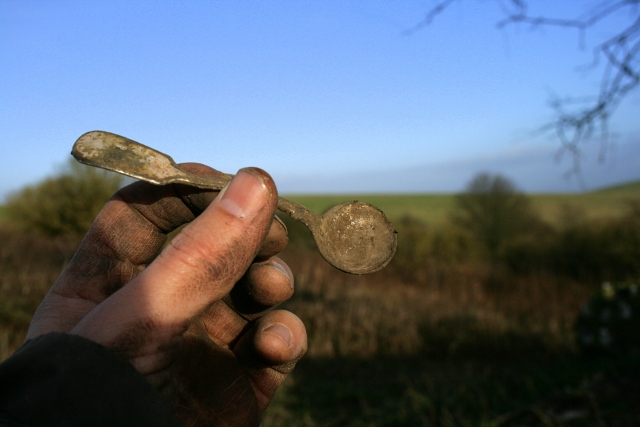
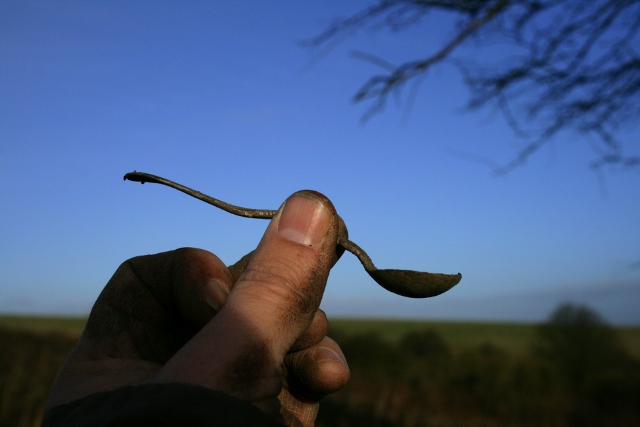
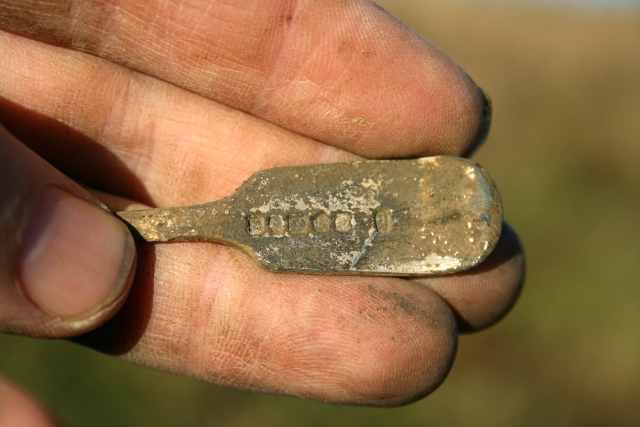
A silver plated ‘fiddle back’ design salt/sauce spoon with 6 date/factory marks (though as yet illegible) – this design may date from the Georgian period onwards – we need to find out the best way of cleaning the marks of their deeply ingrained crud, without damaging the fabric of the spoon;
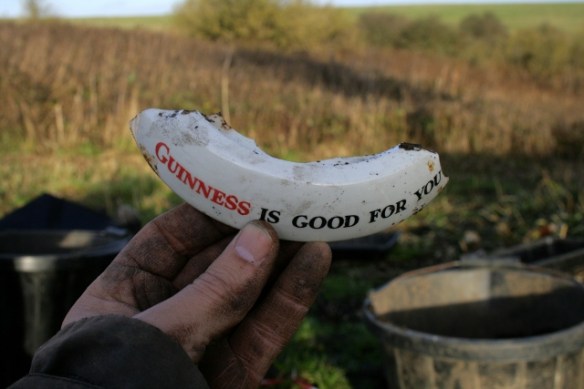
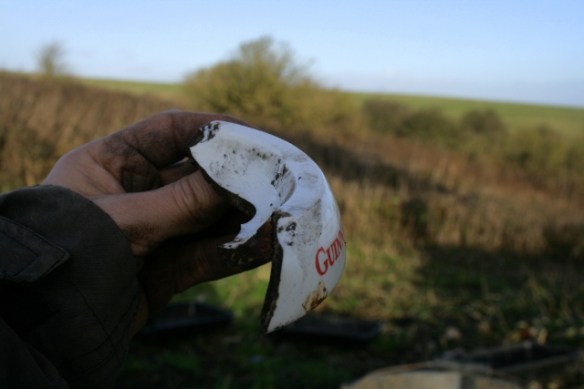
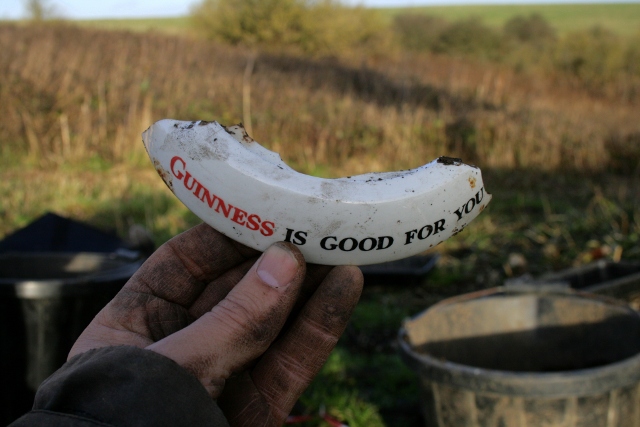
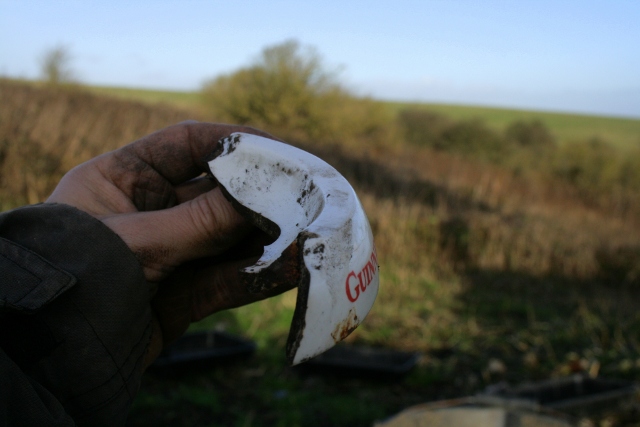
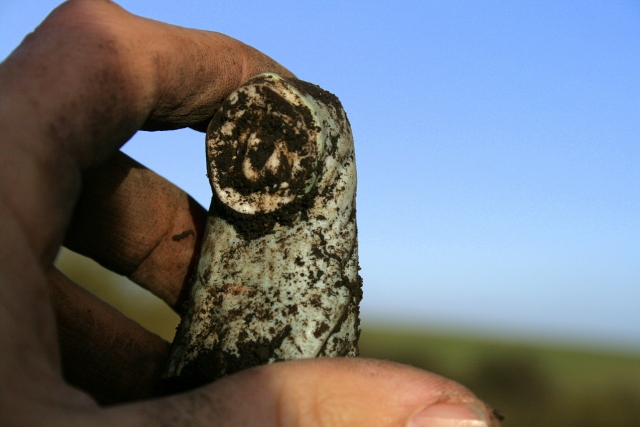
‘Guinness is good for you’ ashtrayGuinness ashtray
Some large fragments of a post 1920’s ‘Guinness is good for you’ pub ashtray;
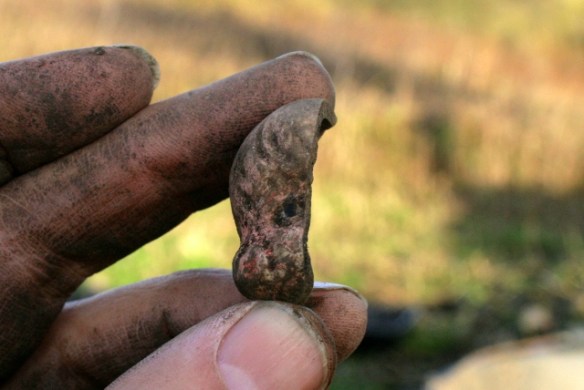
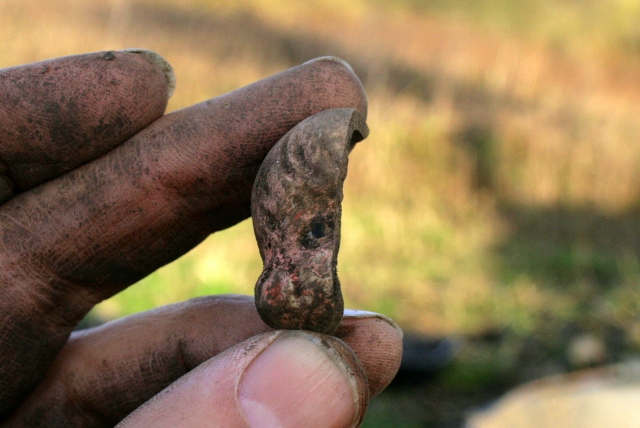
Left side of bisque doll’s head
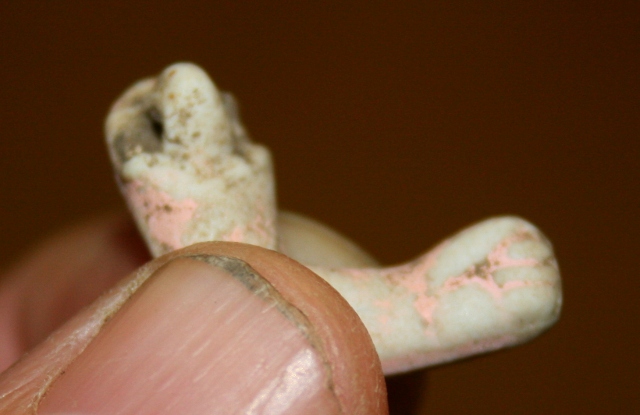
Yet another part of a bisque doll of a type similar but different to those previously found;
A bisque doll’s leg;
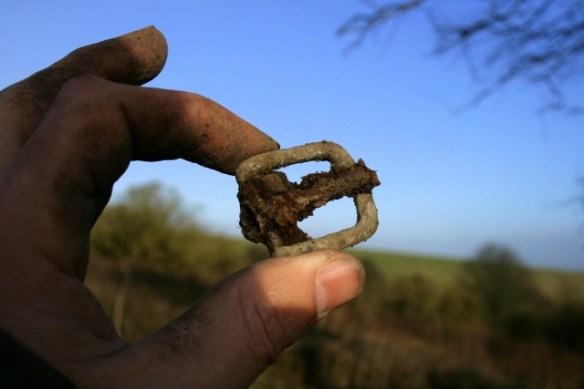
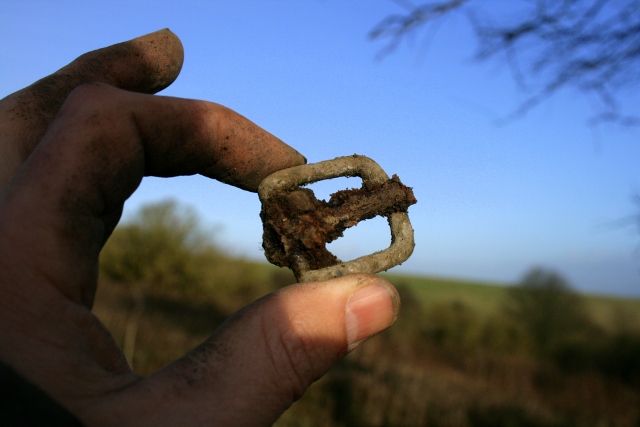
A belt buckle
A belt buckle with a copper alloy ‘frame’ and a ferrous ‘prong’;
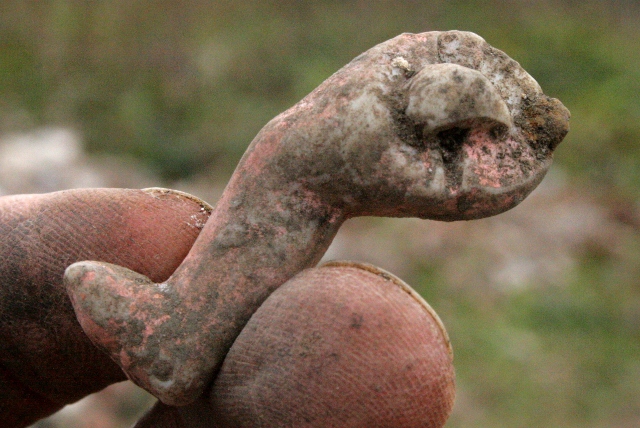
Ceramic arm? of figurine? with gilt decorationInner face of shoulder? joint of ceramic arm? of figurine?
The possible shoulder joint of a ceramic figurine, maybe?;
Another donkey horseshoe;
The sidewall of a small sauce bottle;
Several small light blue glass beads;
Rodent bones – rat or rabbit?
A solid section of antler or possibly even ivory?;
A 1919 George V farthing – interesting that this is our second coin found dating 1919, and our other two coins were also of the reign of George V (the value of the coins found so far total a penny halfpenny!);
The side panel of a relatively small glass bottle bearing the word ‘sauce’ – possibly a Garton’s HP Sauce bottle;
A small shard of flat (window?) glass with red (painted?) top and bottom surfaces – possibly from a lamp?;
A reasonably large quantity of rusty nails and other metal objects of an unknown nature, a range of glass shards (the only window glass shards were of the thinner type), and much more!
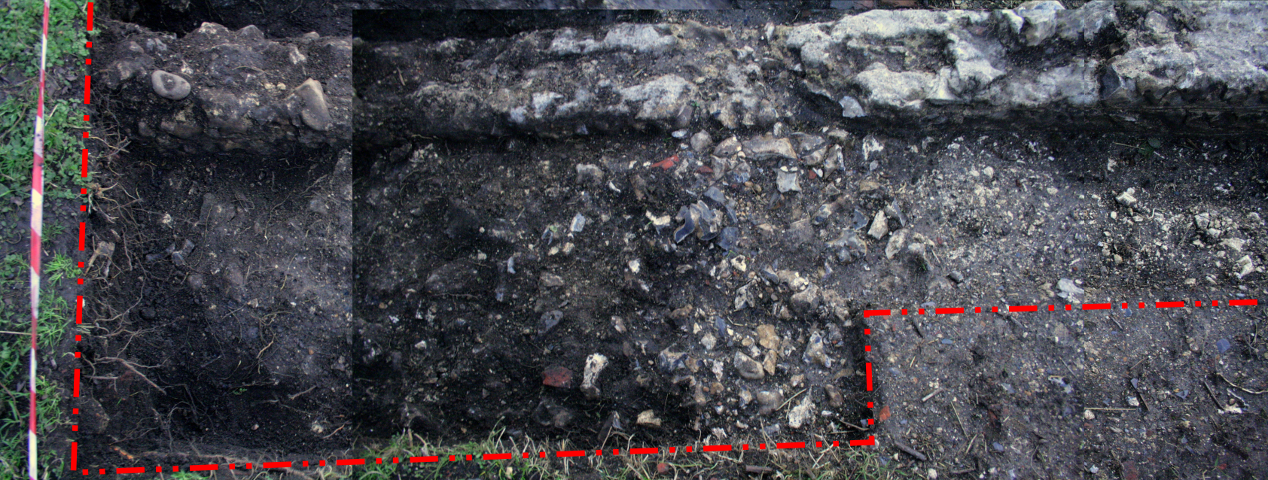
Looking S at N side of front garden gateway – dotted line indicates the extent of excavation – click on image to enlarge.
The west edge of the midden partly overlaid some badly laid loosely packed flints, which presumably were part of an approx. 3′ wide path. The wall, which bounded the south side of this grid square had been cut by the later bulldozer right down to immediately above the level of the path. I had expected to find at least the foundations for a brick pillar or quoin either side of the entrance-way, such as has generally been found elsewhere on the site, but there were no signs of any edges to the threshold of the gateway to be seen.
The demolition fill deposited over this area contained more .45 and .303 cartridges, as well as a smaller density of finds, but nothing of particular interest.
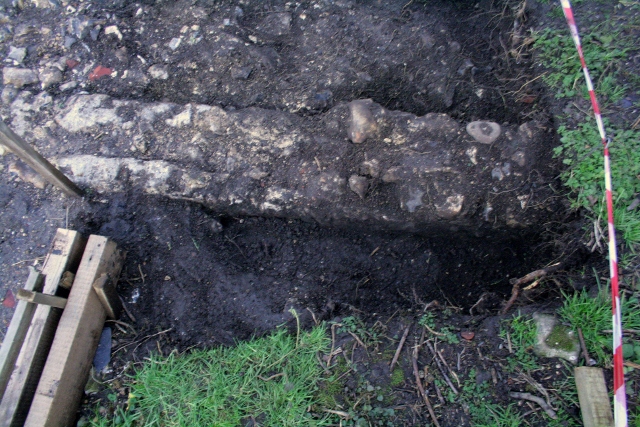
Looking N at front garden wall E of gatewayLooking E at front garden gateway
A small trench extension was made along the south side of the wall to compare the levels of the original ground surfaces on either side of the wall. As expected, though the bulldozed demolition fill starts to rise (or more accurately, the downwards slope was reduced) as it begins to form the large mound of demolition rubble further to its east, the underlying original ground surface starts to drop off relatively steeply.
Finds from small extension to trench, SE side of front garden gateway
Finds here were relatively few and unremarkable; the most noteworthy being more thick glass shards of a silvered mirror.
Looking NE at excavation over east side of front garden gateway.
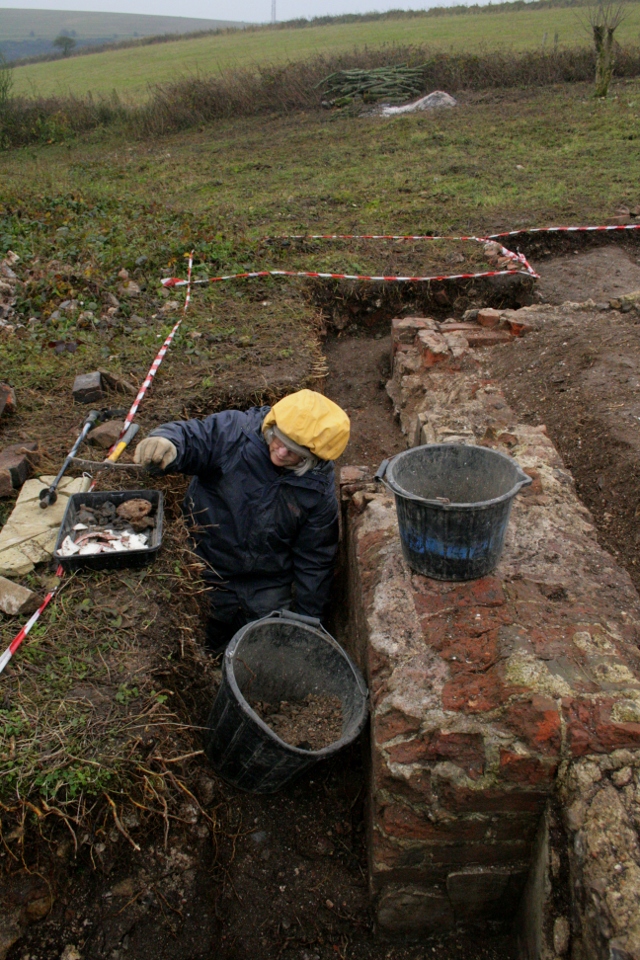
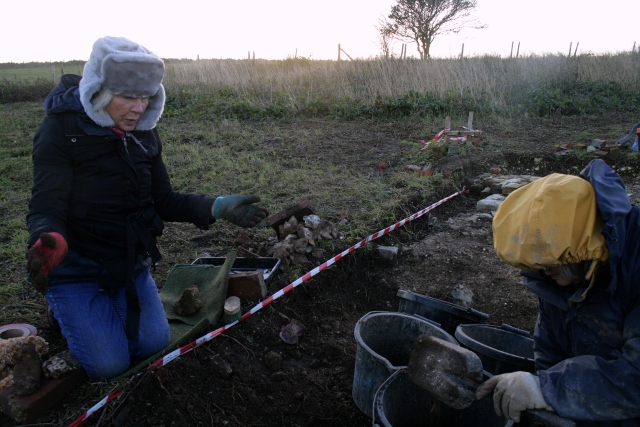
A very wet morning was spent continuing the excavation of the east side of the front garden gateway. The photograph above was taken last week – on Sunday it was far too wet to take any photos on site.
In the demolition rubble over loose (probable) flint cobbles, a relatively large number of finds were uncovered. These included;
A small articulated arm of a bisque doll
a small porcelain (bisque) doll’s arm – smaller than any found earlier;
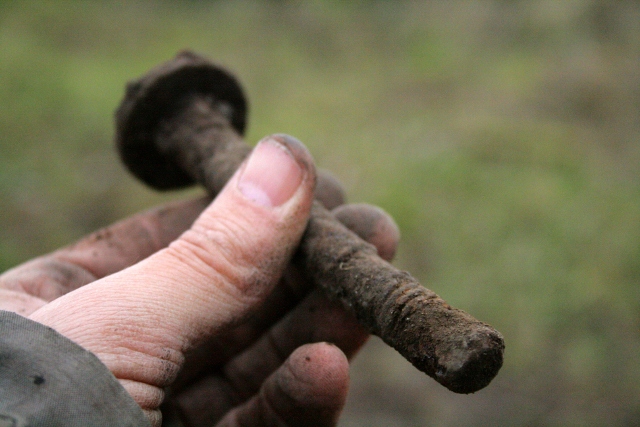
a 30cm long rusty iron bolt – larger than any previously found on our dig;
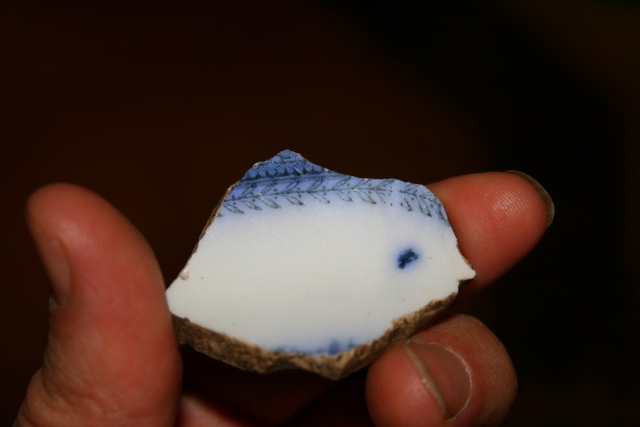
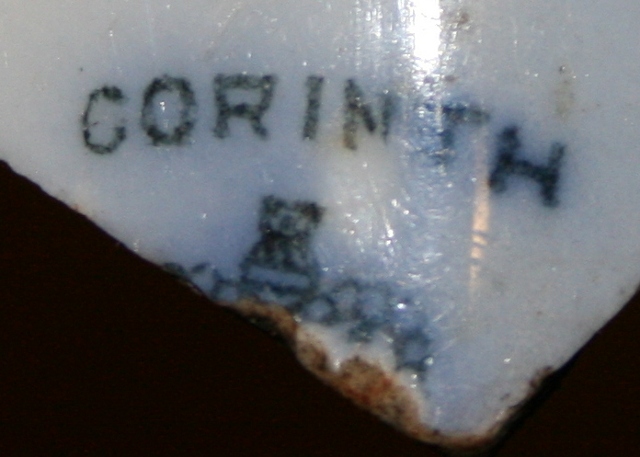
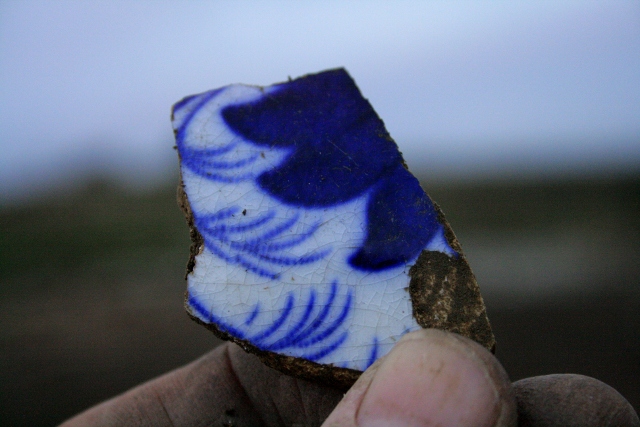
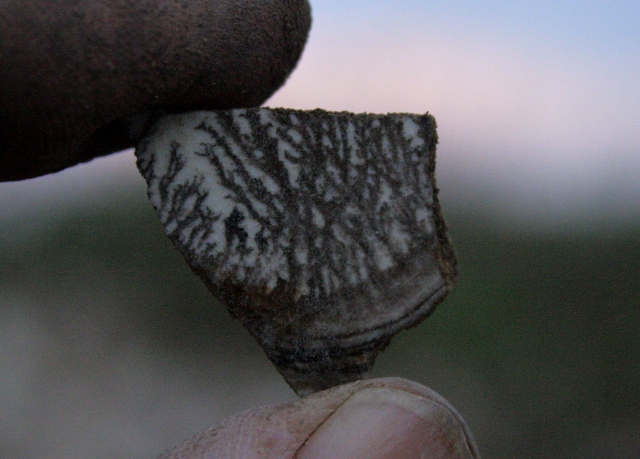
Blue and white ceramic shardReverse of blue and white shard bearing ‘CORINTH’ name over part of a crown design
This blue and white ceramic shard has – on its reverse – the word ‘Corinth’ over the top most part of a crown. Research suggests that ‘Corinth’ was the name of the pattern, but the design of the crown mark failed to match any of 2,656 shown on the marksandlibrary.com website.
For our last two coming Friday and Sunday dig days before Christmas – if we get enough volunteers – we may be able to open a small extension to a trench on the south side of the cottage to explore a drainage pipe observed in the wall of our southern most trench side (though this is far from being a priority); was it to divert rainwater to a nearby water-tank or well? Our priority however, is to finish the excavation of this 1x1m area over the entrance of the front garden gateway, and to give the site a final clean up for our promised hi-res laser scan on Monday (weather and other factors permitting). We also need to complete our survey of the site, and to collect any representative building material samples which have not as yet been added to our finds collection. As yet we are still looking for a mechanical digger – this is very much a priority – to be done as soon as possible after a well-earned Christmas break. If there is time between the laser scan and the back-filling of the site, I would very much like to fully excavate the salt-glazed stoneware drain on the north-east corner of the cottage in case we can find a datable manufacturer’s mark. I would also like to dig a very small sondage down to the bedrock in front of the kitchen window and also by the masonry blocks by the north-west corner of the cottage just in case the well (or water-tank) – which the oldest of the Latham family children believes used to be there – was back-filled before the demolition of the cottage and thus has been hidden from our excavation so far.
A cloudy but (relatively) mild day, which just about stayed dry till it was time to go home. It was also one of the best days over the past couple of months of the dig for finds of both quality and quantity.
Looking NE at excation over east side of front garden gateway.
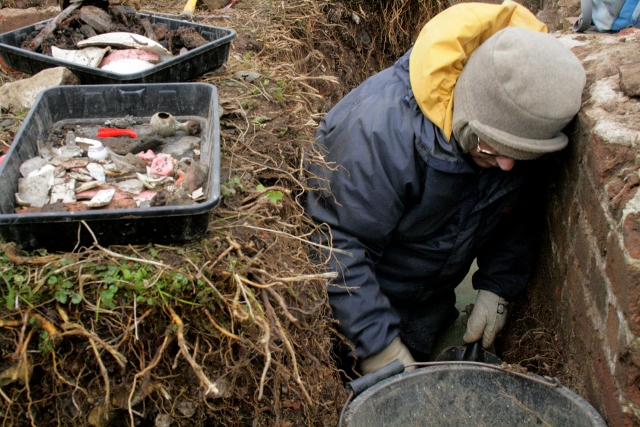
It was a dig of two halves. The 3x1m area in front (north) of the front garden gateway was continued to be excavated.
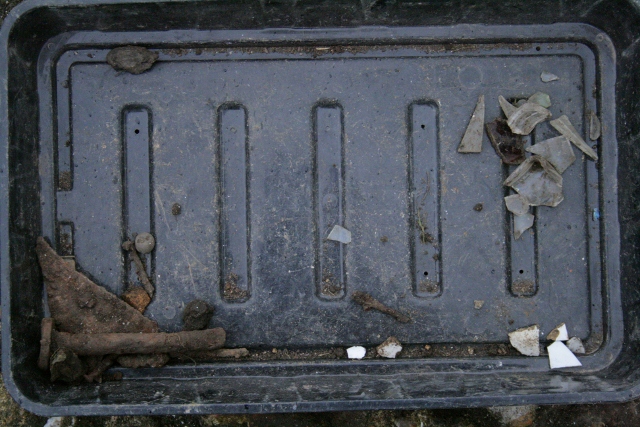
Finds tray from upper part of demolition fill over north-east part of front garden gateway.
Finds from the upper level of eastern half of the demolition fill were unexceptional;
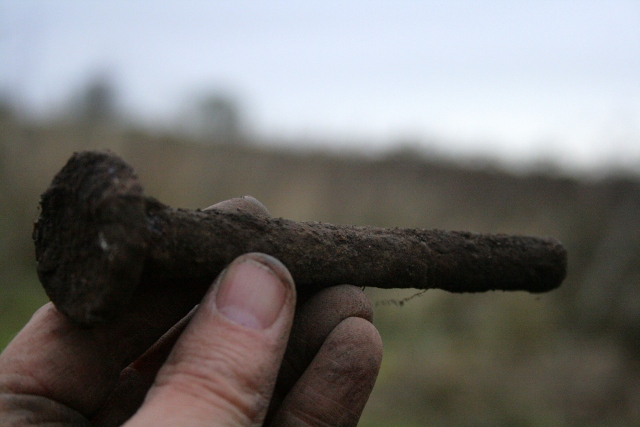
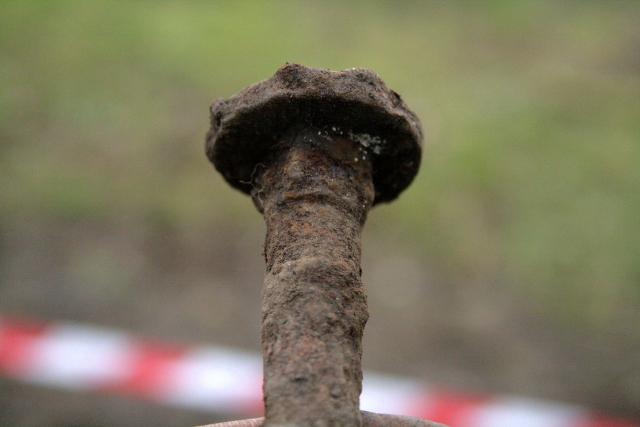
Large iron bolt.Iron bolt showing screw threaded end.
Iron bolt showing square cross-section under head.
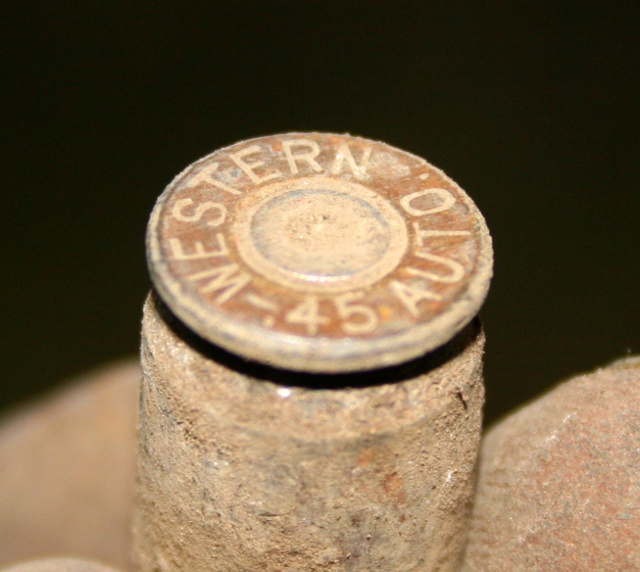
Western Cartridge Corporation .45 Automatic Colt Pistol cartridge.
The best find was a .45 Automatic Colt Pistol cartridge by the Western Cartridge Company. It appears that the .38 Enfield No. 2 was prefered by the British because it had less recoil. The heavier .45 Colt and its many variants needed more training to use than was cost-effective for the many WW2 conscripts, but because of its better stopping power it was particularly used by those on special operations. This increases the likelihood of the local rumour that the No. 3 Newmarket Hill area – which covered the area from Woodingdean to Southease, including Balsdean – was used for secret training operations.
Looking S at excavation E of chimney base.
However, the continuing excavation of the demolition rubble east of the chimney revealed some really exceptional finds:
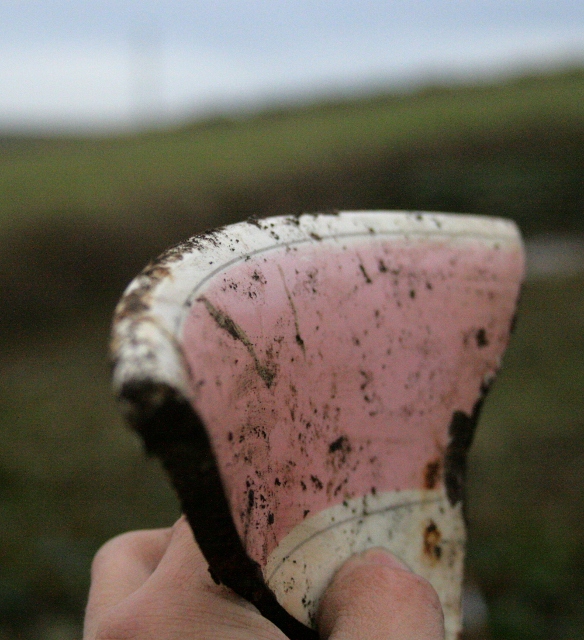
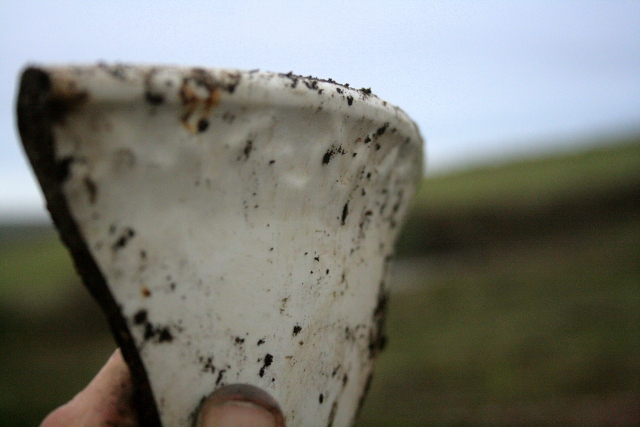
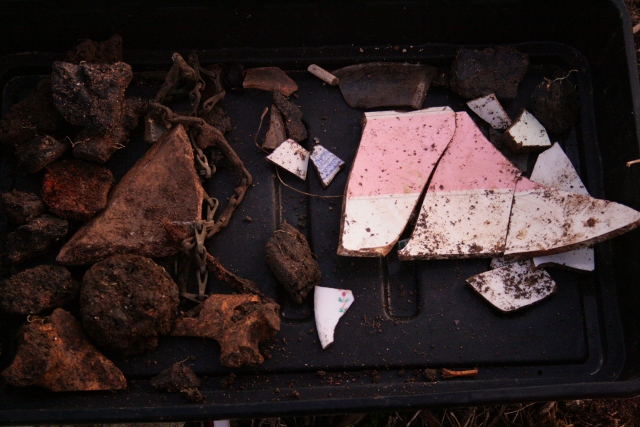
Finds tray from E of chimney base.Pink and white wash jug shards.Rim shard of large wash bowlMoulded pattern on outside of large rim shard of ceramic wash bowl
More matching very large shards of both a pink and white wash bowl and jug were found. A similar design has been found on the Internet, dating to about 1920 – Newmarket Farm was certainly not exceptional in having no mains water – half of Woodingdean had no mains water till 1929;
A Garton’s (HP Sauce) glass and cork (club sauce type) stopper (1903-?) – the cork of course had decayed, but the bottle or one like it may well be hidden amongst our many glass finds of the dig;
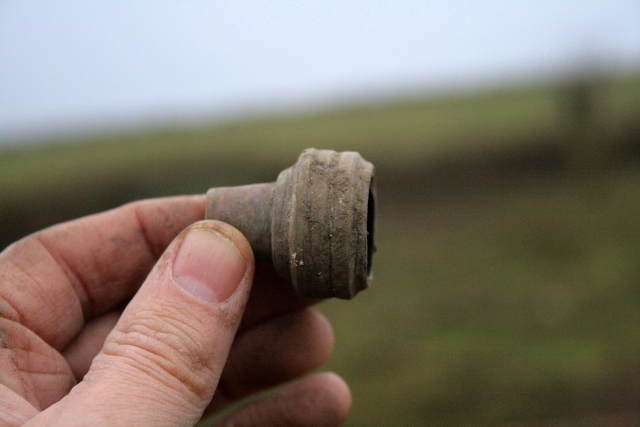
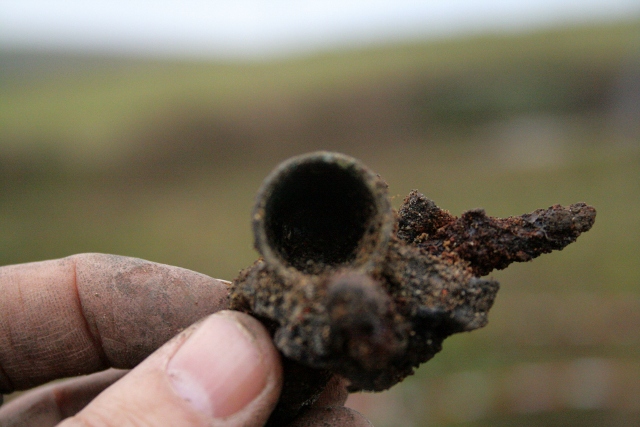
Copper alloy cylindrical object.
An unknown copper alloy cylindrical object resembling a hose pipe adapter;
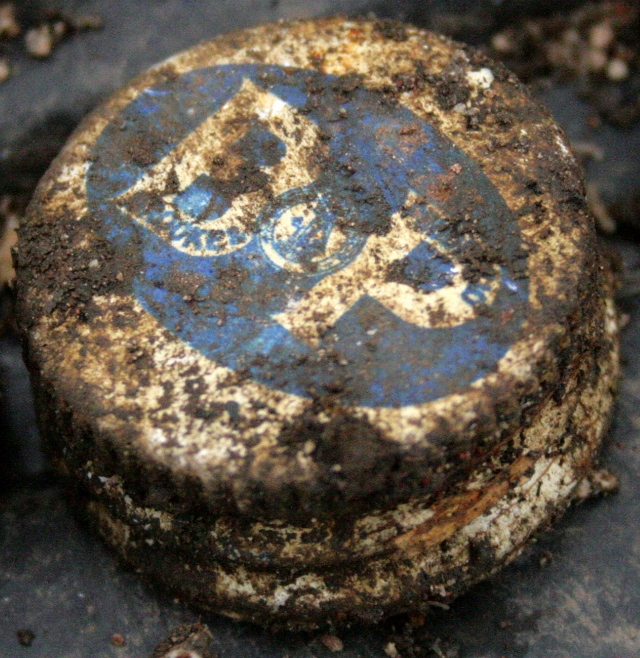
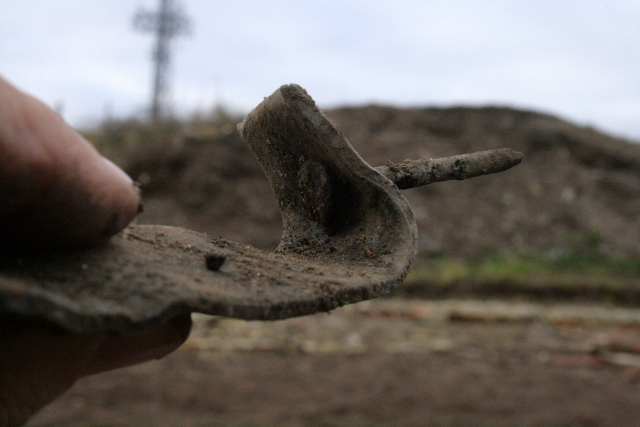
Brooke & Prudencio bottle top
A Brooke & Prudencio mineral water metal screw top from the late 1920’s or early 1930’s – this Bristol based company had a bottling plant in Lewes;
A screw threaded cap for a mortar;
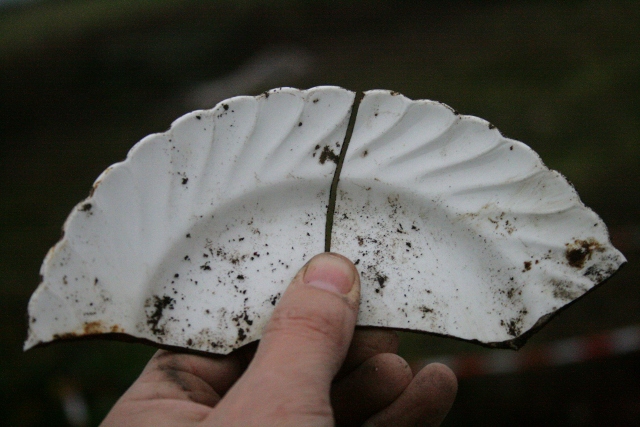
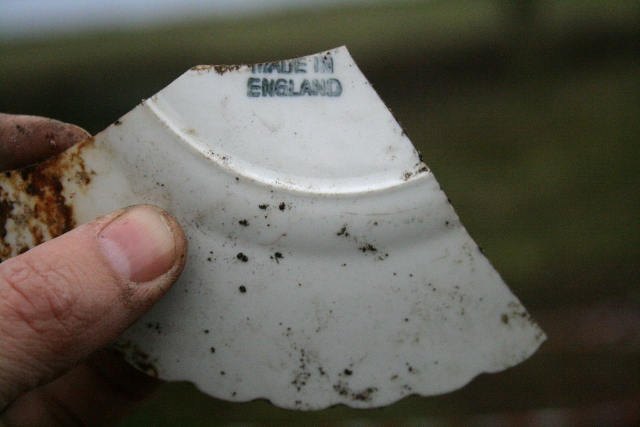
Ceramic side plate shards.Ceramic shard with ‘MADE IN ENGLAND’ inscription.
The ‘MADE IN ENGLAND’ inscription was introduced by a number of potteries in the early decades of the 20th century;
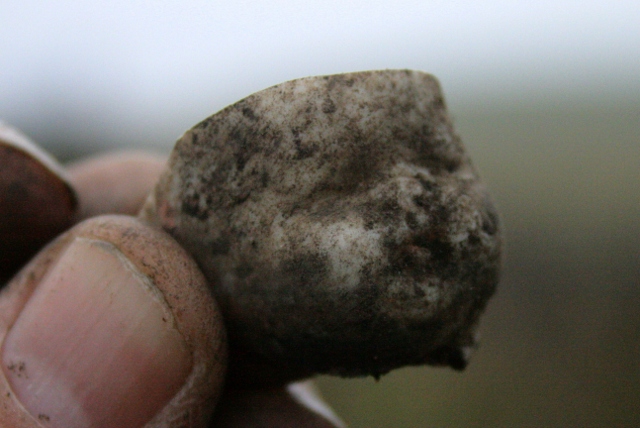
Green-ish ceramic or plaster bead.
A few of these green-ish coloured beads have also been found elsewhere on the site – they possibly originated from a ‘beaded doily’ to keep flies out of open containers, such as plates of food, jars and jugs;
A very dirty ‘bisque’ doll’s face.
This same design of ‘bisque’ doll’s face was recently found nearby;
A possible shard of the body of a ‘bisque doll’
This ceramic shard may belong to the same type of doll as that of the head shard shown above – 2 articulated arms and a leg have been previously been found, one of whose joints may have fitted into its hole;
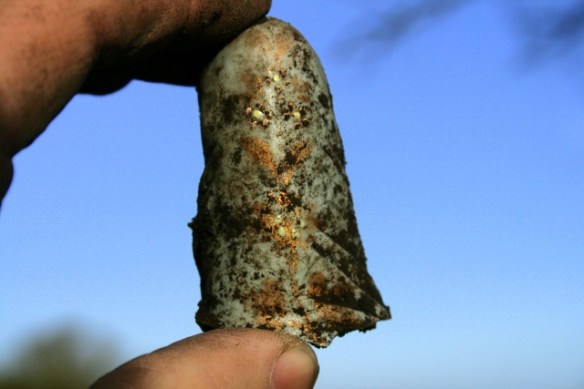
Possible copper alloy thimble concreted together with rusty nails.Possible copper alloy thimble concreted together with rusty nails.
This seems to be a copper alloy thimble – made for small fingers;
A Sussex Brick & Estates brick.
Two other small fragments of Sussex Brick & Estates Co. Ltd. brick have been found – the only named bricks from the site – which date from between 1922 and 1930, so most likely belong to some (unknown) building works or repairs by Oscar Selbach;
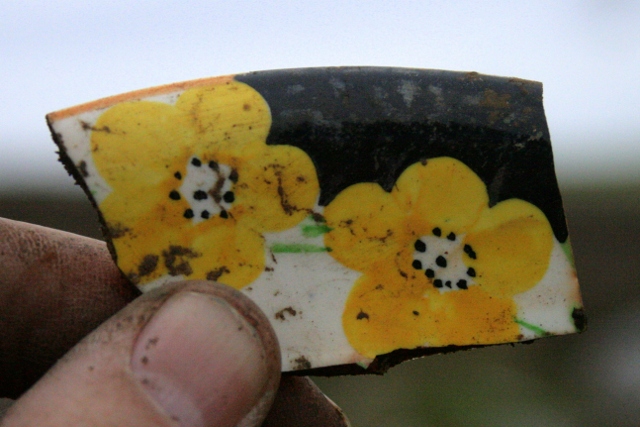
One of a few shards of a floral design plate;
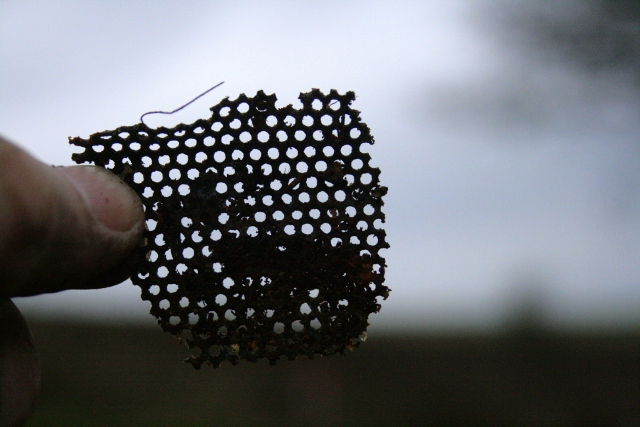
One of many fragile fragments of metal gauze.
This metal gauze was almost certainly from a fly screen, possibly a meat safe, and has been found right across just about all of the areas excavated outside the cottage;
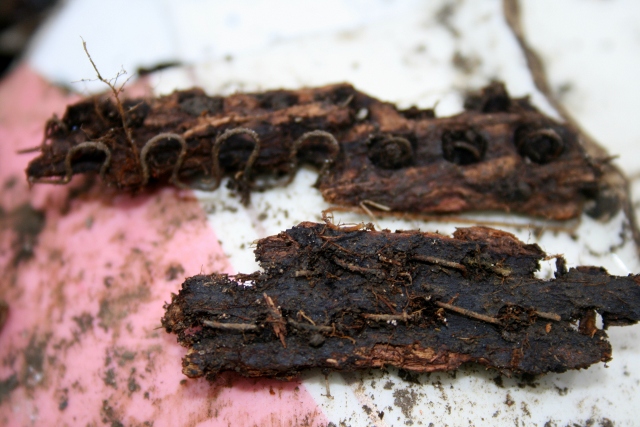
Fragments of wood with stitches.
Badly decayed fragments of wood were uncovered bearing stitches threaded through drilled holes belonging to an unknown object;
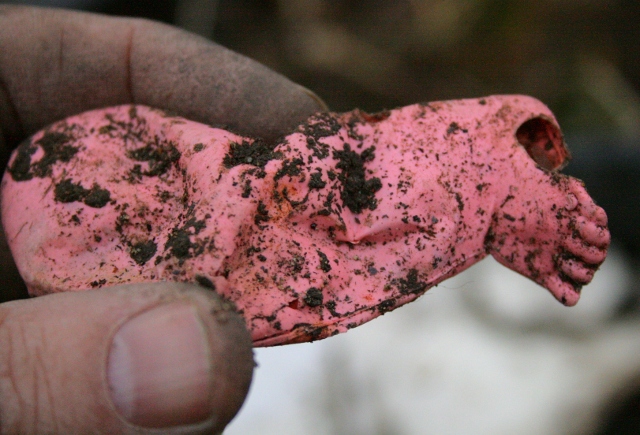
Plastic (PVC) doll’s leg
A small (PVC?) plastic doll’s leg – if it is PVC then it dates to sometime after 1926;
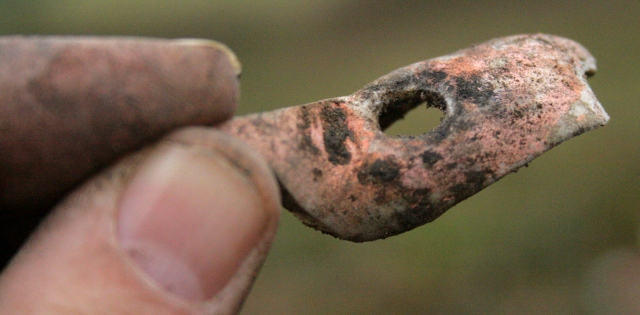
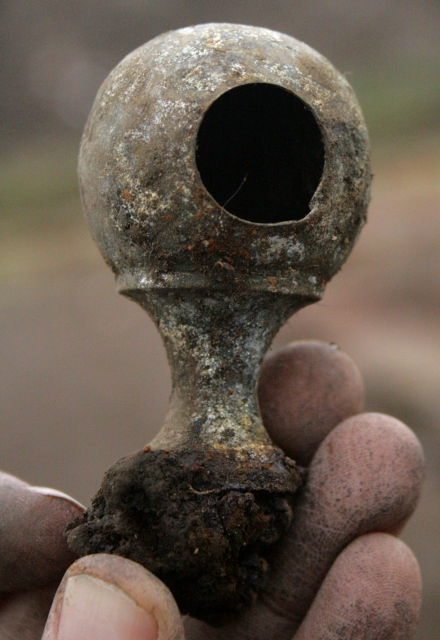
Copper alloy hollow knob with iron at base
This hollow brass knob may have been part of a bedstead, the hole in its side may have held a rail;
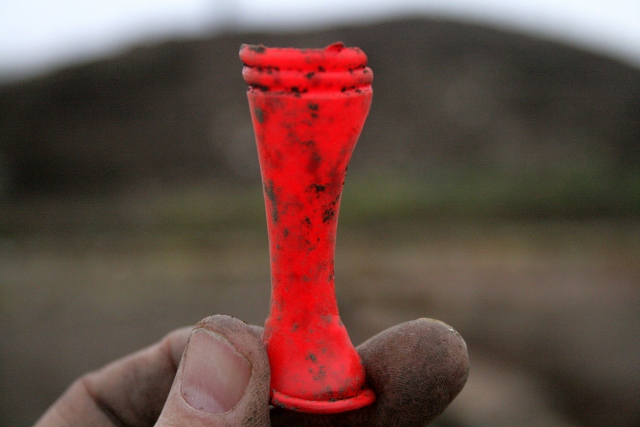
Half a split red plastic (PVC?) waisted cylinder
This split moulded plastic part of an unknown object, if PVC, dates to after 1926;
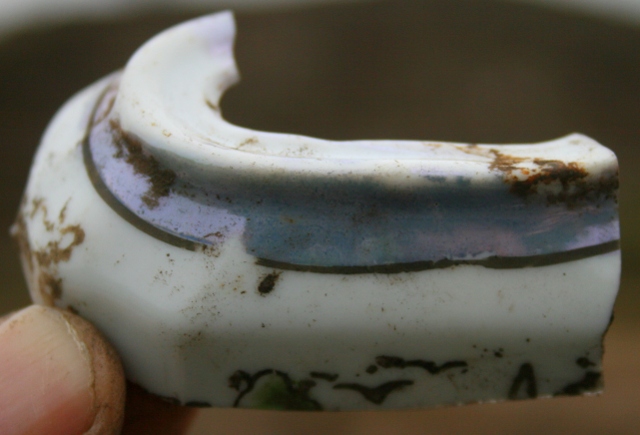
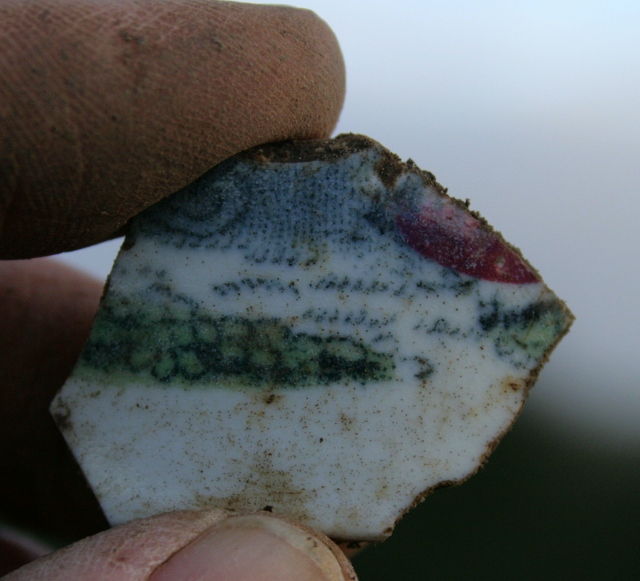
A shard of a decorative ceramic object with a narrow slot in the top
This decorated ceramic object may possibly have been a small money-box (the slot in the top is easily big enough to take an old penny), with a landscape of birds and trees on one of its sides;
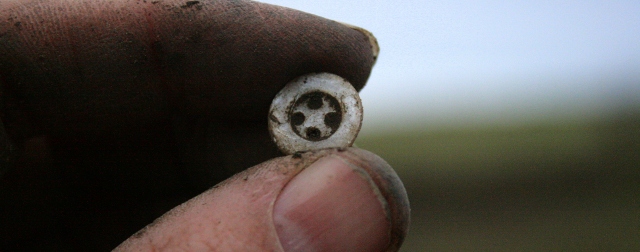
Mother of pearl button
A small mother of pearl button – yet another indicator that however poor the farm labouring occupants may have been, many chose to spend money on pretty things.
Natural England’s Castle Hill National Nature Reserve wardens had done some more clearance work of the scrub immediately to the south-east of the site, which probably originated from the suckers of a plum-tree in the Newmarket Farm Cottage garden. They uncovered two large objects:
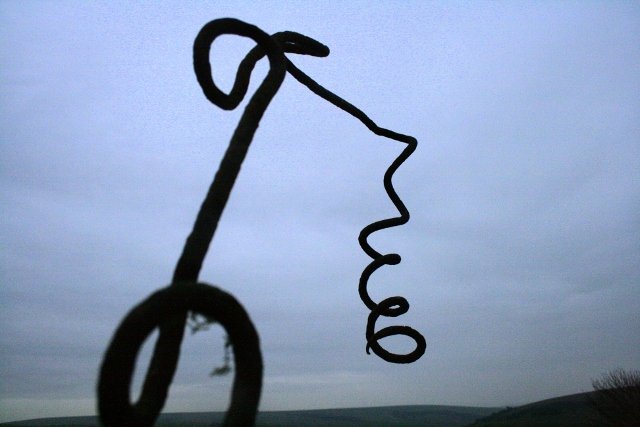
Screw picket for barbed wire
Though these were used for the quick installment of barbed wire defences during the first world war, this almost certainly dates from sometime between 1942 and 1945;
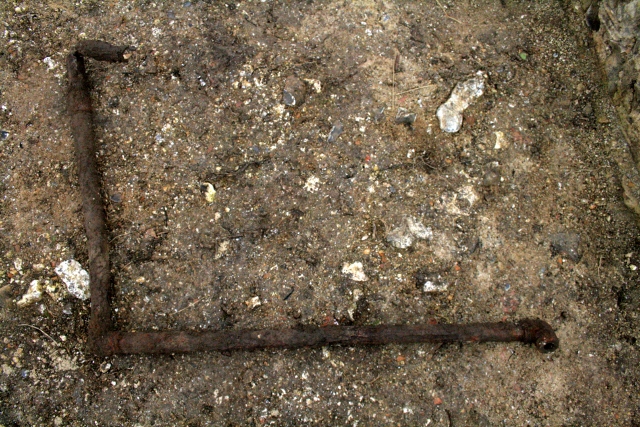
A large length of 1″ iron pipe;
This approximately one inch diameter iron pipe may not have been used to transport water, but more likely was used as a framework to support an unknown structure.
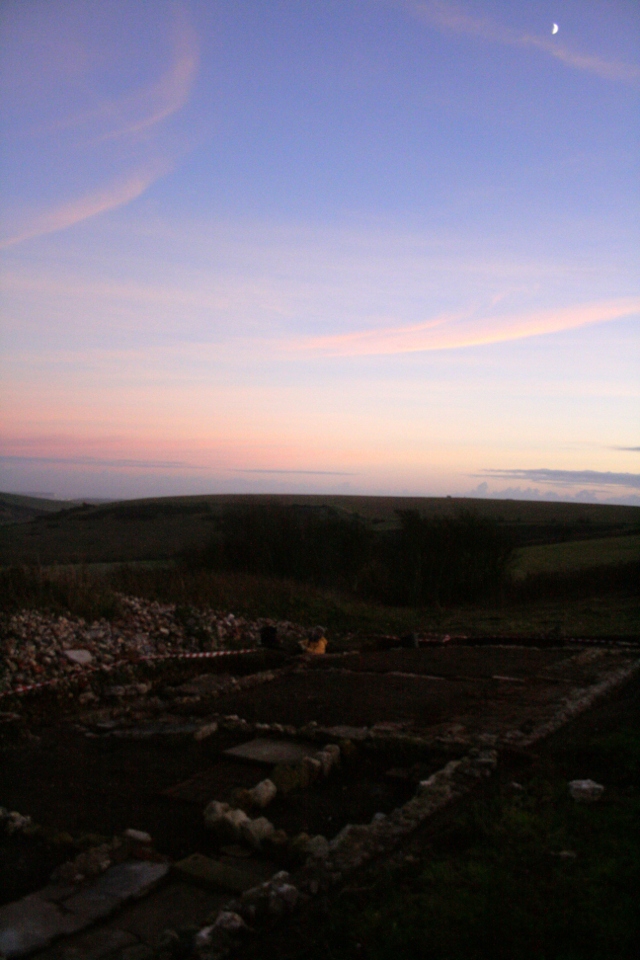
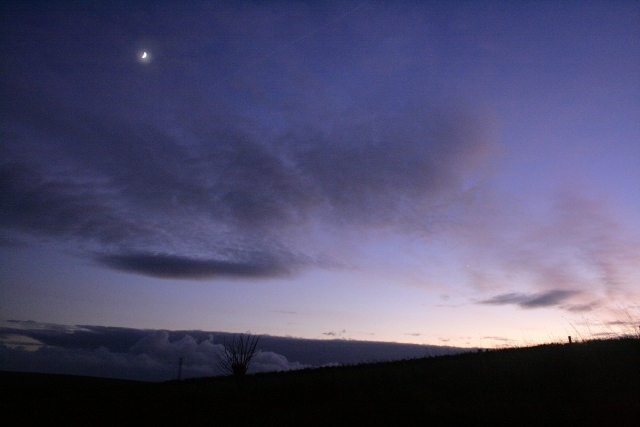
A sunny day, a squeaky clean site, some very nice finds, and a beautiful sunset – what more could we want!
Small fragment of painted wall plaster.Small fragments of painted wall plaster.
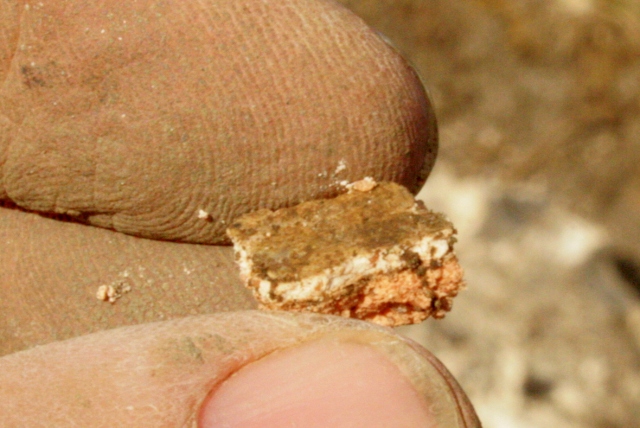
A big push was made to finish cleaning up the site, which resulted in our digging out a number of interesting finds. Shown above is part of a larger fragment of painted wall plaster, found in the surface of the path next to edging stones at the path’s edge between the front door and the outside toilet. The salmon pink underlying material had been previously found in a number of patches near the base of the demolition rubble fill in the area in front of the house. It was incredibly crumbly – it looked like it was dry powdered blancmange – if it is possible to imagine such a thing, am I showing my age?! It should be noted I know next to nothing about building materials or construction, and am just beginning to learn, at present, based on careful use of the Internet (though I have been on a 3 day course on lime mortar).
This find was almost certainly a fragment of an interior plaster/render either wall or ceiling. Is it possible that the open crumbly structure of the pink coloured material may have been because it used to contain organic materials? Certainly the ‘plaster’ of medieval wattle and daub, and its later replacement, lath and plaster, traditionally contained a range of organic materials such as cow dung, straw, and horse hair. Once the cottage was demolished these would have been exposed to the elements and started to decay, thus potentially leaving an open structure without any mechanical strength. This is something worth further investigation.
From cleaning out much of the soil from the gaps between the brick and stone paving outside the front door, ceramic, glass, metal and small bone shards were found. The best of these were;
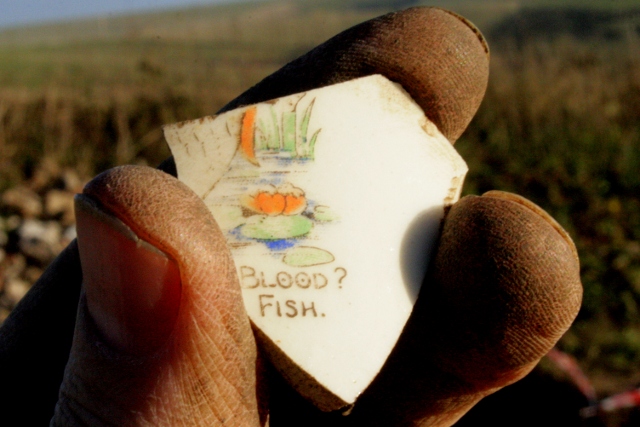
Shard of cup decorated with verse from ‘Who Killed Cock Robin’.
Parts of a child’s cup or mug found in August 2013.
The verse is from ‘Who Killed Cock Robin‘. An Internet search failed to find a published speculation about the possibility that this may, at some level, be a Christian allegory. There is a tradition that Robin Redbreast got his red breast from Christ’s wounds at his crucifixion. Another myth or legend is that the Holy Grail was a sacred vessel used to collect Jesus’ blood. And the fish or ichthys was an early Christian symbol of Christ’s resurrection. Thus, what we have found is not necessarily a gruesome verse, but intended to give a child a sense of right and wrong, and of life, death, and resurrection.
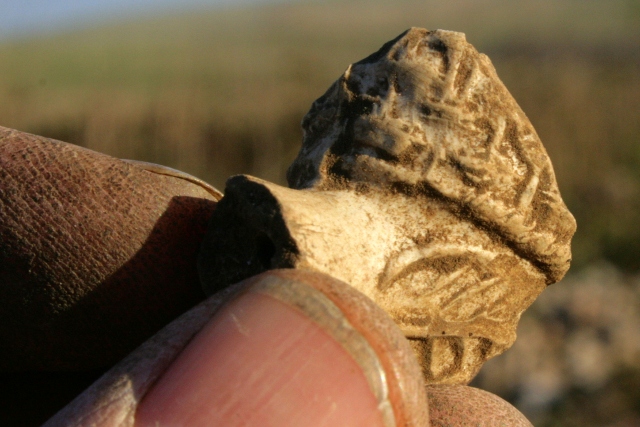
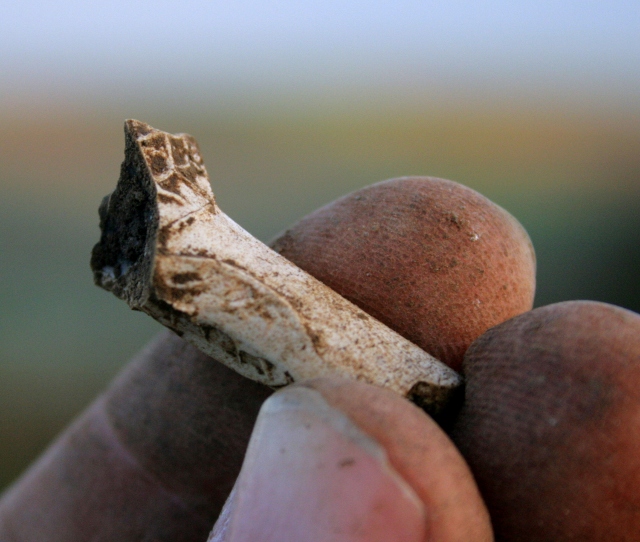
Decorated base of clay pipe bowl.
Also found was part of the base of the most highly decorated clay pipe bowl of the dig; it has a large leaf at its heel, and the upper part of the design may be of a basket weave design, but this is far from clear – further cleaning and examination may reveal more.
Looking N at cottage from S of ‘lean-to’ extension
Elsewhere the inner faces of the cottage walls were cleaned up. This involved digging a short distance down into the chalk rubble foundation of the floor. Finds have been particularly scarce in this context; interesting was another piece of (cow?) bone – a butchered piece of tibia(?). Previously similar such bone and a large base of a green bottle have been found from elsewhere in this context, suggesting the builders of the cottage threw away the remains of their dinners into the foundation trench.
Looking N at ‘lean-to’ extension to S of cottage.Looking N at possible in-situ brick and mortar structure S of SE corner of ‘lean-to’ extension.Looking W at possible in-situ brick and mortar structure S of SE corner of ‘lean-to’ extension.
On Friday, whilst cleaning the south side of the extension to the south of the cottage, a previously overlooked mortar structure was further examined, east of a potentially in-situ brick butting onto the remains of its wall. It now looks even more likely to be part of an in-situ structure. On the left hand side of the above photo – between the peg and the base of the top brick – can be seen what appears to be part of a salt-glazed stoneware drainage pipe. Could this have diverted rainwater to fill a water-tank, or to top up a well?
Looking SW at excavation of base of chimney.Looking SW at excavation of base of chimney.
Meanwhile, our effort to excavate down through the demolition rubble east of the chimney base also continued. And very nice finds were found from here as well;
Finds tray from excavation of demolition rubble from E of chimney base.
Large pieces of a pink and a white wash basin, seemingly identical to a large fragment found on the other side of the demolition rubble mound;
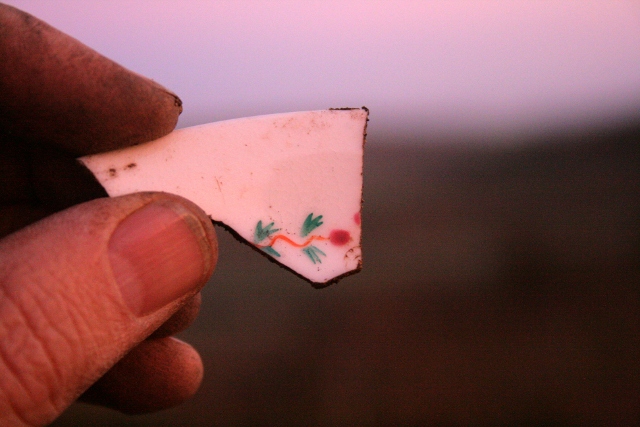
Ceramic shard, in late afternoon sun, from excavation of demolition rubble from E of chimney base.
Some nice decorated ceramics;
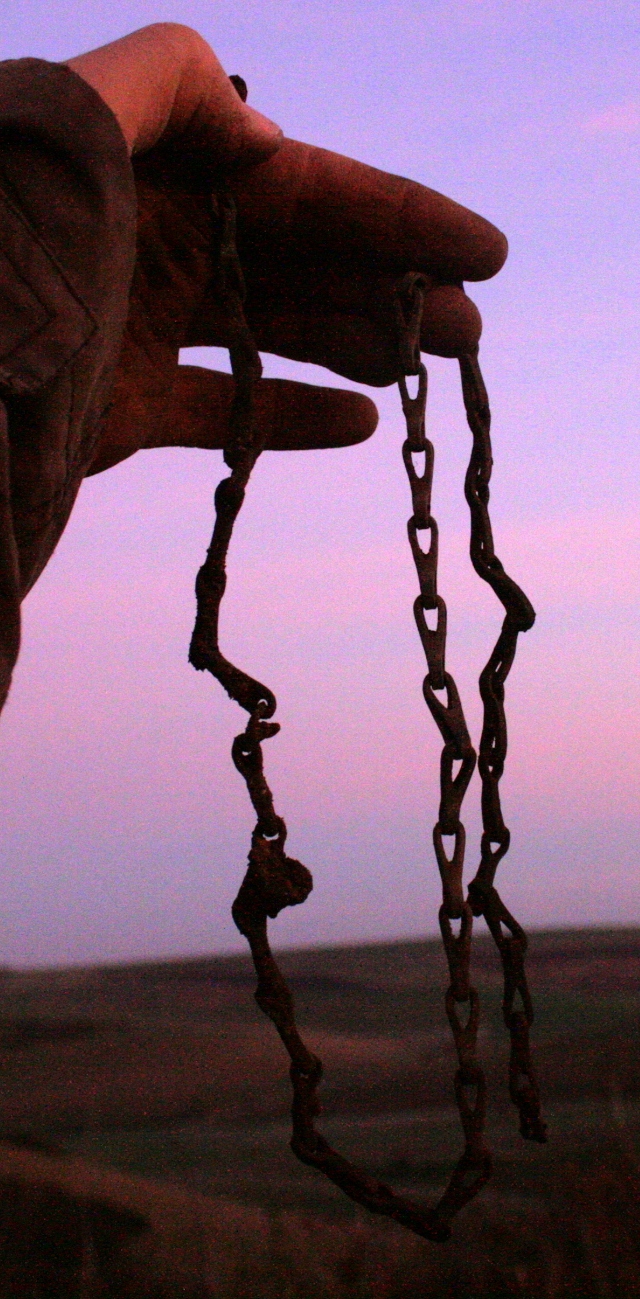
Copper alloy chain from excavation of demolition rubble from E of chimney base.
A copper alloy chain from which an object may have been hung – perhaps of about 5 kilos – was another nice find.
Now that the site has been cleaned our hi-res laser scan – courtesy of SeSurveying.co.uk – can now go ahead, though apparently it may not happen till the 23rd of this month.
How much we manage to excavate over the next four dig days, before we officially shut down for the winter on Sunday 22nd December, depends on how many volunteers brave the cold to help us dig (no experience required)! Excavation targets are;
the east side of the front garden gateway (ongoing);
the ground surface east of the chimney (ongoing, and which has revealed some beautiful finds); and,
the newly observed possible drain-pipe which may possibly lead to the long hoped for well or water-tank.
It should be noted that since this is a research excavation (not a treasure hunt), the main focus should not be on the (possible) pipe itself. It should focus on its relationship with any surrounding contexts; how does it relate to any demolition rubble which may be found – is it above it – is it either side of it – or is any demolition rubble to be found under it; are there any in-situ mortared or other built structures associated with it; what evidence is there for the original ground surface having survived intact – or has it been cut by the later bulldozer; does it sit under/in/on a dark garden soil – a more orange coloured sub-soil – or chalk rubble; and what is the extent of any of these fills on either side of it – is there any evidence of a trench dug in the ground in which the (possible) pipe may have been laid, and then back filled to bury it.
It clearly appears to be associated with the south side of the south-east corner of the lean-to ‘conservatory-like’ structure against the south wall of the cottage. The east side has already been excavated. If we have the people to do it, the trench on the south side of the ‘conservatory’ should, ideally, be extended southwards by about a metre to investigate at least part of this new feature. One of the reasons for this is that the other purpose of this dig is education – to learn about archaeology, and to share what we find. It is much easier to enable our visitors and volunteer diggers to understand what we have found when they can see how it relates to other structures. Which is why I ended up with an open area excavation, even though this was not my original plan. Therefore, whilst starting on new areas at this late stage of the dig would normally not be a good thing to do, to postpone resolving this new feature till next year – after the site has been backfilled – would make its visual interpretation so much more difficult, unless previously excavated areas are reopened. Not an easy decision – unless we get lots of new volunteers!
We meet at the car park near the junction of Bexhill Road and Falmer Road, just north of Woodingdean, Fridays & Sundays at 10am, and if the weather is too bad to dig we are still happy to give a quick tour for anyone interested. Please don’t hesitate to email me further info: scienceinthegreen@yahoo.co.uk
A beautiful (cold) sunny day and more cleaning of the site. However, a welcome visit from a volunteer digger we hadn’t seen for a while enabled some more of the flint cobbled surface of the path just beyond the front garden gateway to be excavated. Unfortunately, for various reasons, I did not take any photos – so I have used those taken on previous occassions.
Looking S at cobbled surface N of garden gateway with chalk rubble to right.
The cobbles had been very roughly laid, indicating rough repairs. A number of rusty metal, small decorated ceramic shards, some bone, and a few glass finds (one decorated) were found from the demolition fill and the path surface on which it sat.
Looking S at ‘shed’ and possible base of a ‘copper’ on E side of cottage.
The above photo clearly shows the roughly paved brick floor of the ‘shed’ on the east side of the house, and the possible base to a ‘laundry copper’ behind it. These structures were both further cleaned up. The possible copper was described following its discovery on 29th September. This enabled further consideration of the circumstantial evidence that the structure which was butted onto by the ‘shed’ was indeed a copper:
This structure is of about the right size
It is against the outside wall of the 19th century washhouse or scullery
Peter Mercer, in The Huns Mere Way, interviewed the last tenant of nearby Cambridgeshire Farm (formerly Hill Cottage) which was similar to Newmarket Farm but a smaller nineteenth century farm labourer’s cottage and barns; it had ‘a copper to which a tap was added later but was never used’
The shed, which butted against it was therefore built after it
However, the shed was probably contempary with the original building;
Its (mostly) brick cobbled floor was very badly laid with a fairly random selection of bricks, broken floor tiles, and stone blocks, at a level slightly below the original floor level, suggesting an original earth floor wore away and was replaced at later stage, and indicating that this structure was particularly old
A structure in this location has been drawn on all maps and plans dating back to its original construction
It has been recalled that the shed was an integral part of the frontage of the cottage, with the upstairs rooms under the gable fronted roof extending right across its top
Therefore shed doesn’t appear to be a later replacement of an earlier structure,
And thus, since the shed is likely to be original, this mystery structure is also likely to be contemporary with the original cottage,
Many early nineteenth century labourer’s cottages had laundry coppers
The Newmarket cottage was too far – a mile and a half and a steep climb – from the nearest alternative laundry facilities in the village of Kingston.
Also, no memory of any backdoor, no sign of an steps down to the ground surface about half a metre below it.
No proof, but a lot of evidence points towards its having been the base of a laundry copper for heating water.
Its construction appears to be a form of high quality bungaroosh, such as that of the walls of the cottage. Solid built flint wall faces with strengthening brick quoins at the corners, holding loosely bonded flints. The surviving bulldozer cut top was bonded with a lime mortar concrete, but there are one or two small holes in it through which unbonded, or poorly bonded flints can be seen. Both the wall of the shed and those of the base of the (probable) copper were one brick length wide, half a brick narrower than the cottage walls.
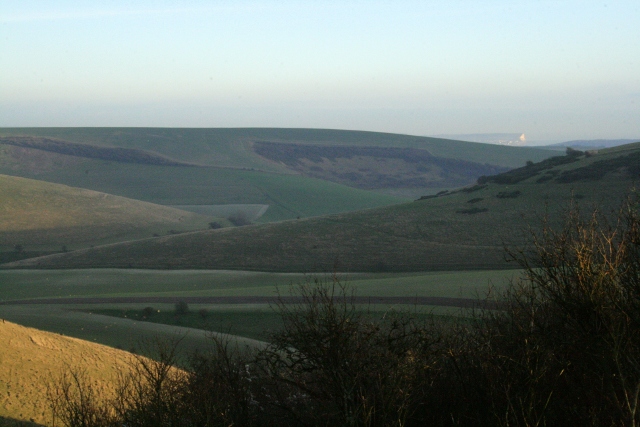
Looking SE at the base of the fireplace and Seaford Head beyond.Looking NW at SE corner of cottage.
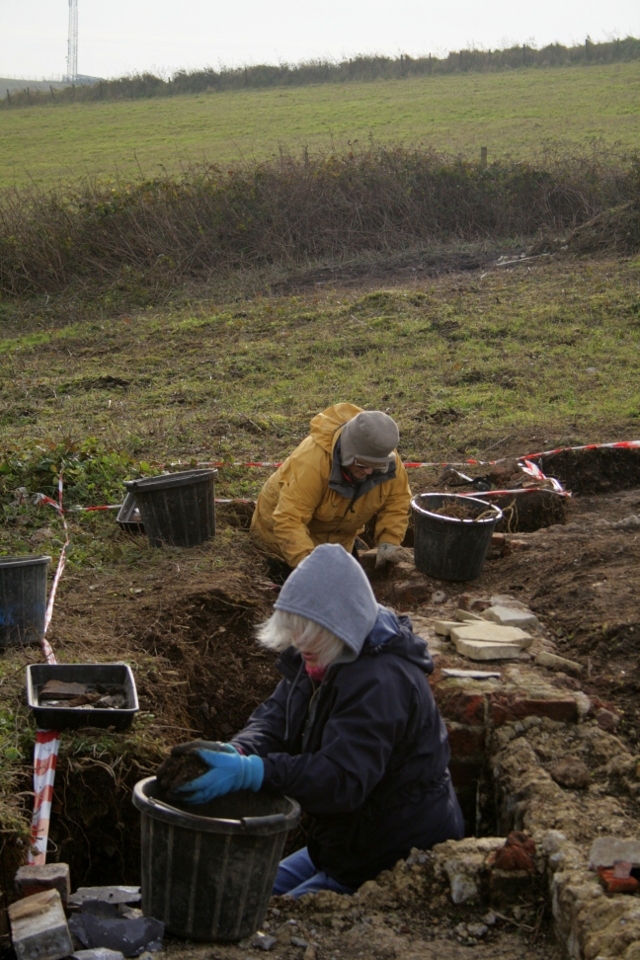
Sunday was another cold dry day, and the sun even popped out for a quick visit from behind the clouds! Some good digging was done in a very narrow slot along the southern half of the outside of the east side of the cottage. This was down through the demolition rubble fill to the original ground surface.
Looking N at E side of cottage.Looking W at WW2 ordnance damage to E wall of cottage
The demolition fill against the outside of the east wall of the cottage, between the base of the chimney breast and its south-east corner, was fully excavated. The full extent of the damaged section of the wall was revealed, and included a small crater in the ground surface matching that of the wall. Because the cut of the crater had a sharply defined boundary, and was entirely filled by powdered brick, mortar, and flint, this was almost certainly caused by second world war ordnance. However the type of ordnance used was not able to be determined for no shrapnel was found (or perhaps, but unlikely, found but not identified). Whilst a metal detector could be used to search for possible shrapnel targets, all other such ground surfaces contained a relatively high density of rusty nails and other metal – both ferrous and non-ferrous – objects, such that a metal detector is of little use.
Looking S at southern half of E side of cottage.Looking S at gap between bases of ‘laundry copper’ and chimney.Looking N at gap between bases of chimney and ‘laundry copper’.
The gap between the base of the laundry copper and the chimney breast had also been partially excavated. The intention, as with most of all the other areas dug, was to excavate down to the base of the demolition rubble layer. However, this has not always proved easy to do because both finds and small quantities of building material occured in the soil immediately below the upper context. Therefore the eastern half of the gap between the base of the laundry copper and the chimney breast, which had been partially excavated down below the demolition fill, was further cleaned up down to the bottom of this soil fill of the cottage’s foundation trench. This fill was of a relatively uncompacted dark soil, coloured by the relatively high concentration of charcoal, small fragments of both burnt and unburnt coal, and rusty nails which it contained. Therefore this area had probably been used as a dump for ash from the cottage fireplaces, and at least some of the wood burnt was that of almost certainly previously used timber. The burnt material was not deposited there by the later bulldozer, for it was under (not over, or in) the demolition fill.
Finds tray from E side of cottage, S of chimney.Finds tray from E side of cottage, N of chimney.
Finds, in the vicinity of the chimney, increasingly became similar to each other, with more coal, charcoal and rusty nails than elsewhere. They included:
Ceramic doll’s articulated leg;
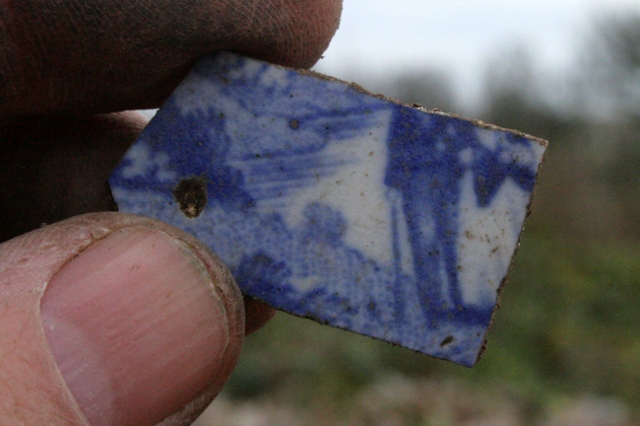
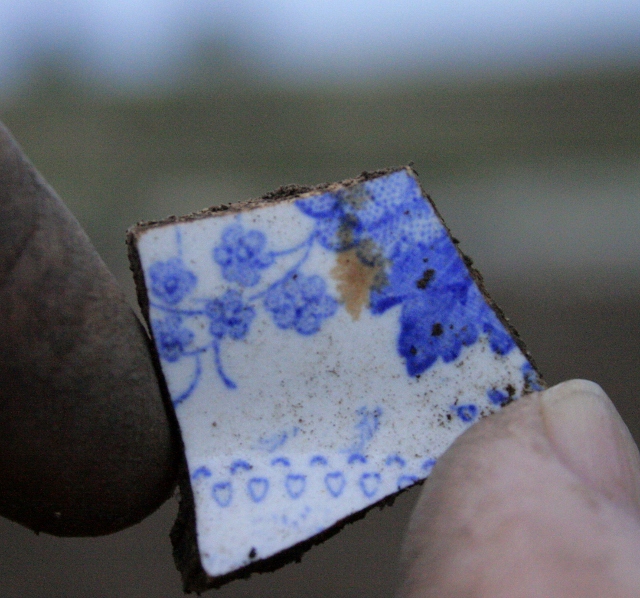
Blue and white ceramic shard of gentleman and lady in front of a pond or lake;
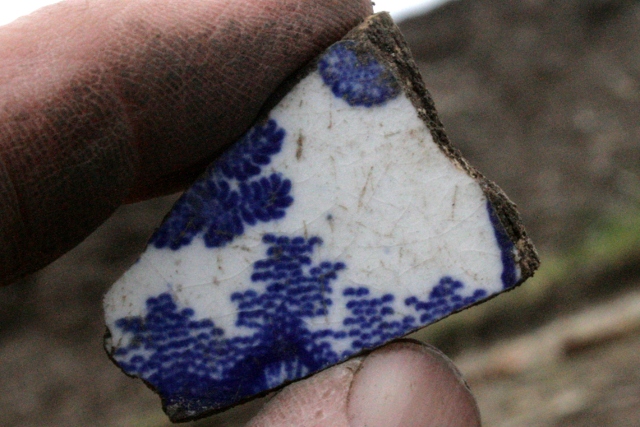
Blue and white decorated ceramic shard;
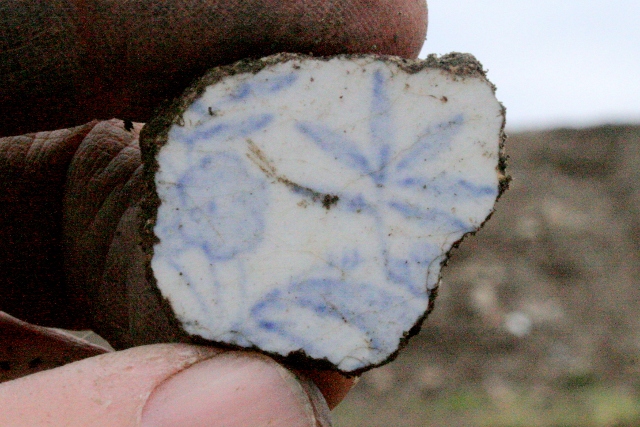
Light blue and white decorated ceramic shard;
Piece of lead (flashing?).
The doll’s leg matched that of an arm found a couple of metres to the north earlier in the dig. Relatively little glass was found, either window or bottle. Also, a lack of military finds was another big difference.
Our finds are clearly unevenly distributed across the site. I look forward to finds analysis after the dig – changes in what, where & when things were dumped can tell a lot about changing patterns of behaviour over time.
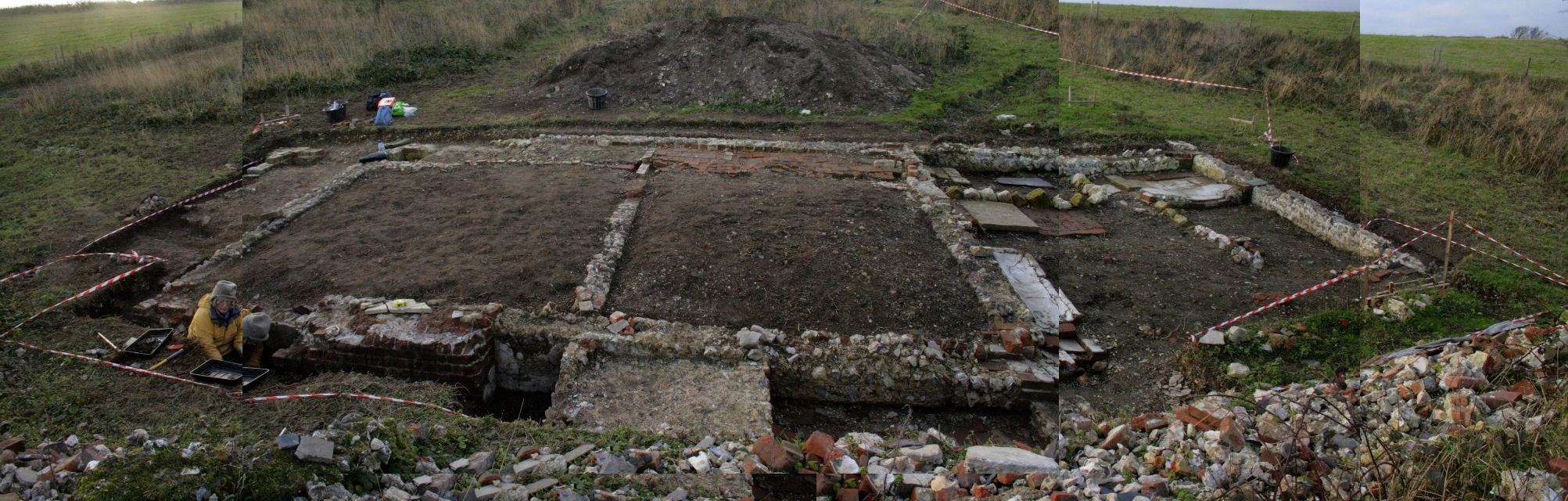
Panorama looking W at dig site; click for enlargement.Looking E from dig site.
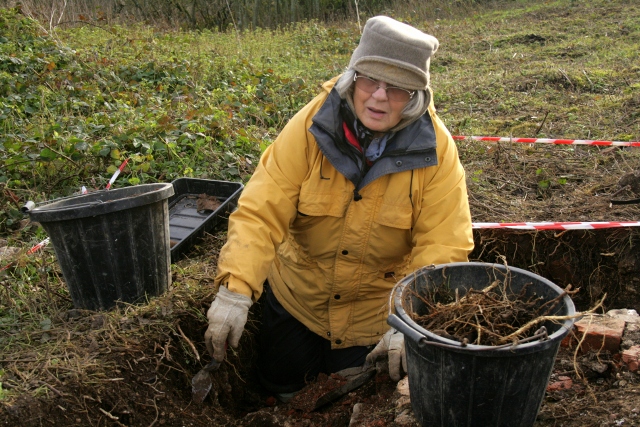
A hard days digging by the SE corner of the cottage.
A challenging but rewarding day’s dig. The winter has well and truly set in, and with it a pressure to finish off our excavation of the cottage site before we have to shut the dig down.
Looking S at E side of the cottage.
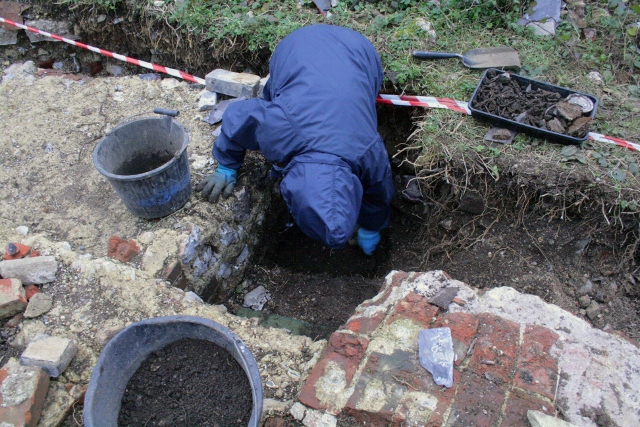
Our volunteers were therefore hard at it in the deepest of our trenches; narrow slots down through difficult demolition rubble hard up against the southern half of the east side of the cottage, just wide enough to dig in, with the intention of discovering the depth and nature of the original ground surface.
Looking NE at gap between bases of laundry copper and chimney.
The good news was that finds were plentiful. The bad news was that the majority of these were rusty nails – almost half a bucket full! In the gap between the base of the laundry copper and the chimney breast it appears that a fire burnt a quantity of wood, which may have been the source of the nails; perhaps timbers taken from the cottage’s demolished remains.
Ceramic finds were very nice though. Some nice decorated ceramic shards of mocha ware, blue and white, and other nice pieces.
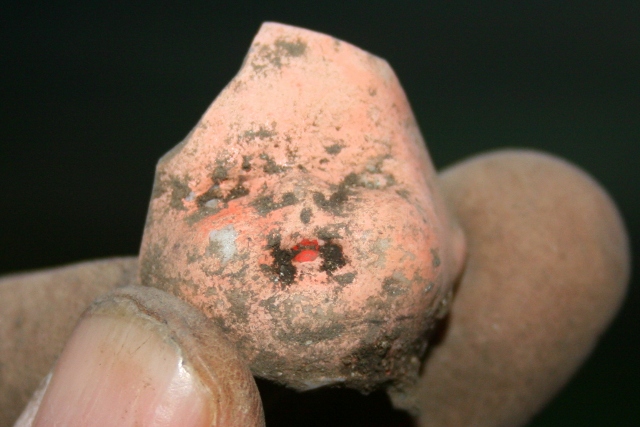
Cherubic face of ceramic doll.
The very best of these was the cherubic face of a small doll.
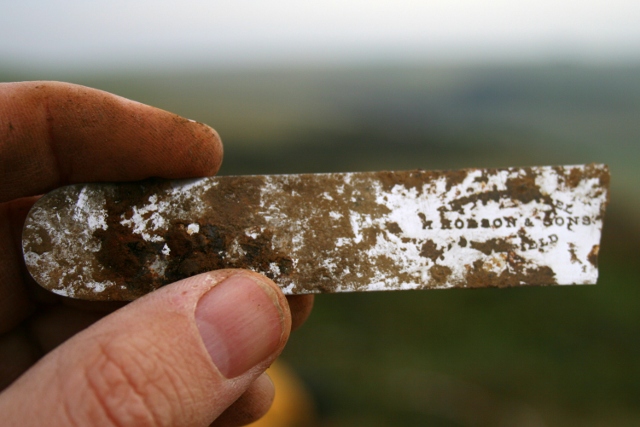
Rustless (stainless) steel desert knife by H. Hobson & Sons, SheffieldRustless (stainless) steel desert knife by H. Hobson & Sons, Sheffield.
The best metal find was the ‘rustless steel’ blade of a desert(?) knife by H. Hobson & Sons, Sheffield. This dates the blade to shortly after 1913, when stainless steel was first invented but before this name had been invented or fully adopted. This almost certainly puts it into the ownership of the Moon family, resident from at least 1911-1920.
A cold mostly dry bright day, but for those well dressed for the weather, some good digging was to be had.
Looking E at S end of cottage from inside ‘lean-to’ extension.
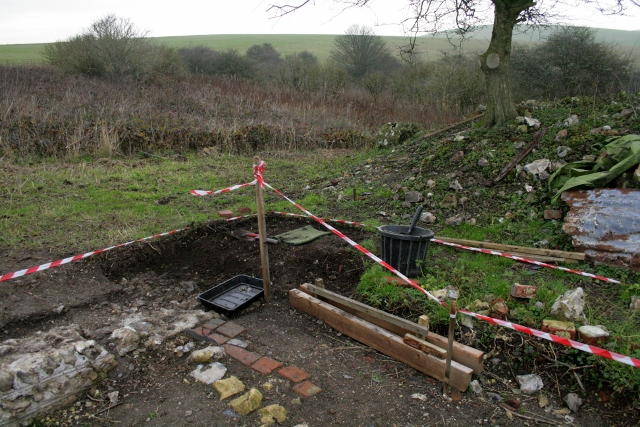
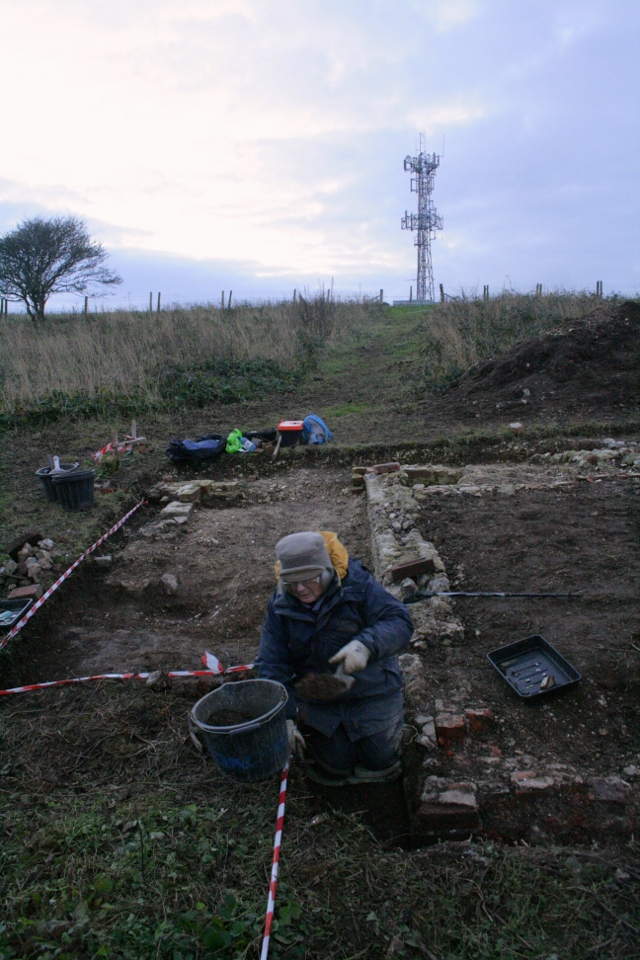
To the south of the cottage, a 2x2m area to the east of the later extension was the main area excavated. This area had been almost completely excavated previous to our guided tour a few weeks ago. My original intention was just to excavate down through the topsoil and demolition rubble to the original ground surface. This has not proved easy, for this surface was uneven, with patches of building rubble from the building of the extension mixed in with a very much more compacted, orange brown clayey sub-soil. This sub-soil fill contained many finds, so the temptation to dig down into this lower level was great! So, to clean up the trench, the most heavily dug western part was fully excavated down to where all signs of building materials or occupation debris disappeared. The partially dug eastern part was only excavated down to the base of the demolition rubble fill. The absence of a garden loam soil (such as that found in the garden areas north and east of the front garden path) indicates this area may have been a yard surface such as that found across the front of the house bounded by the front garden path and the front of the house. However, it cannot entirely be ruled out that the 1950 bulldozer may have cut any evidence of a possible garden fill. The expected demolition fill from the 1942-1945 WW2 ordnance was particularly shallow, and finds such as window glass shards were particluarly found in isolated pockets. Nevertheless, it was far deeper and far more plentiful than that over the lean-to extension to its west. The bulldozer clearly went deeper here than elsewhere, but I believe the balance of the evidence is that this area was used as a yard (perhaps covered by roughly maintained grass) and not garden. Since it was to the south of the cottage; perhaps it was used for drying laundry, for a washing line.
Finds tray from 2x2m grid sq S of cottage E of extension.
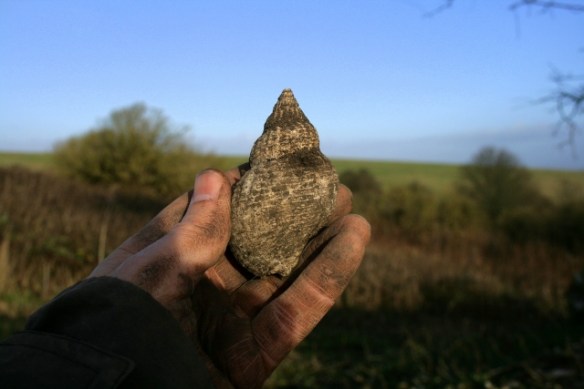
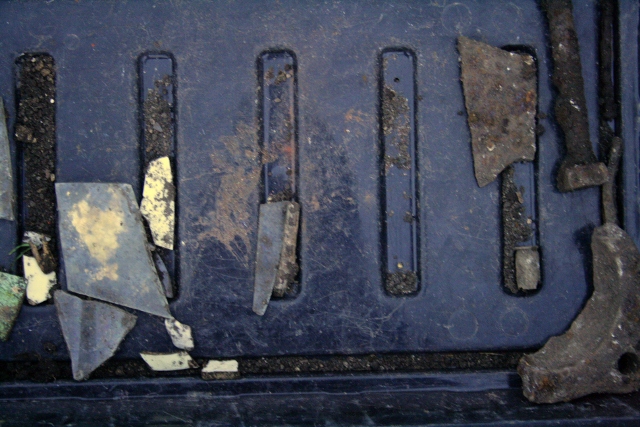
Finds from the area excavated were fairly plentiful and varied. Just a few hand forged nails and a thin metal strip represented the metal finds. A limpet and a part of a scallop accounted for the shellfish finds – which have been rarely found. A wide range of ceramic shards included some yellow-brown salt-glazed stoneware, and some clay pipe stem shards, as well as;
a couple of chunky pieces of dark cyan (teal green) modern designed cylindrical mug(?) large pieces of which were previously found both sides of the cottage including part of its handle – its curvature was about the same as a pint-sized coffee mug I own, but the fragments are taller, so based on an internet search, the best match so far was a very ‘modern’ 1920’s 2 pint mug.
Shards of an ‘aesthetic movement’ design plate (same design as large pieces found the previous Friday).
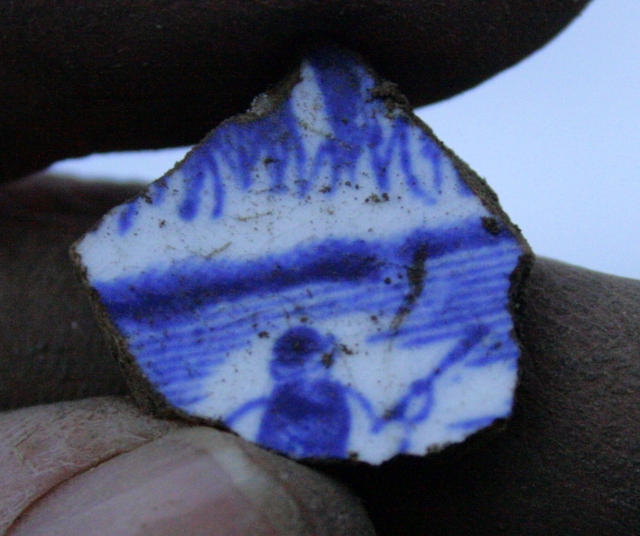
Blue and white ceramic shard.
Blue and white ceramic shard.
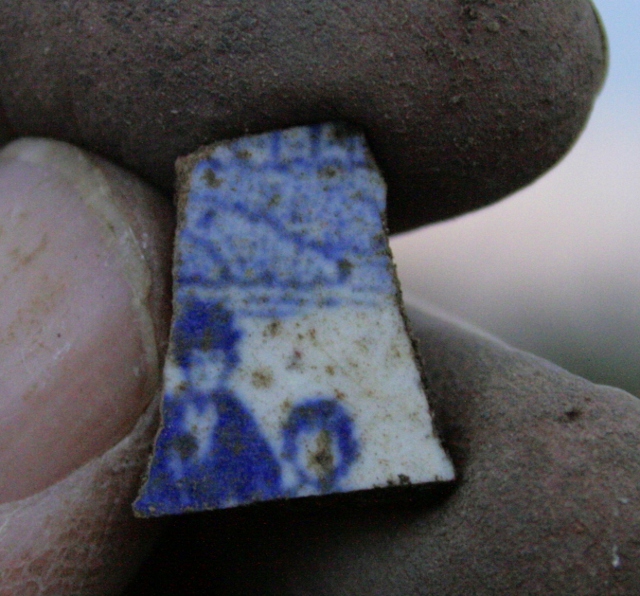
Blue and white ceramic; decoration with image of fisherman?
Blue and white ceramic; decorated with image of 2 figures.
Brown and white mocha ware shard.
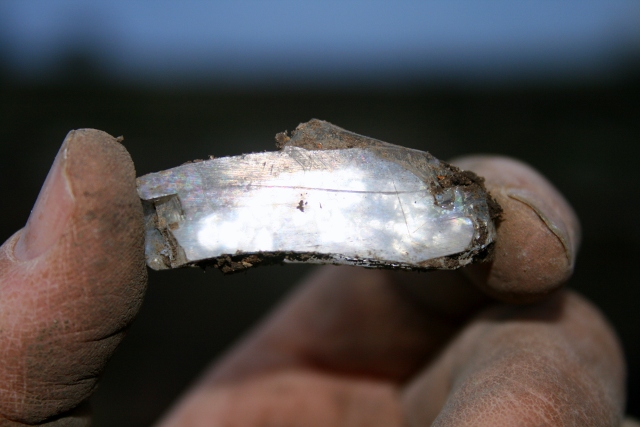
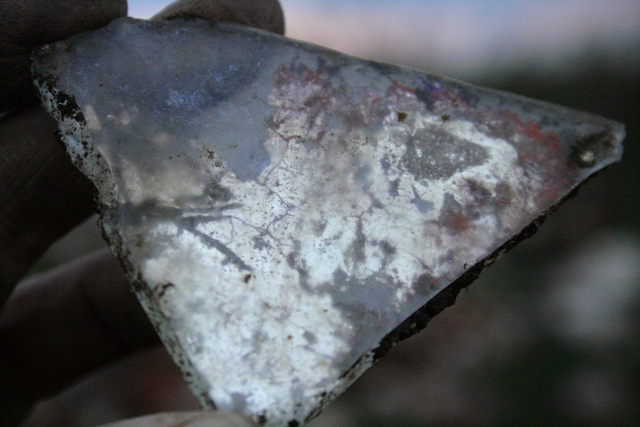
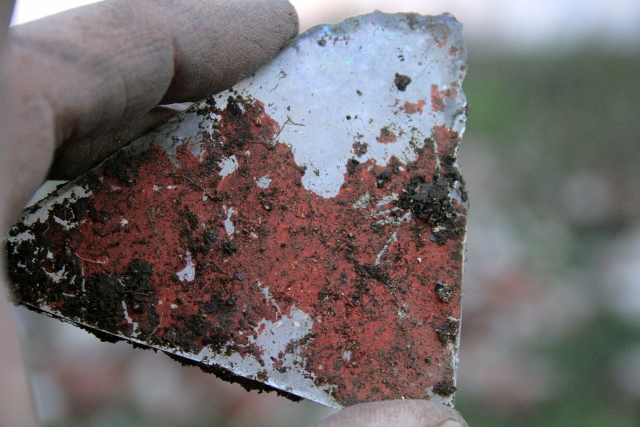
Glass shards included a variety of bottle, window (the window glass from the lower context was exclusively of the thinner, older, type), and mirror glass;
Thick glass shard of a mirror (photo with flash).
Mirror glass showing decaying silvering at back.
Reverse of mirror showing outer surface of anti-corrosion red-lead paint over reflective silver metal.
Also found were a few fragments of bone.
Looking W at S end of cottage.
Further work was also done cleaning up previously excavated structures ready for a laser scan sometime soon.
The west wall of the cottage was cleaned up sufficient to outline at least the top of its outer face.
Looking S at cobbled surface N of garden gateway with chalk rubble to right.Looking S at cobbled surface N of garden gateway with brick paving on W path edge to S.Looking S at W side of garden gateway and N side of N boundary wall.Looking S at W side of garden gateway and N side of N boundary wall
Last week’s excavation and cleaning of the western half of the front garden gateway and north boundary wall was also now recorded photographically; we hadn’t managed to do so previously because of rain.
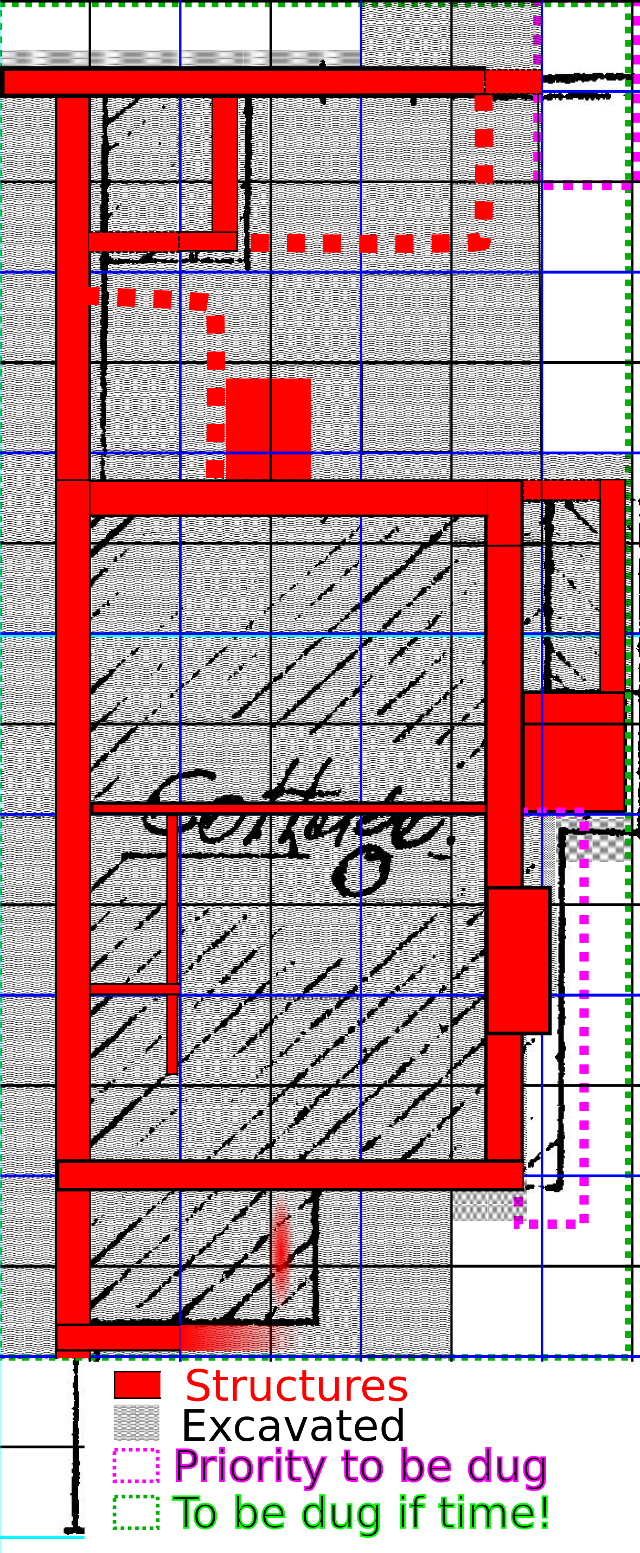
Looking S at E side of cottage.Looking N at E side of cottage.Looking N at E side of cottage (brickwork bottom left is the base of the chimney breast.Newmarket Farm Dig – end Nov 2013; (structures shown are only approximate +/- 20cm). Base plan from East Sussex Record Office.
Also measured out was an ambitious extension to the area already excavated. This would square off the area already dug to encompass an area of 7 metres by 15 metres (of which a little over 90 square metres have already been dug):
Starting from the south-west corner of the cottage extension, 15 metres northwards, 1 metre west of the inside of the west wall of the cottage to 1 metre north of the inside edge of the north-west corner of the front garden boundary wall (this has been already excavated);
then 7 metres eastwards to take in the far side of the garden gateway;
then southwards encompassing the east side of the front garden path (a 4x1m area which has not yet been excavated – there is a memory of possible steps up to the shed which it would be nice to find if we can), continuing along the just about fully excavated outside of the wood-shed and laundry copper foundation on the east side of the cottage (hard up against the base of the demolition rubble mound), then fully excavating the partially excavated original ground surface beyond, down the side the outside of the chimney, down to 1 metre east of the south-east corner of the cottage (an unexcavated area of about 3 or 4 square metres);
and back round the southern end of the cottage, a little under 2 metres south from the outer face of the south wall of the cottage (an area which has now been completely excavated apart from the very far south-east corner of this area; since no features are expected in this latter area, the southern most 1.5 metres of this corner will be left till last).
The purpose of this trench extension would be to better facilitate a complete reconstruction of the cottage, and especially its immediately associated features, which we hope to base on a laser scan by SeSurveying. I really hope we will manage at least 4 more square metres (about 4 more days digging – a minimum of two more weeks):
The 2 square metres north and south of the east side of the garden gateway which would resolve the width of the main entrance-way to the domestic part of the property;
and the narrowest possible trench extension, about 0.5 metres wide and 4 metres long, down the southern half of the east side of the cottage to discover the depth of the original ground surface and to completely clean up the base of the last (only partially excavated) section of the cottage walls).
Looking SW at extension at S end of cottage.Looking SW at excavation of area E of extension, S of cottage.
The trench across the western 2/3rd of the area to the south of the cottage, started before the guided tour, was further excavated. In particular, this was most of the area immediately to the east of the remains of the ~1880 lean-to extension.
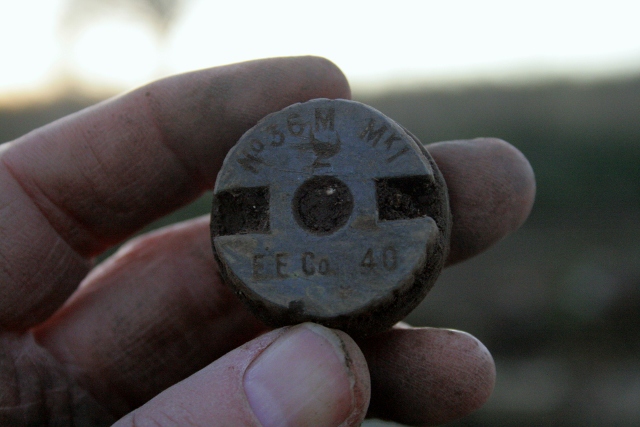
Screw threaded base of a 36M Mills Bomb
The solid zinc screw base of a mark 1, No 36M ‘mills bomb’ (hand grenade) found was yet more evidence of the WW2 training which was responsible for the complete destruction of the cottage, barns and perimeter walls during the latter half of the war.
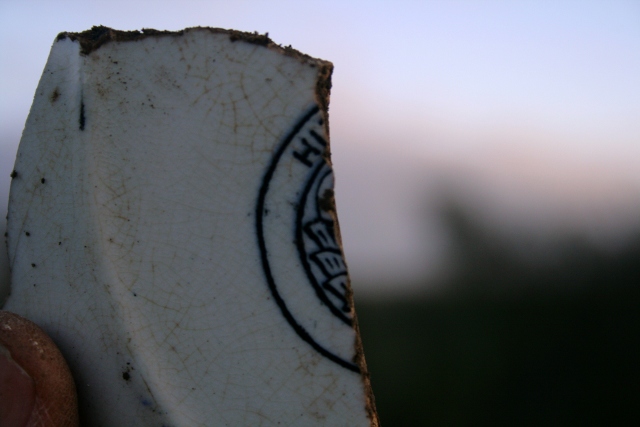
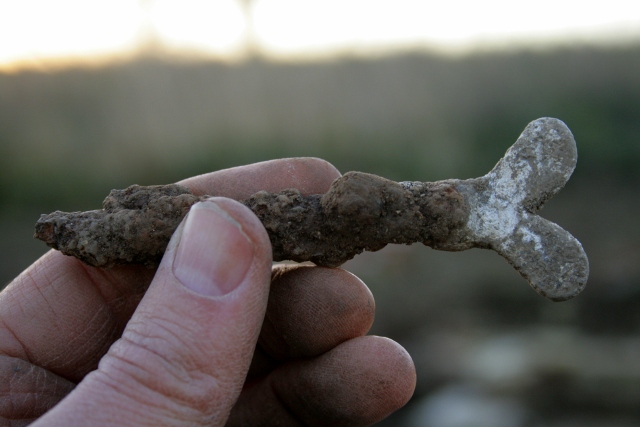
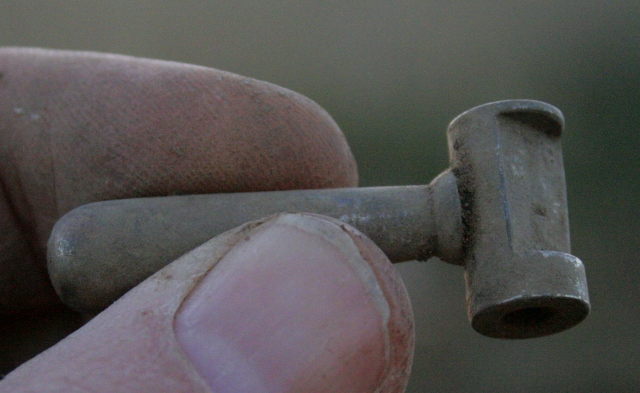
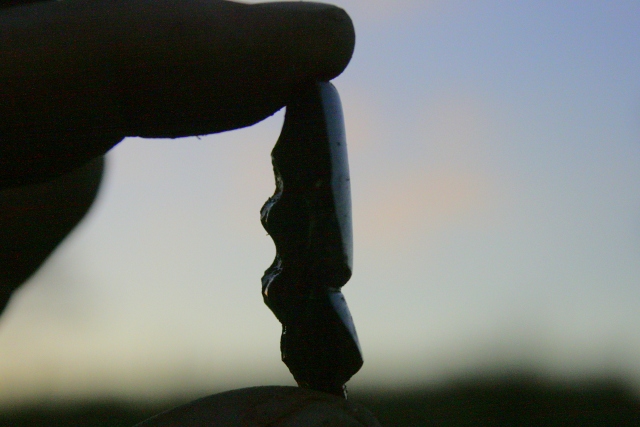
Part of pottery mark for ‘aesthetic movement’ plate.Shards of the ‘aesthetic movement’ design plate.Decorated clay pipe stem fragment.Decorated ceramic shard.An unidentified ‘key’.Mystery brass? object.Broken top of a bottle with internal screw thread on left hand side for rubber stopper
Some amazing finds had previously been excavated from this area, but whilst nothing exceptional was found today, some very nice ceramic shards and intriguing metal objects were excavated.
Just discovered some interesting and potentially useful courses for those doing historical research – and some are free! They are run by the Institute of Historical Research, which is part of the University of London.
They have a couple of courses which would be particularly useful to me;
As with any big research project – and my interest in the area encompassed by Newmarket Hill, Castle Hill NNR and the Balsdean Valley has become just that – a huge amount of information from a wide range of sources has, and will be, collected, and it is particularly challenging trying to keep track of it all. Recording all that information in ways that enable it to be easily accessible to a wide range of people is time consuming. So much quicker and easier to just scribble down rough notes in the short term, but a waste of time in the long term if they get lost, or I can’t easily find and keep track of them all! These courses are likely to be of a great help to people like me.