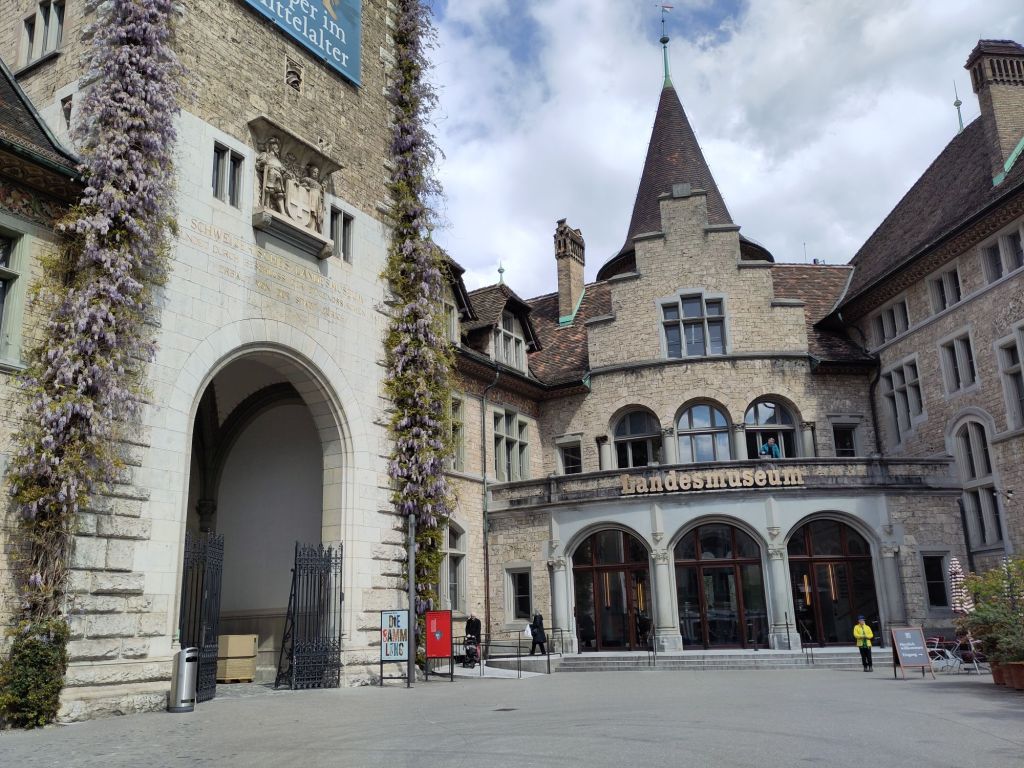
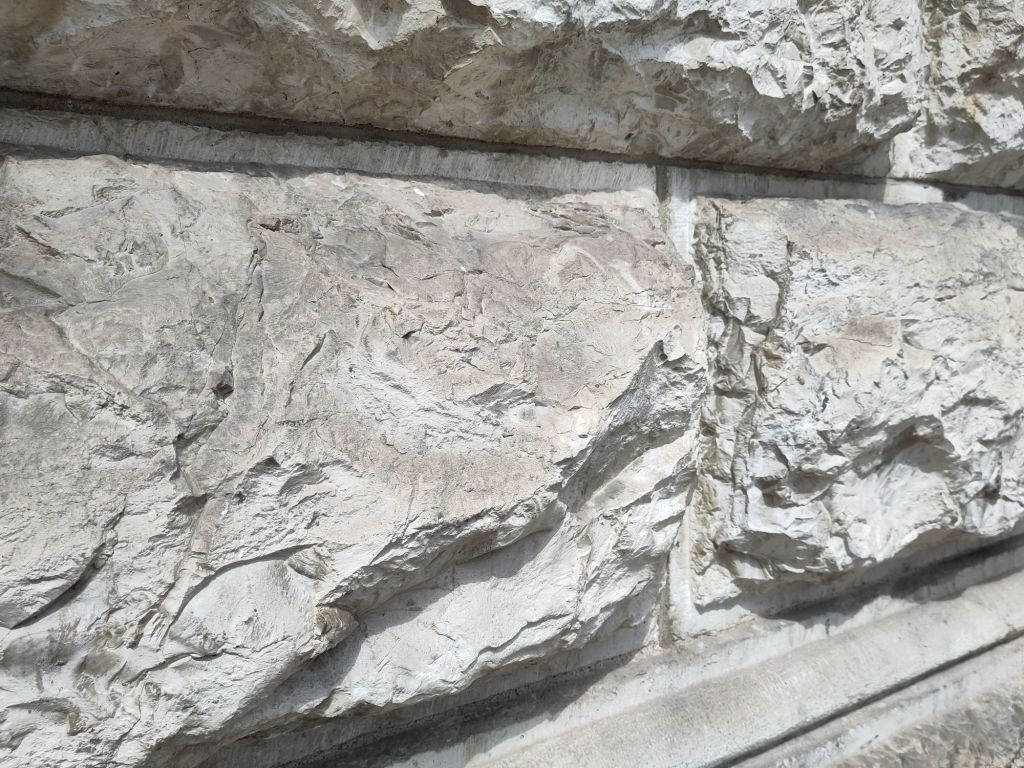
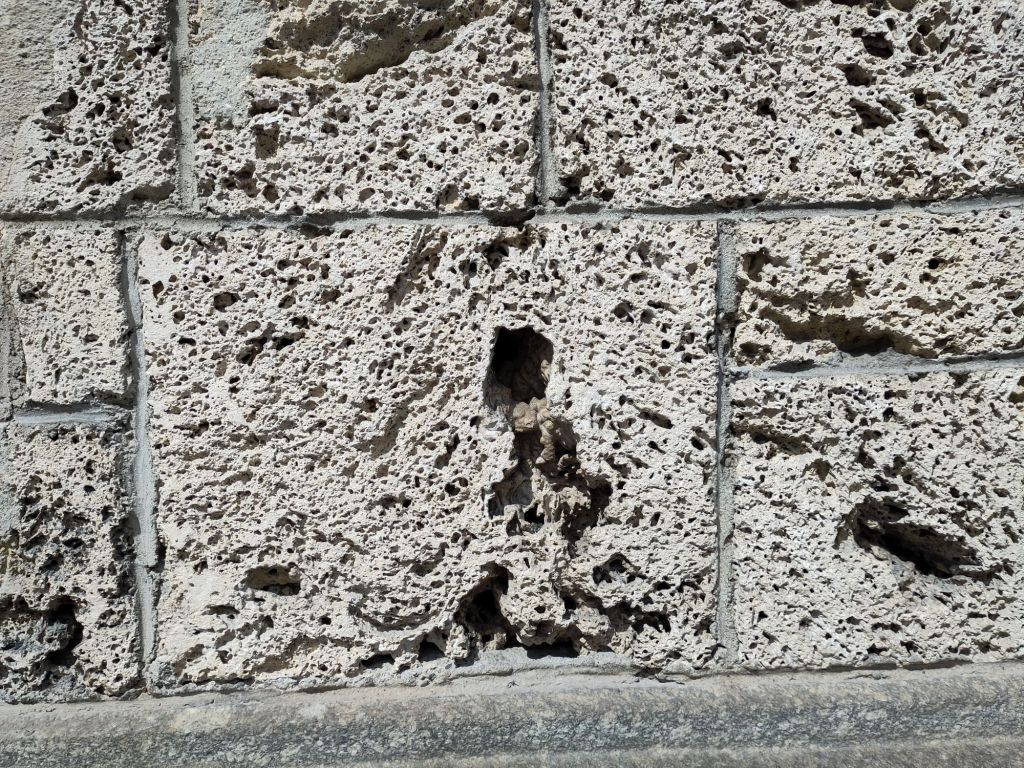
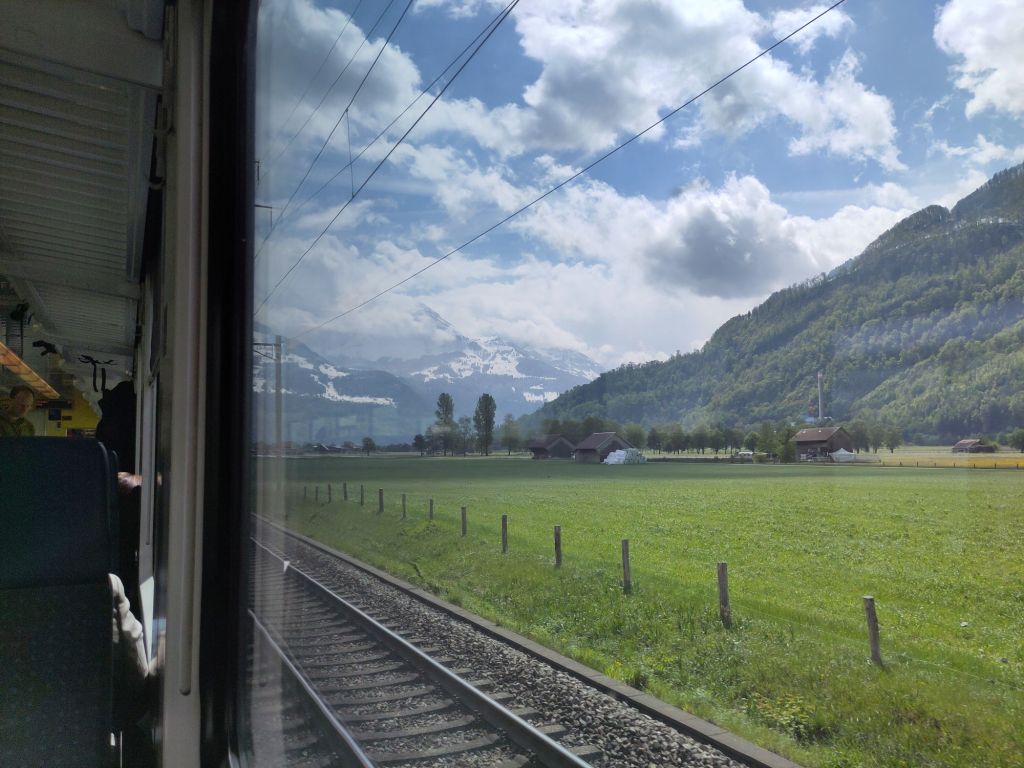
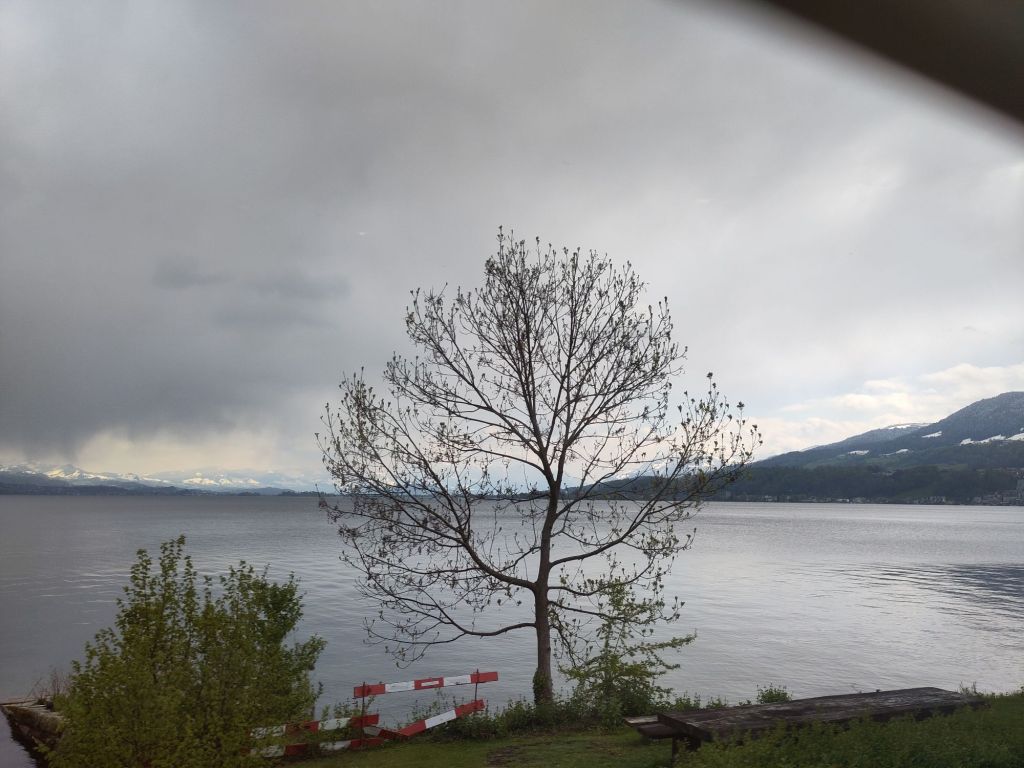
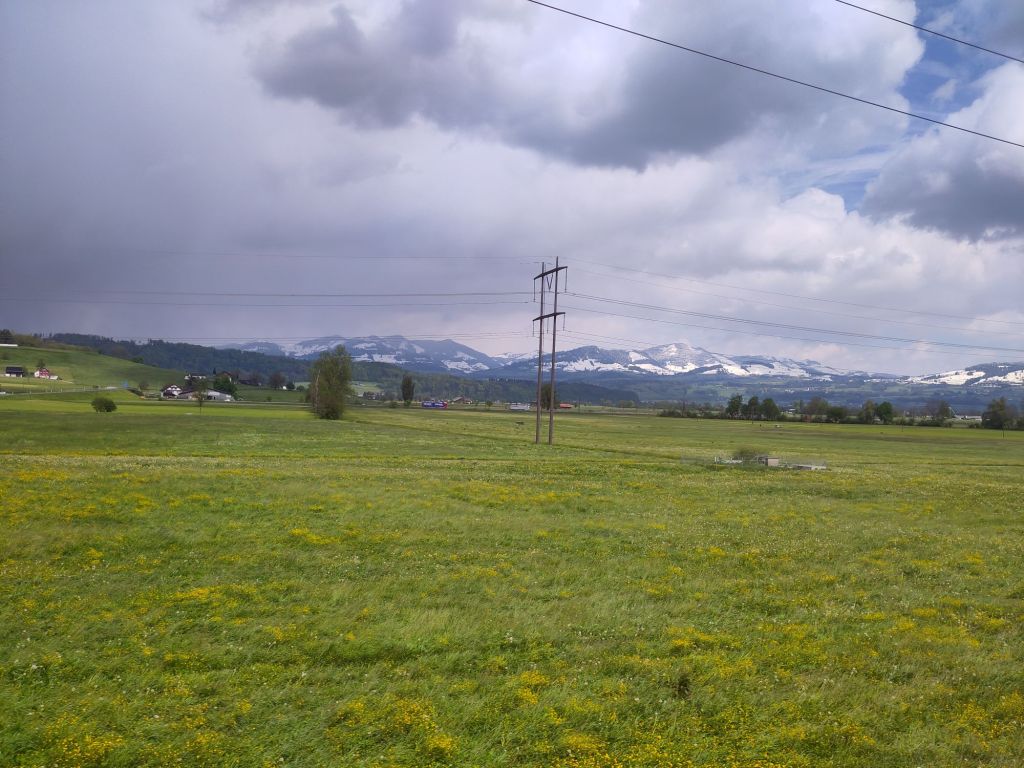
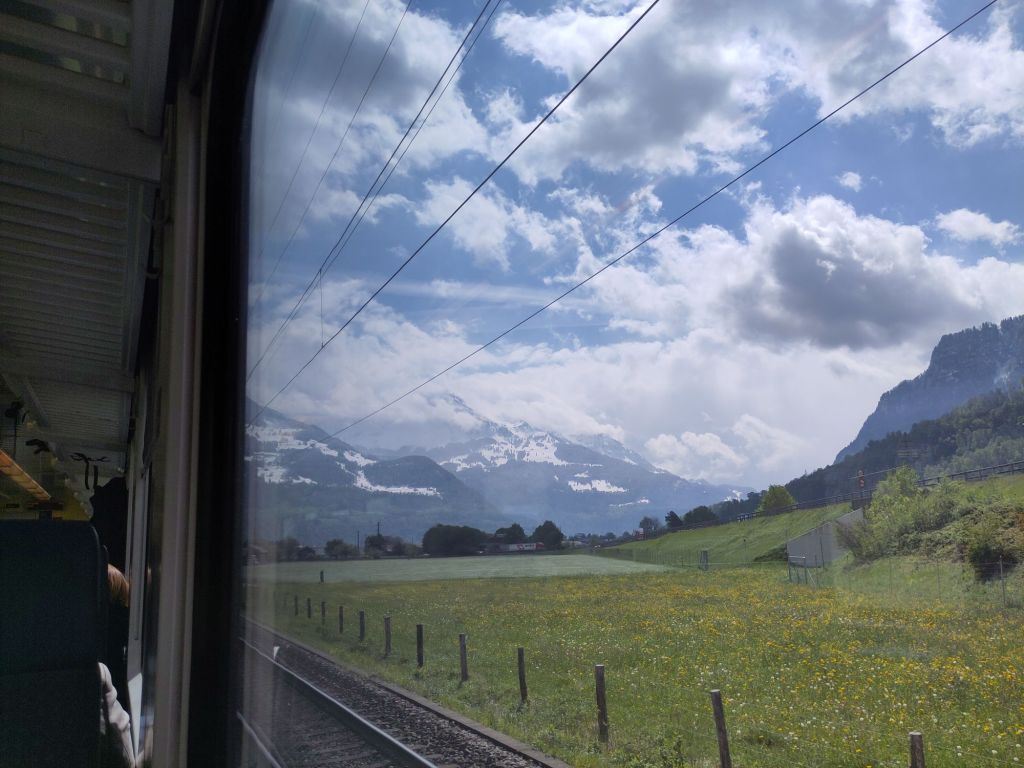
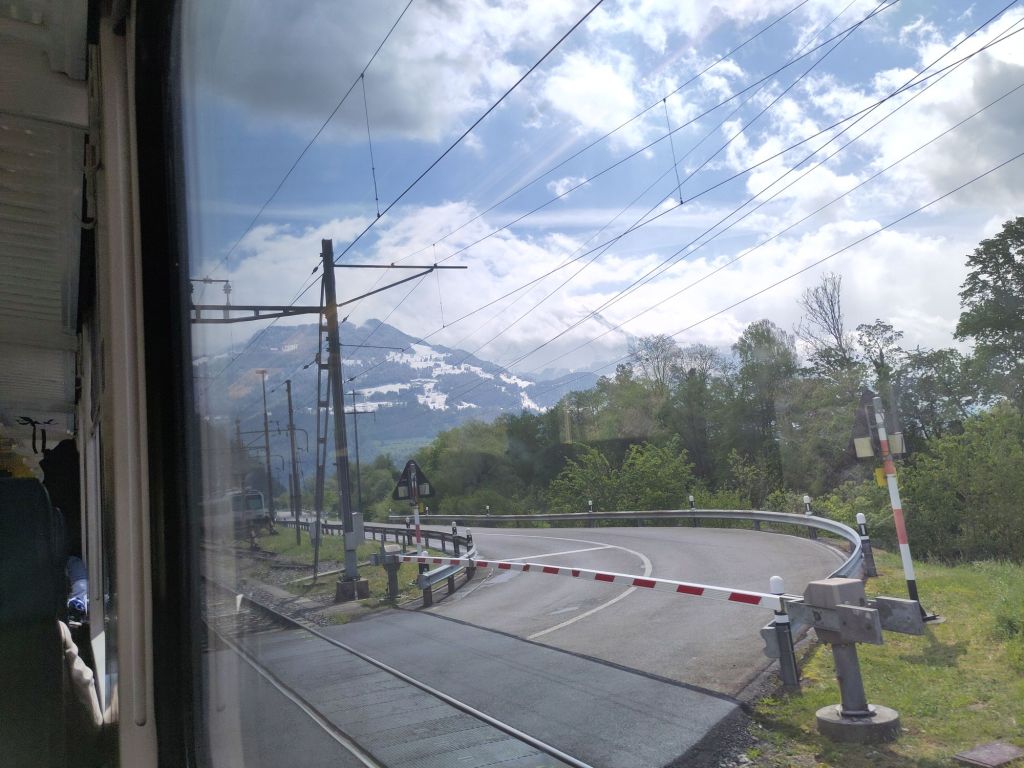
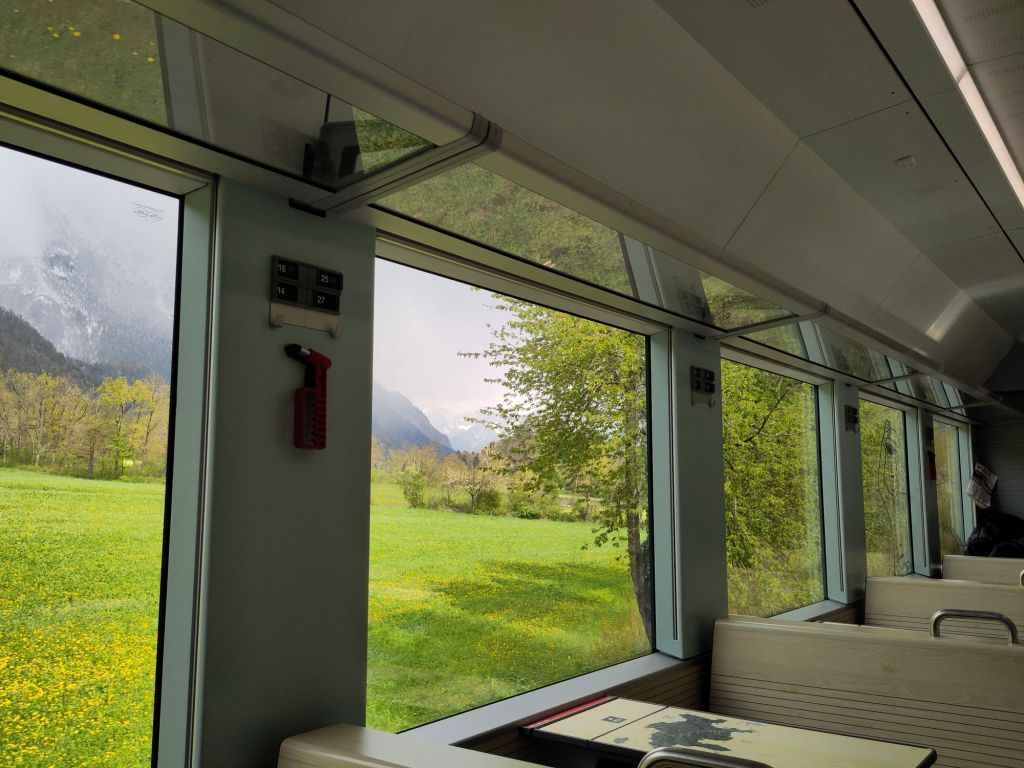
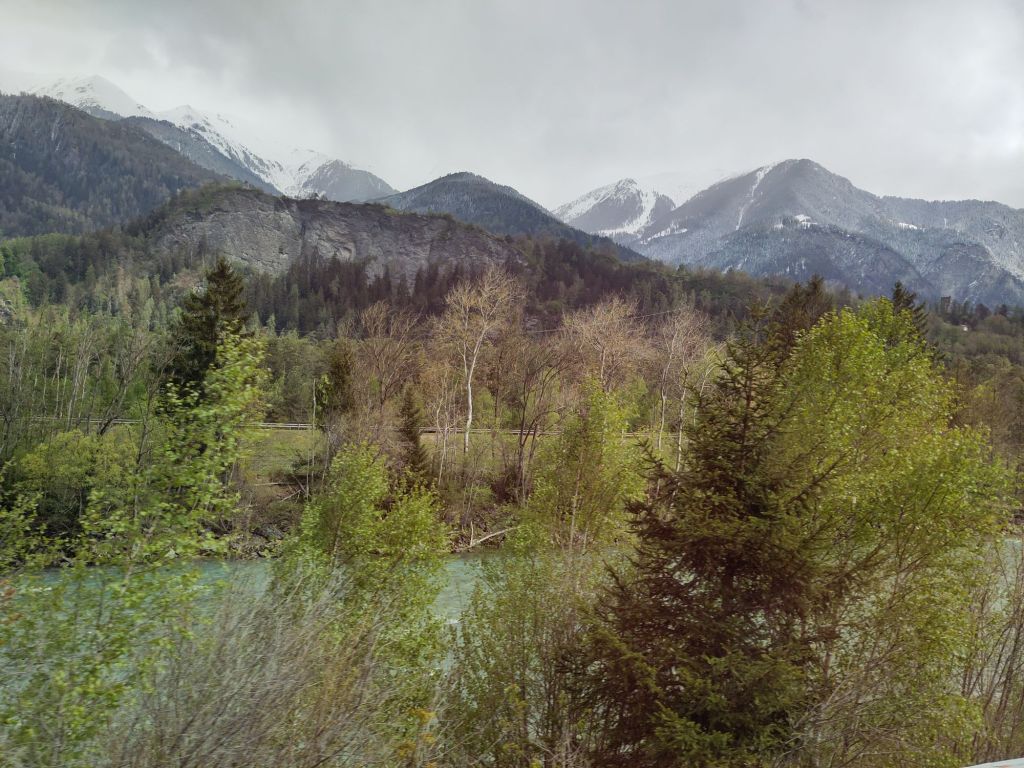
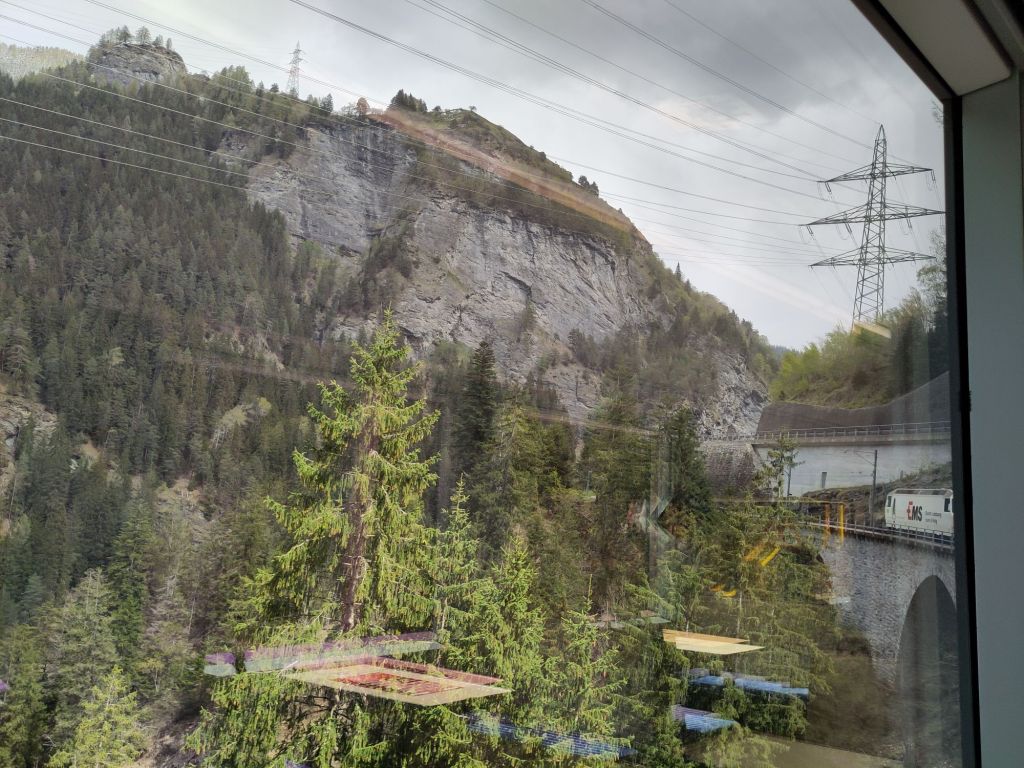
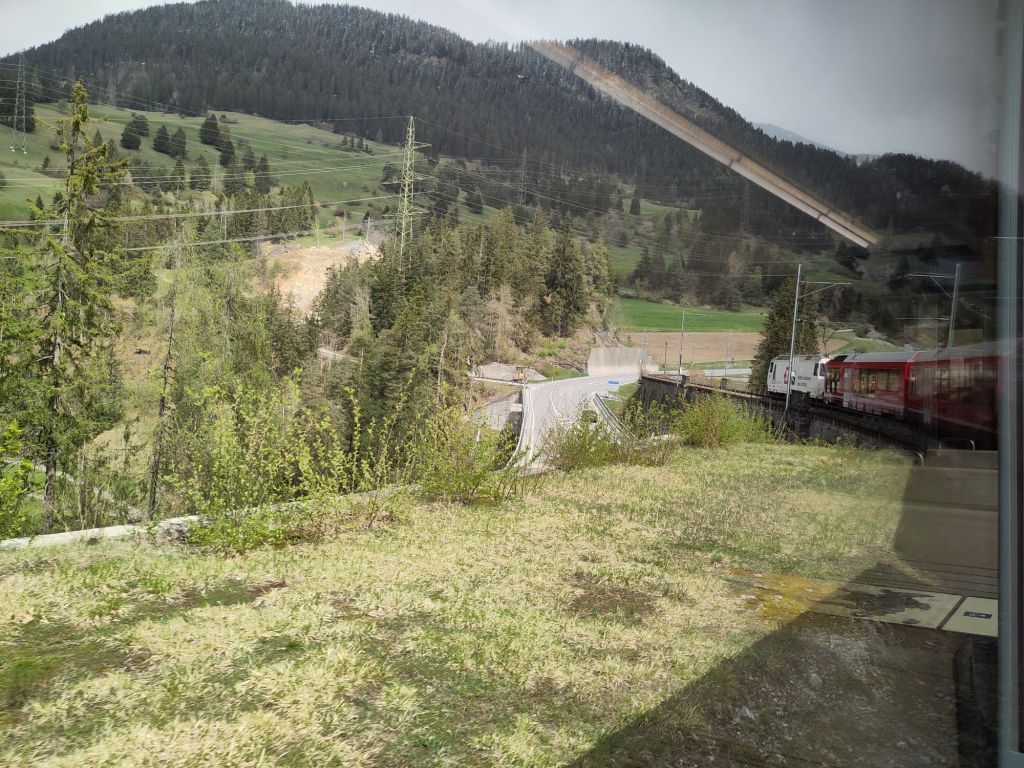
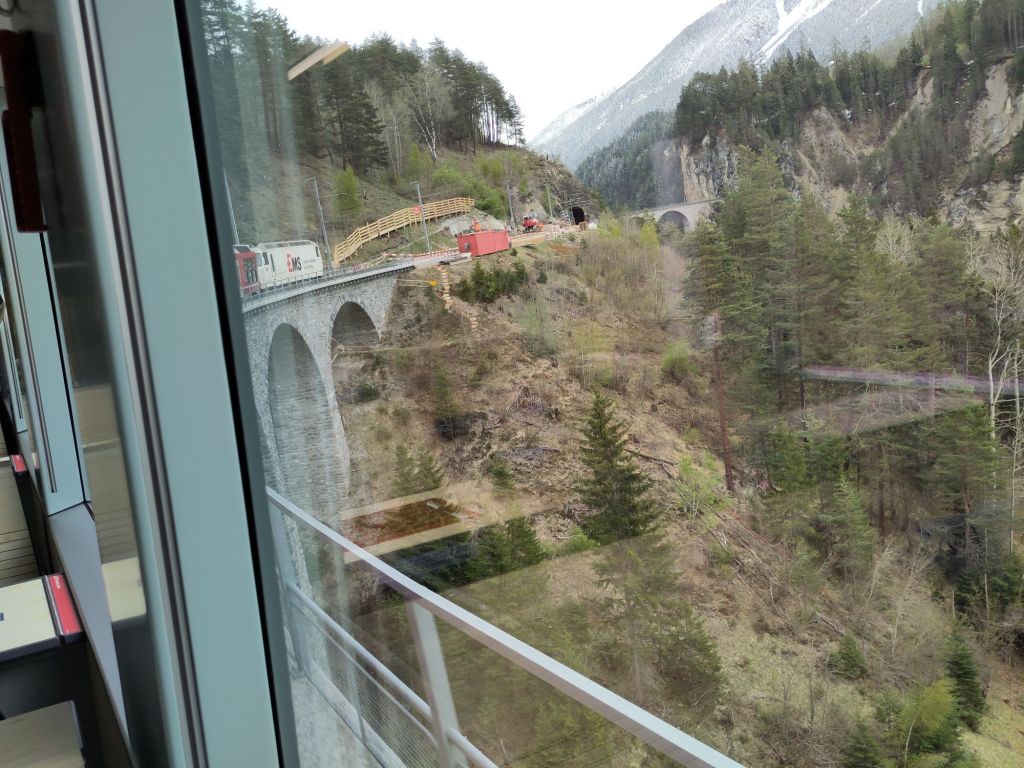
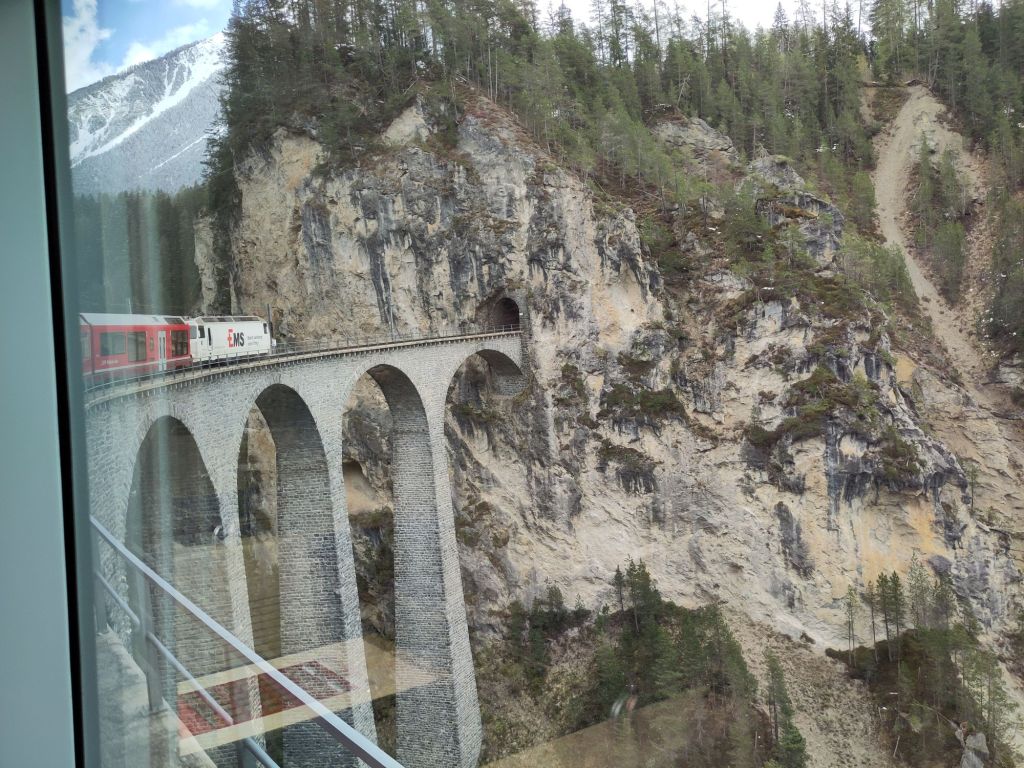
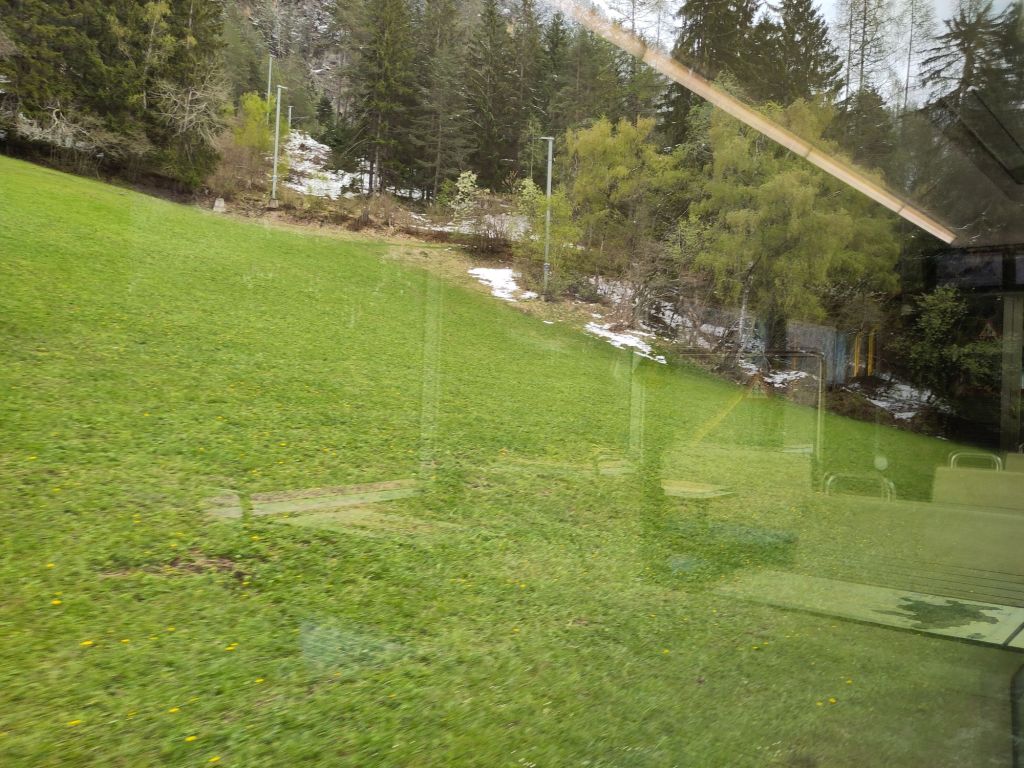
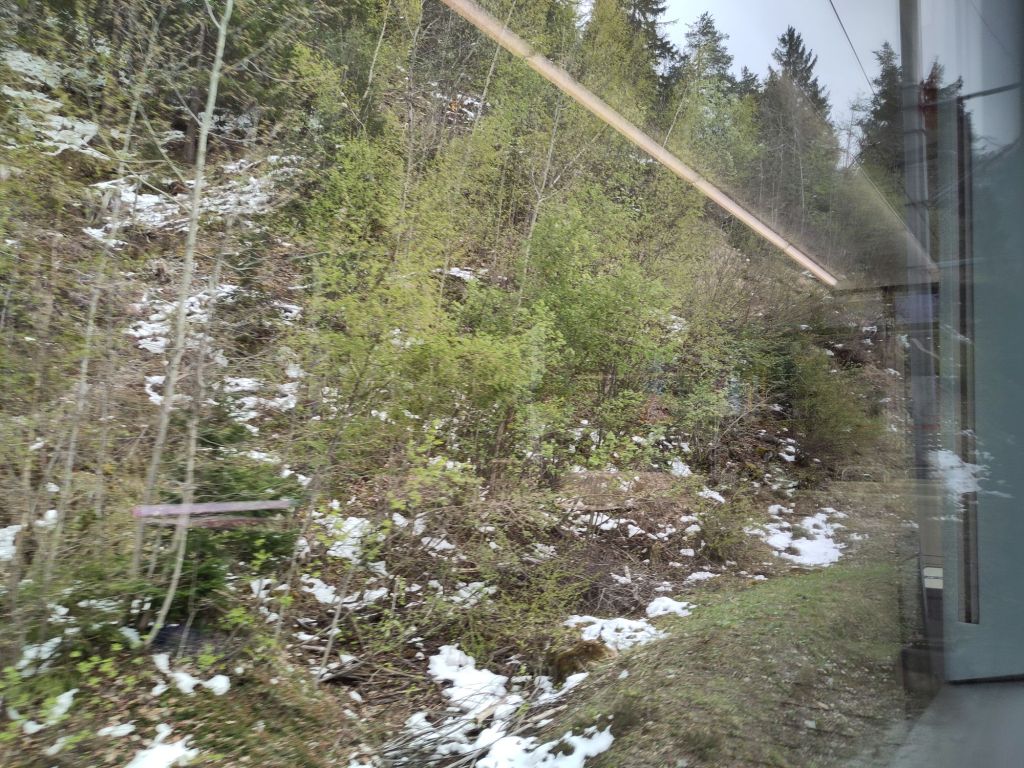
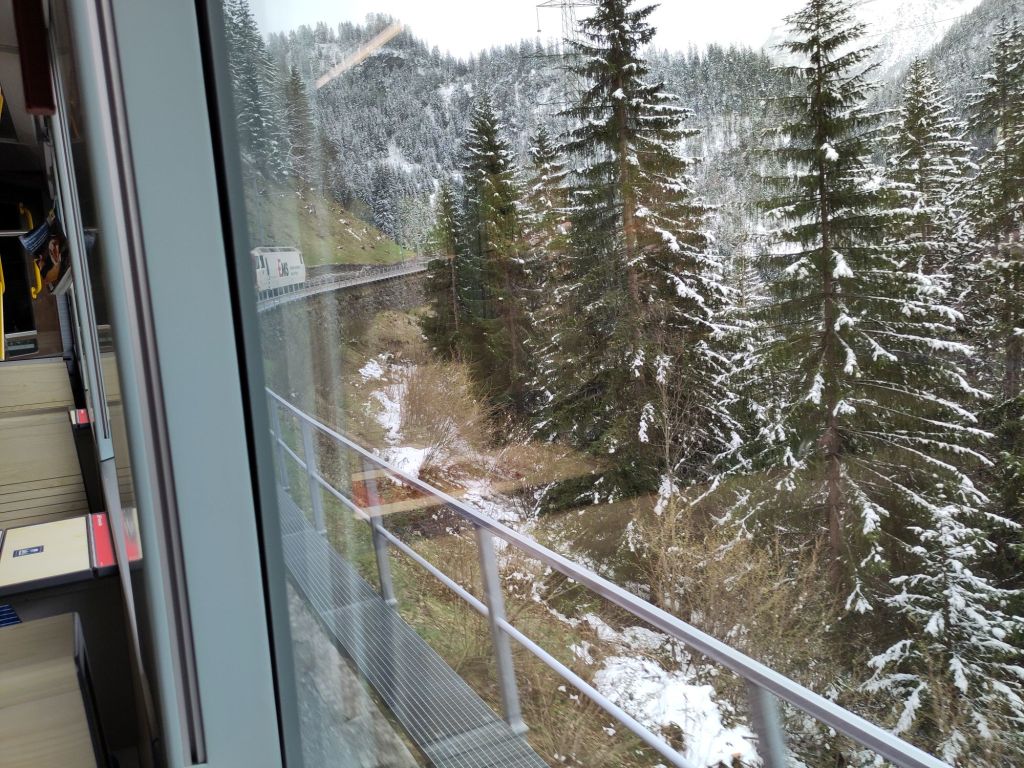
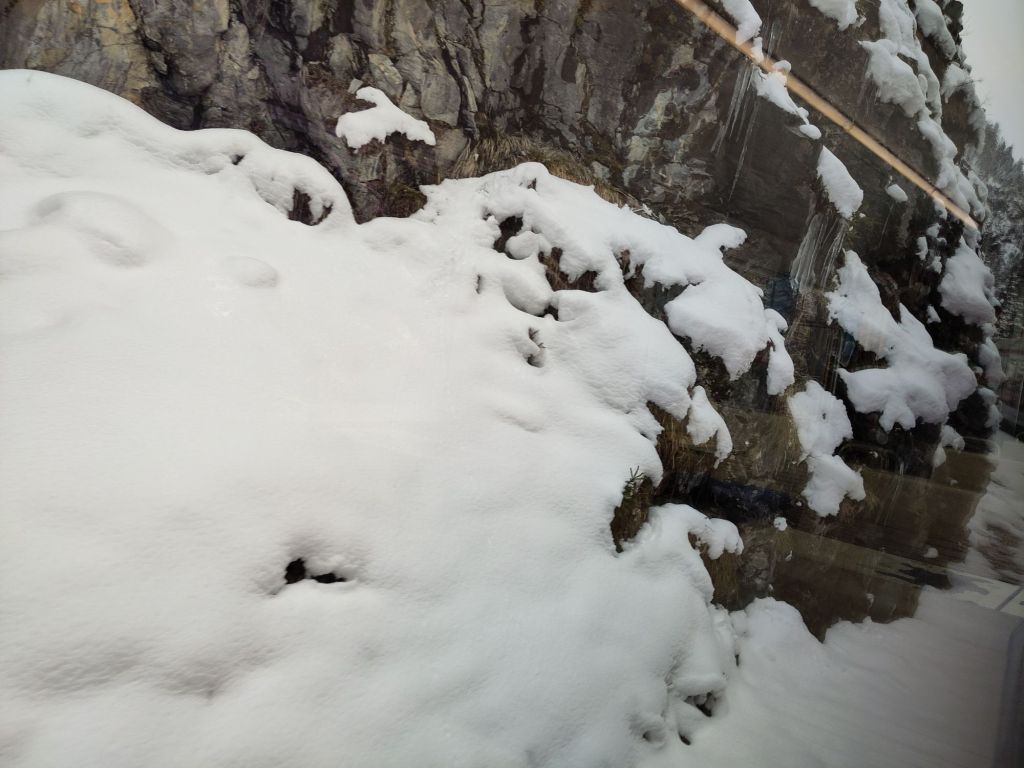
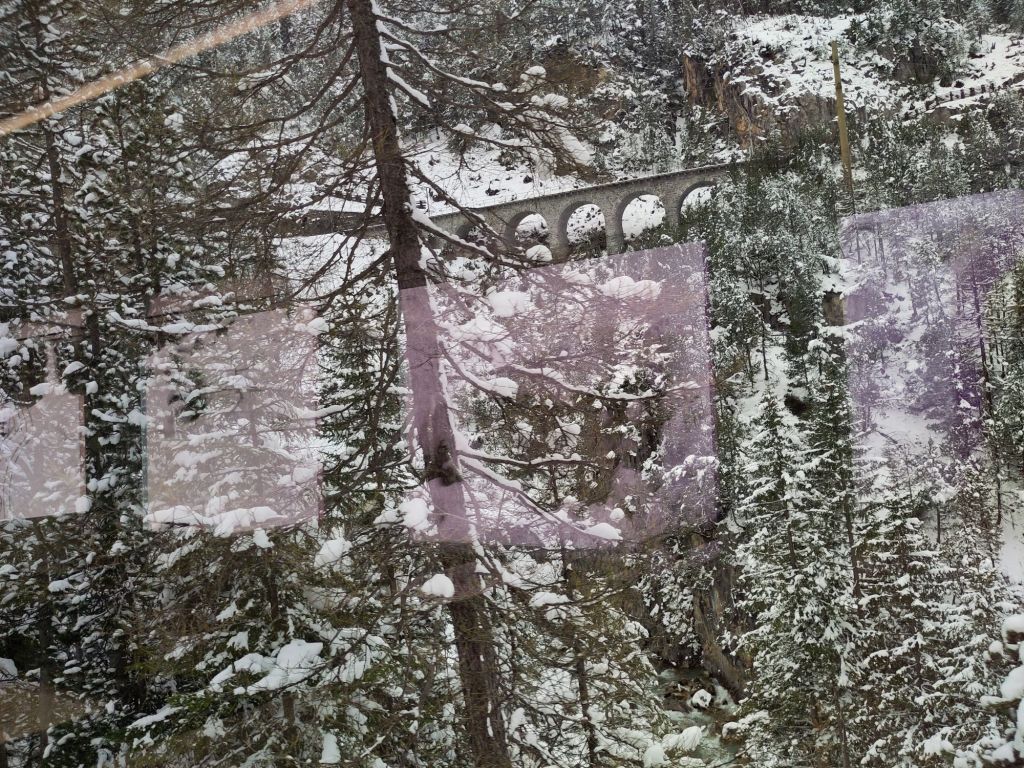
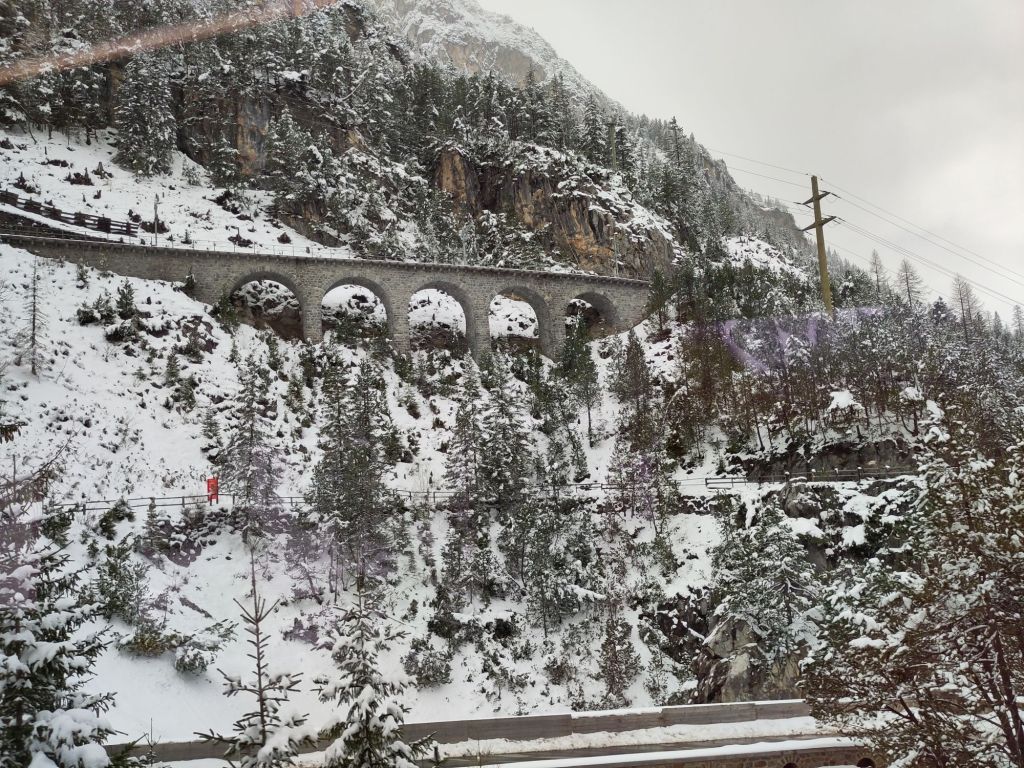
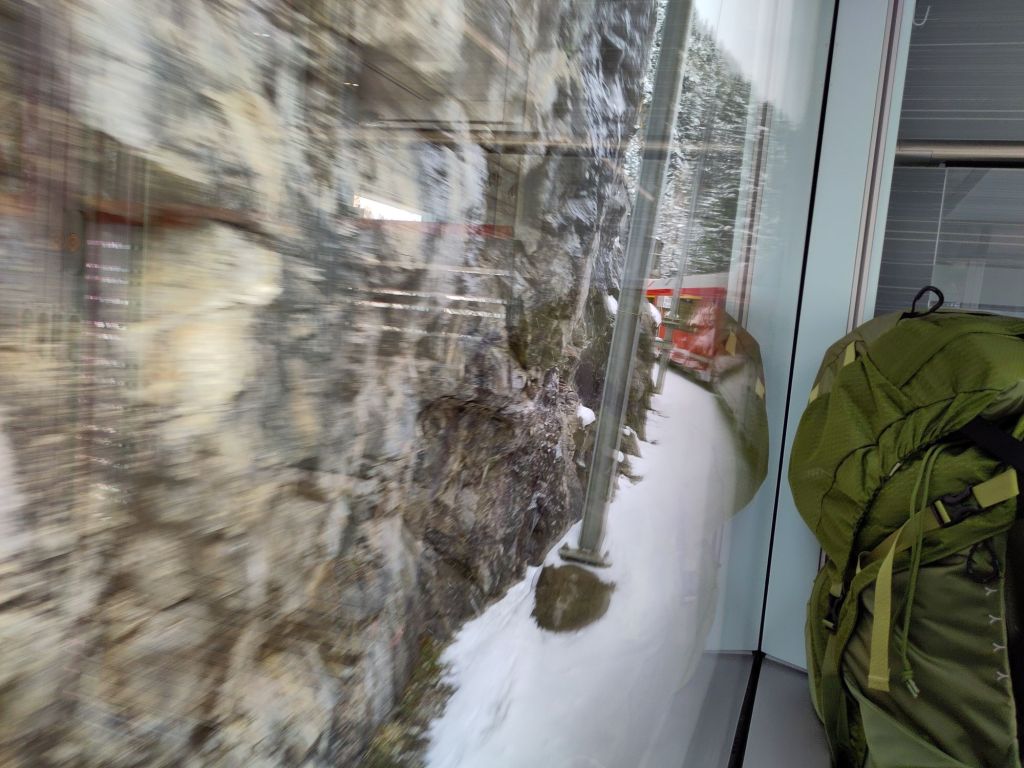
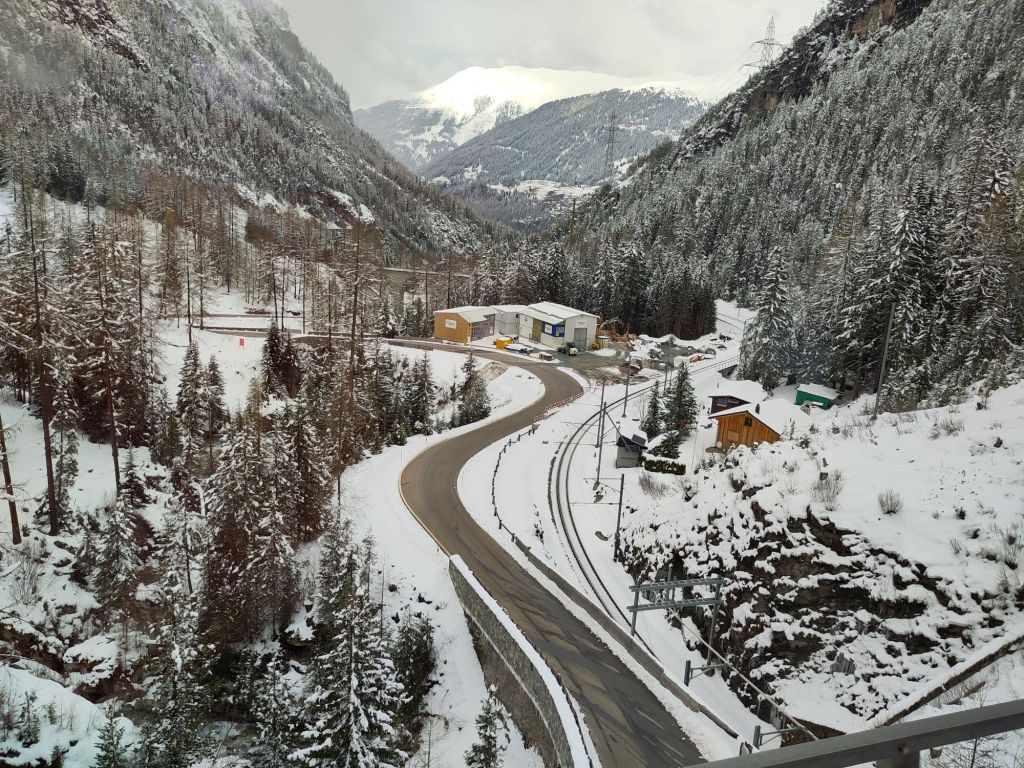
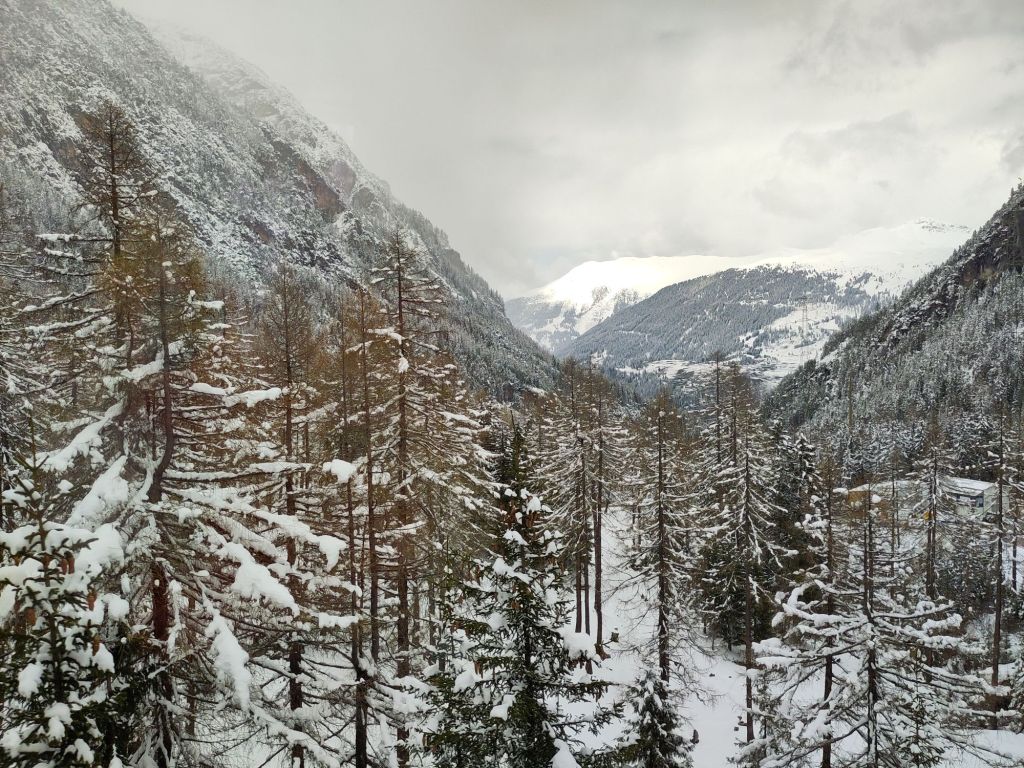
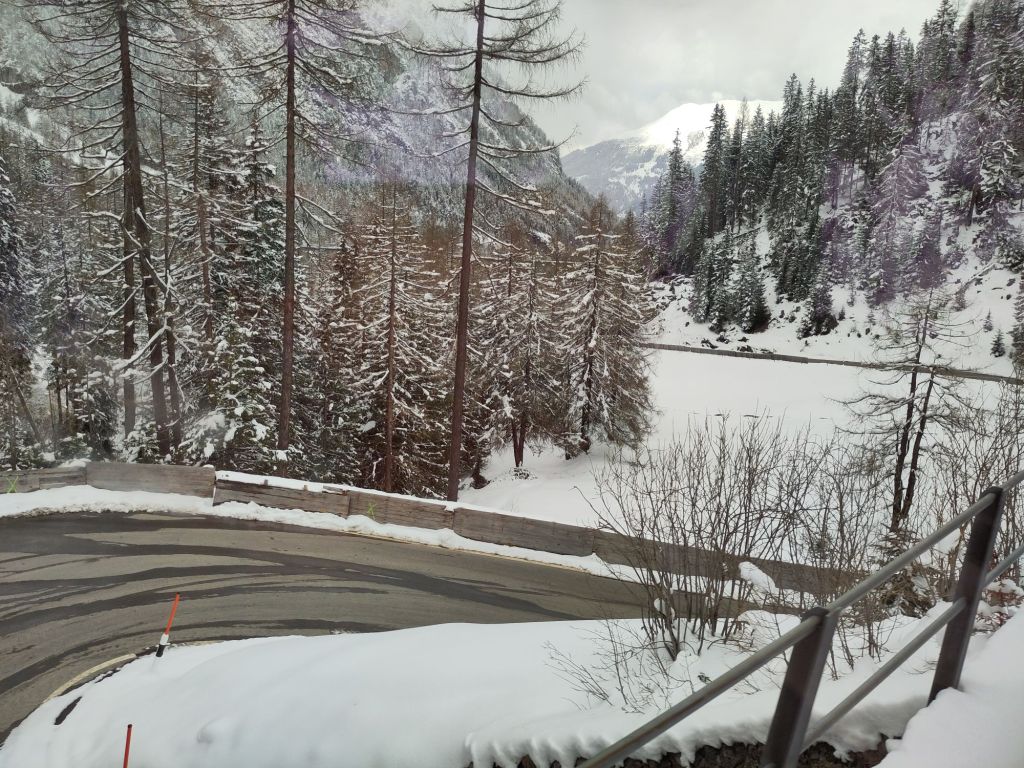
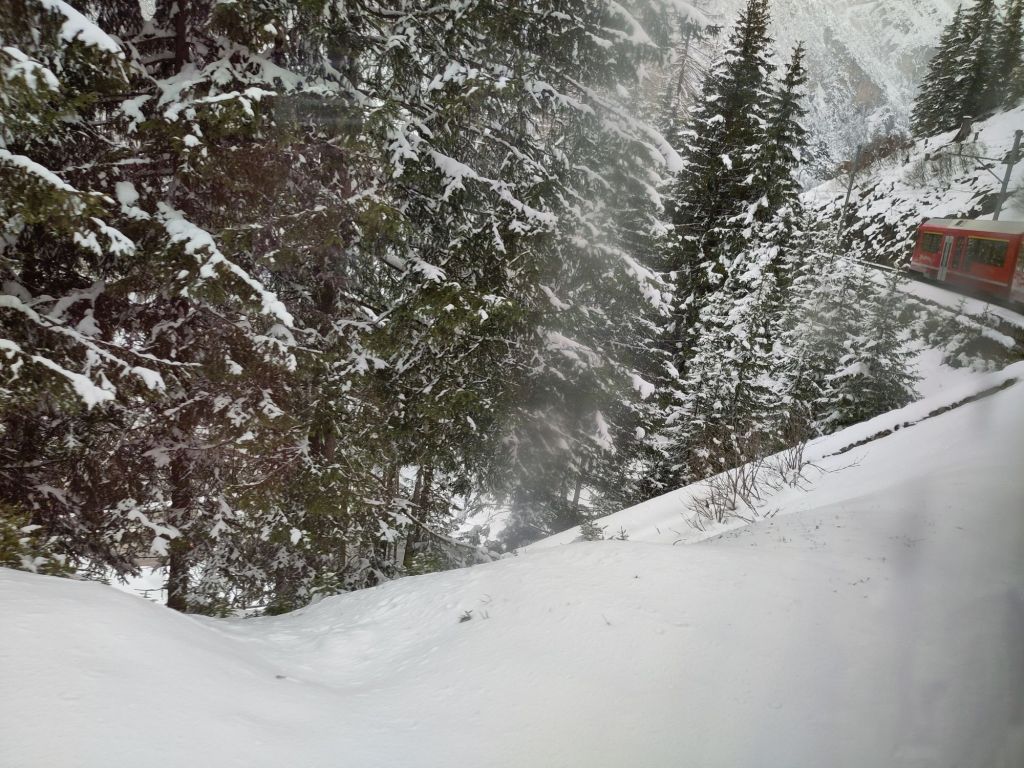
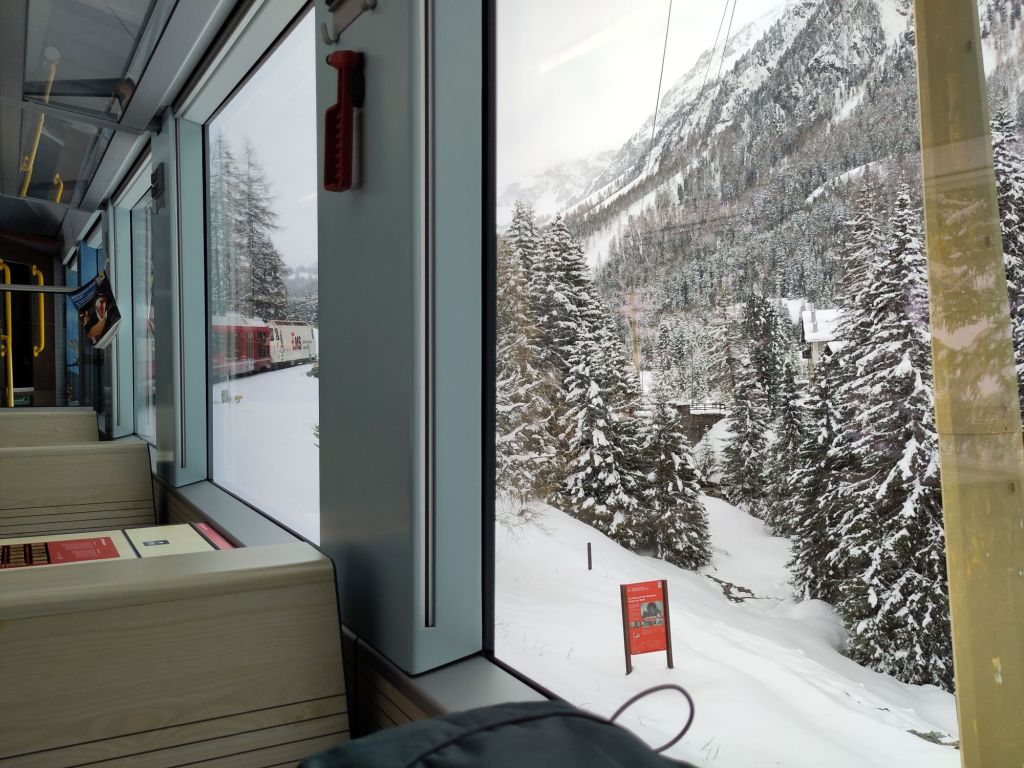
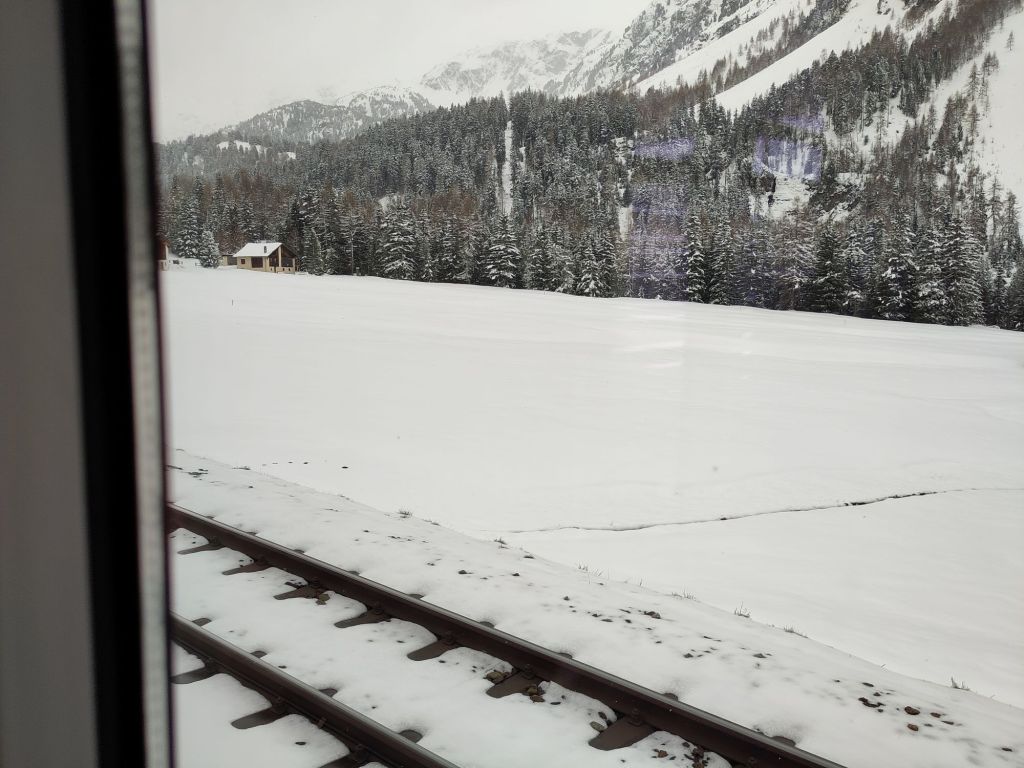
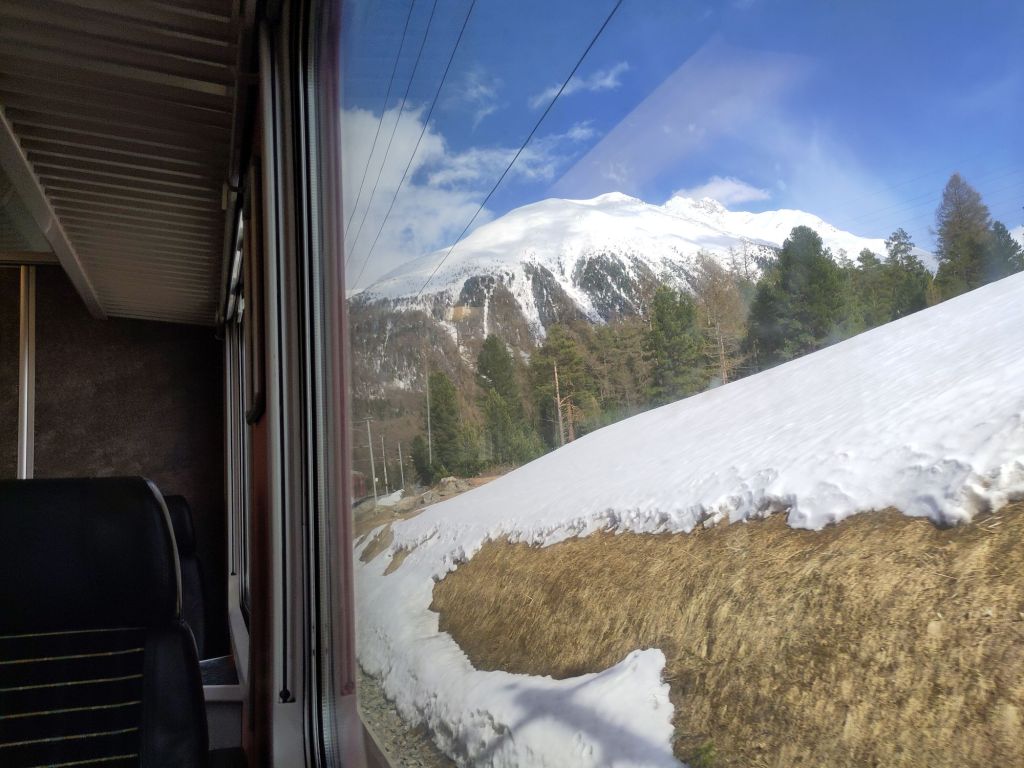
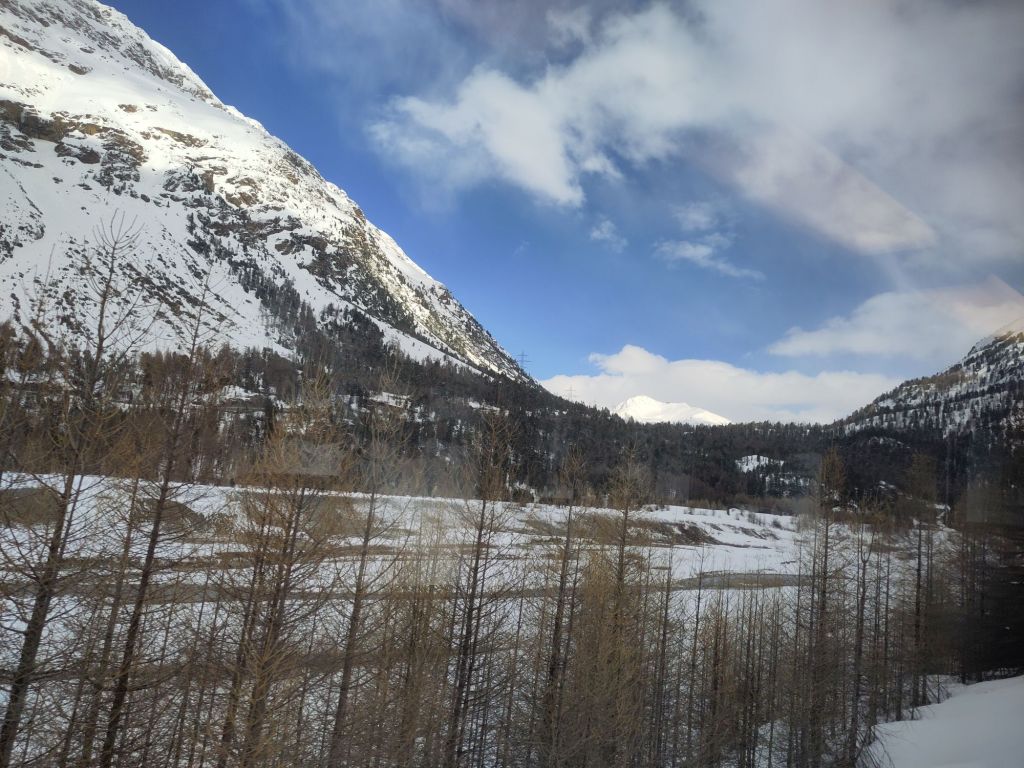
My train in the morning left the Paris Basin and its chalk behind, as I headed eastward into the Swiss Alps. My first change of trains was in Zurich where I observed buildings built of limestone (presumably local). My guess is that it came from the nearby Jura Mountains – a ridge of hills which run along the French-Swiss border. They gave their name to that most famous of geological periods – the Jurassic – made famous by the Hollywood dinosaur films. As you may have guessed I was excited by this!
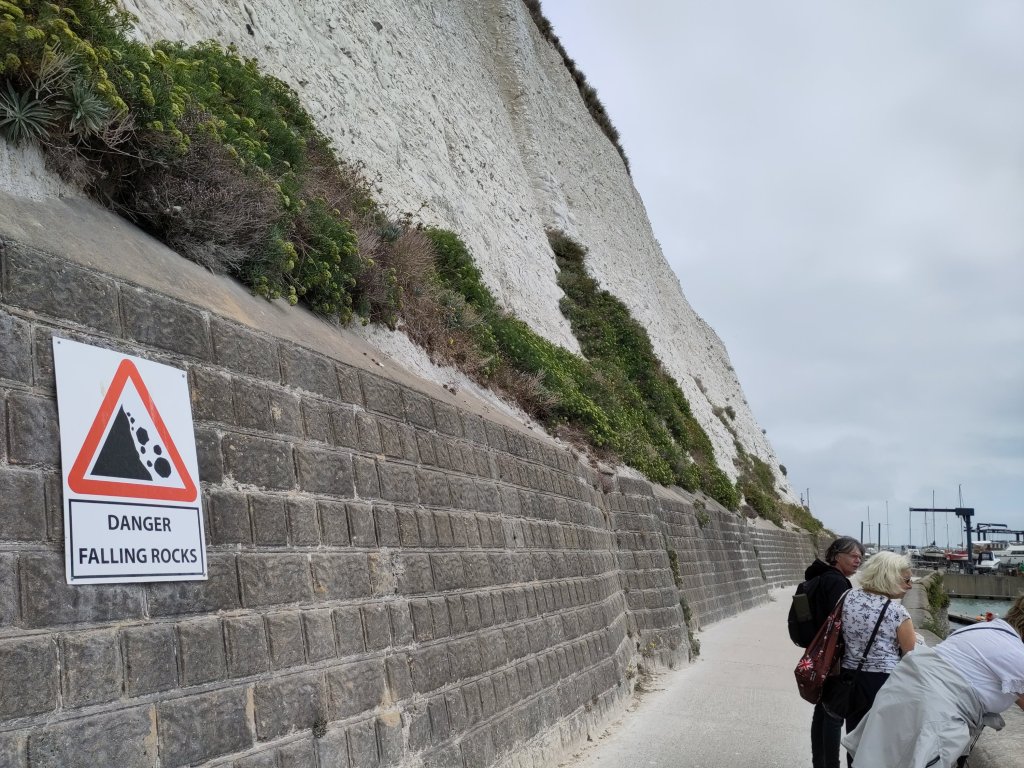
Chalk and limestone have the same chemical composition but are very different in their form. The photos above show two types of limestone; one, solid and compact, the other was full of cavities. Whilst some limestones are purely inorganic in origin, the majority of them were formed by living organisms which lived in the sea. Their fossilized remains can often be found in both chalk and flint.
One of the reasons for this trip is to better understand the nature of chalk, including its origins. It is technically a very special type of limestone. The limestones of Switzerland were formed under very different conditions to the chalk to west and north (chalk is also found in Germany amongst other places).
However it is the other reason for my expedition of discovery that I will be posting here.
Towards the Swiss Alps
The Swiss Alps are famous, both culturally, scenically and geologically. They are extremely high. Yet some of their highest tops are composed of limestone and thus were formed in a sea. These seabed(s) therefore were somehow lifted up two three kilometres into the air. Somehow (more details later) geological scientists have dated the uplifting to be of the same period as when the gentle folds of the South Downs were also formed.
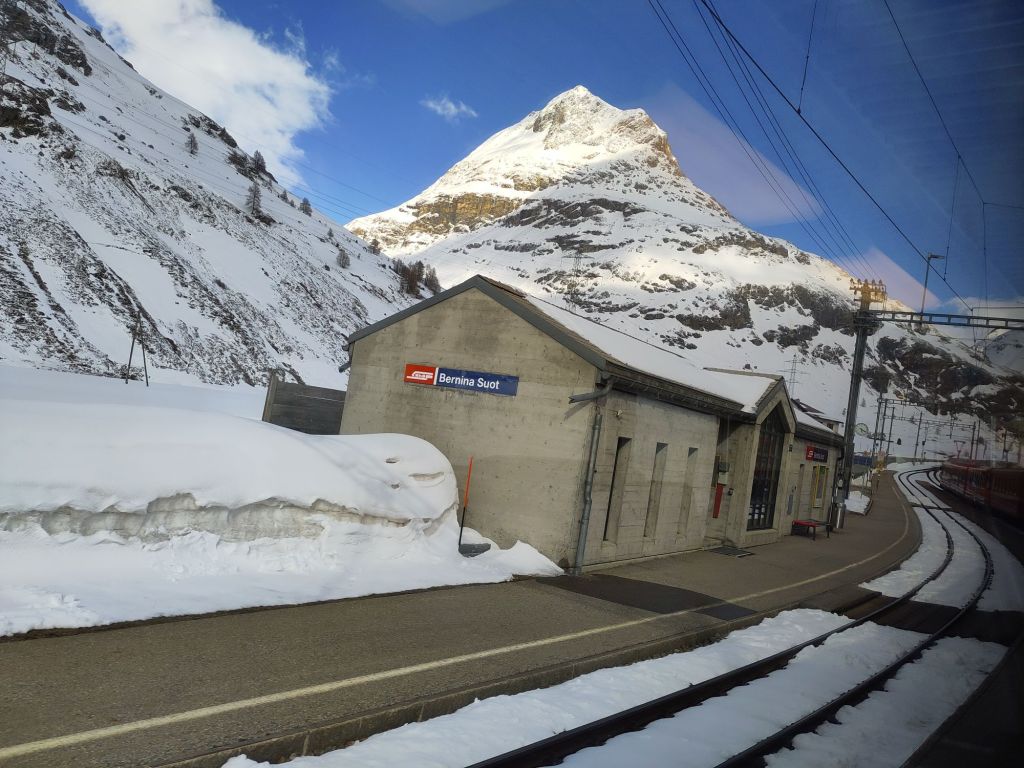
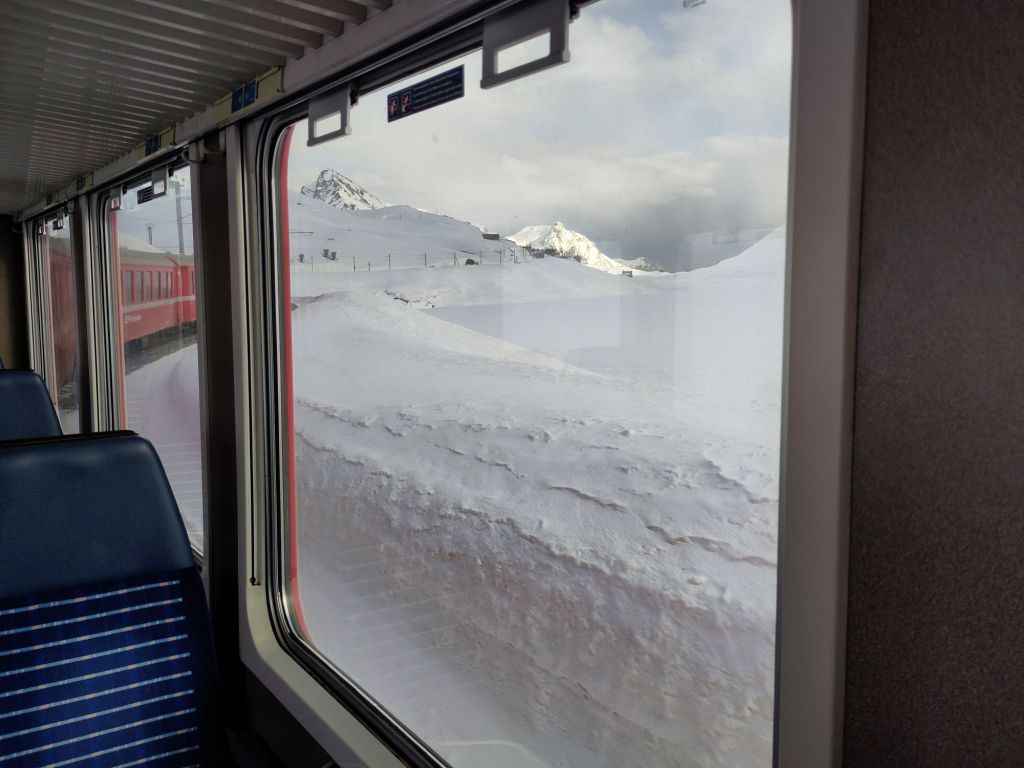
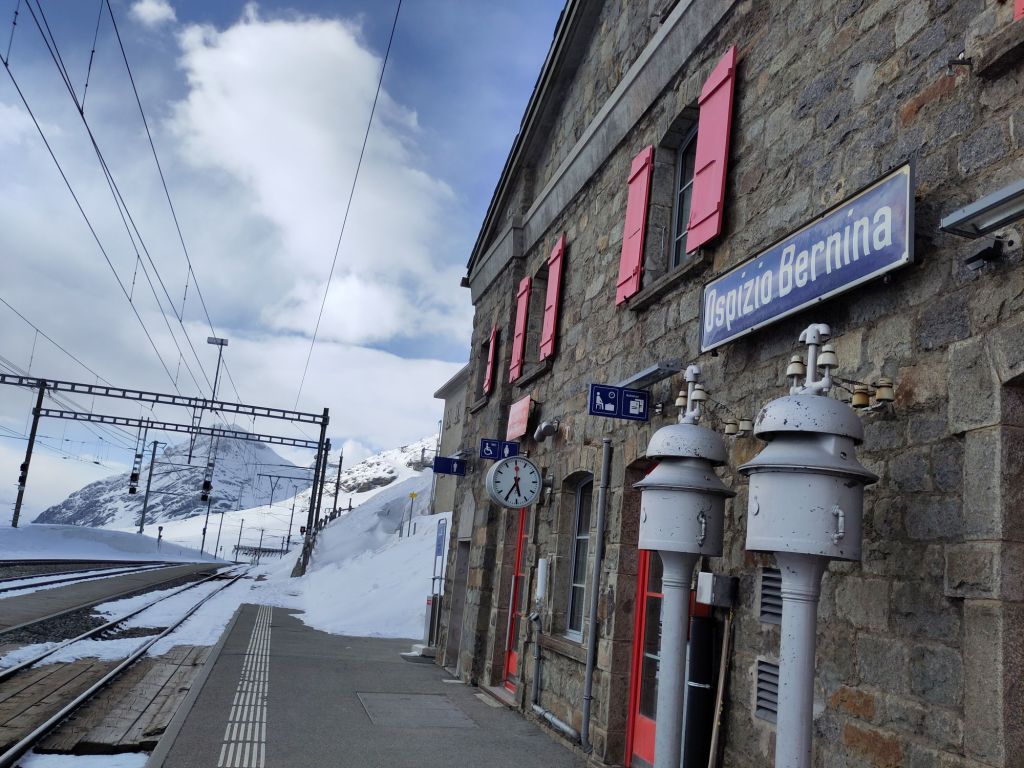
But enough of the technical detail and let me share a few photos of my journey, uplifted by railway to my destination at the end of the day; Ospizio Bernina, the highest station on a passenger mountain railway, that runs on simple rail, in the World!
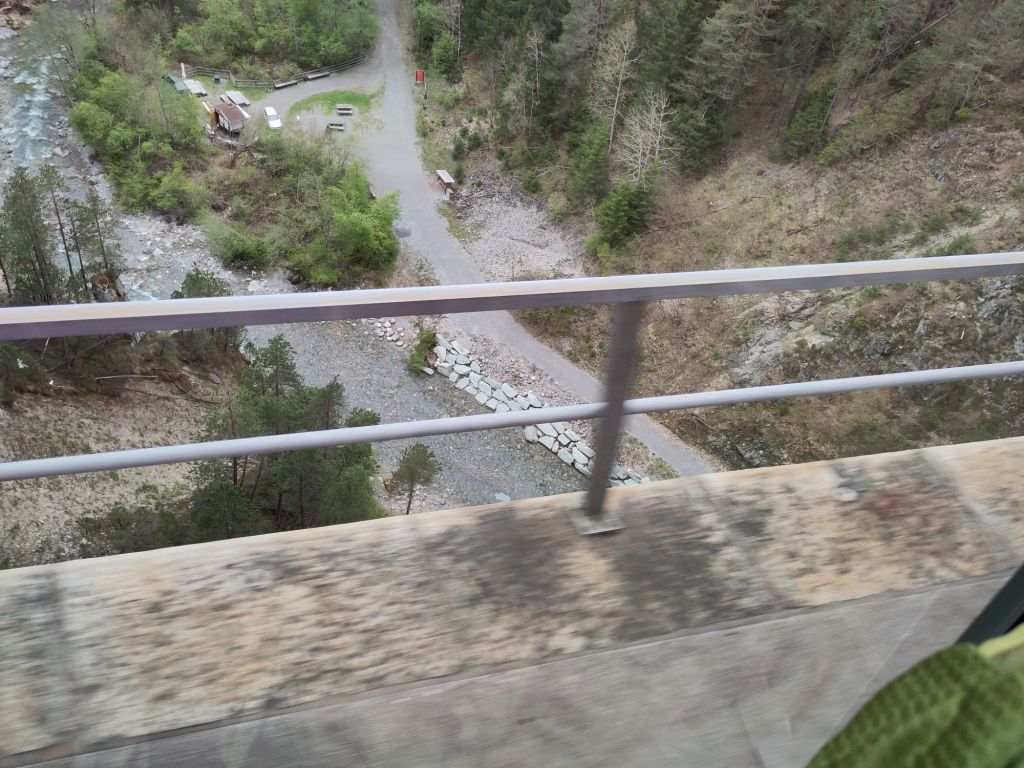
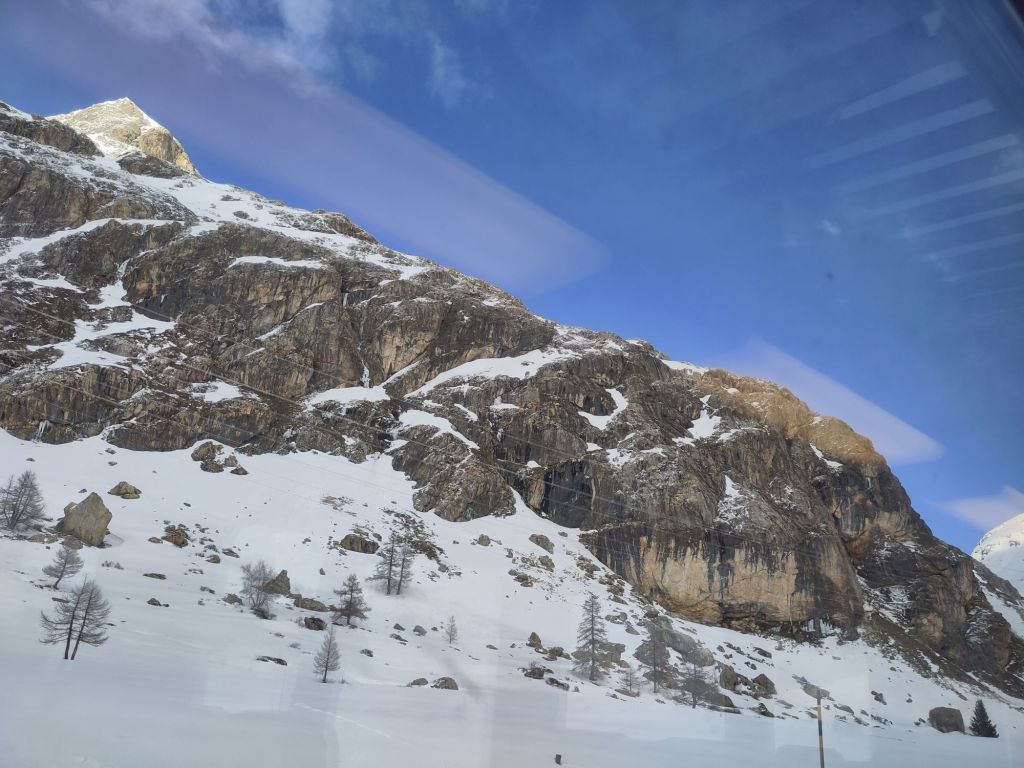
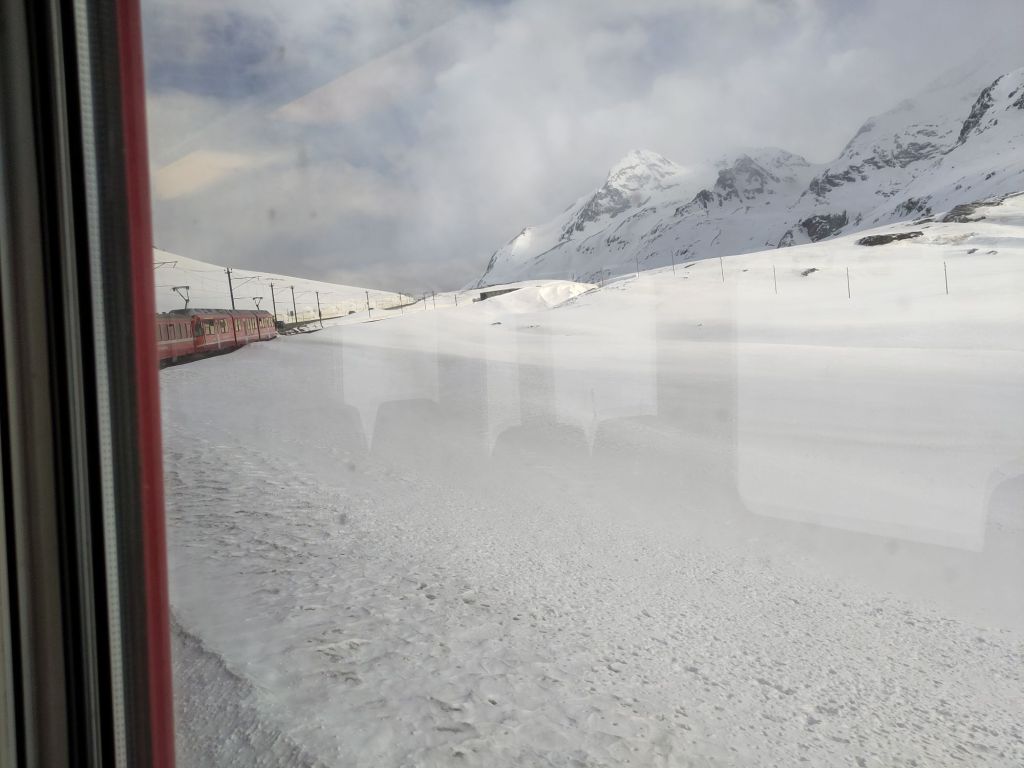
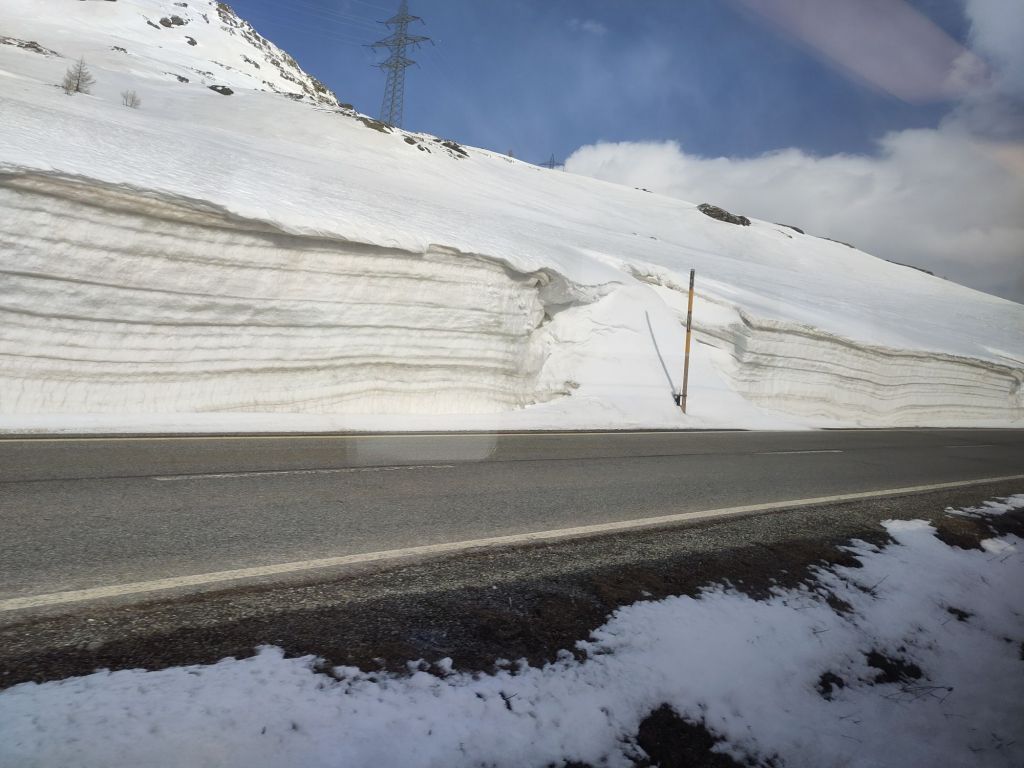
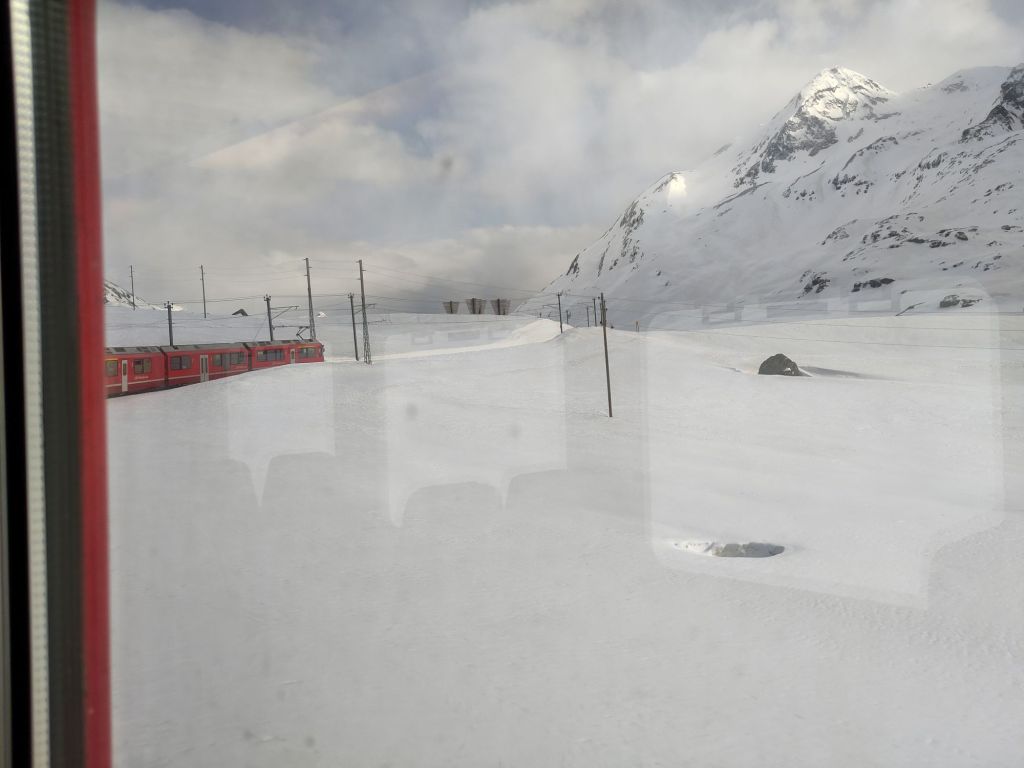
ZurichseeWalenseeMountains, distant right, part of Swiss Tectonic Arena SardonaMore limestone!From Chur we go into the mountainsStausee SolisLandwasser ViaductA long way down!First snow next to railway!We perform many spiral loopsMany tunnels – my luggage is all I can seeStill climbing across rocky mountain sidesOnly three more stops to Bernina PassYet more limestone rock 🙂Leaving the tree-line behindA snowy wildernessCutting through snowdriftsMy train destinationA totally snowed-in ghost station!
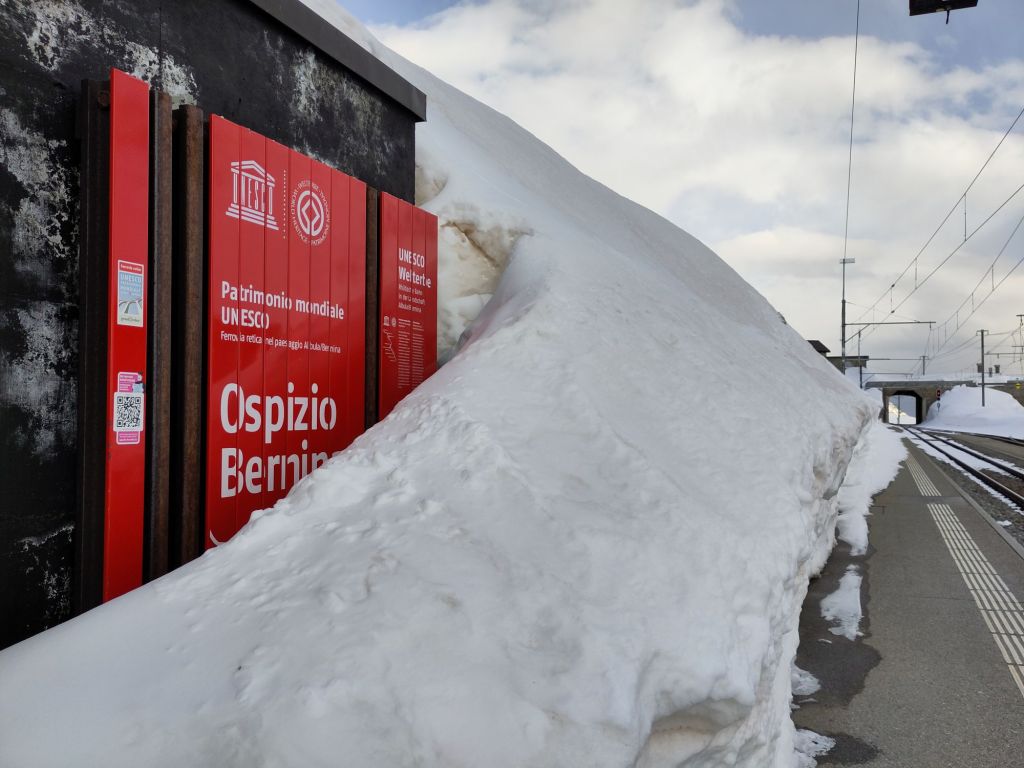
I arrived to a totally deserted, literally freezing station. Ospizio Bernina – 2,253 metres above sea level – is both the highest station and highest point on the Bernina Railway.
It was not at all hospitable. My hotel was normally just an easy 10 minute walk away and 50 metres higher than the station. It might as well have been at the South Pole.
There was no obvious sign of any exit, except for an old set of ski tracks climbing a very steep bank of very deep drifted snow. The temperature was at least minus five plus a strong wind created a painful windchill to any of my exposed skin… To be continued!!
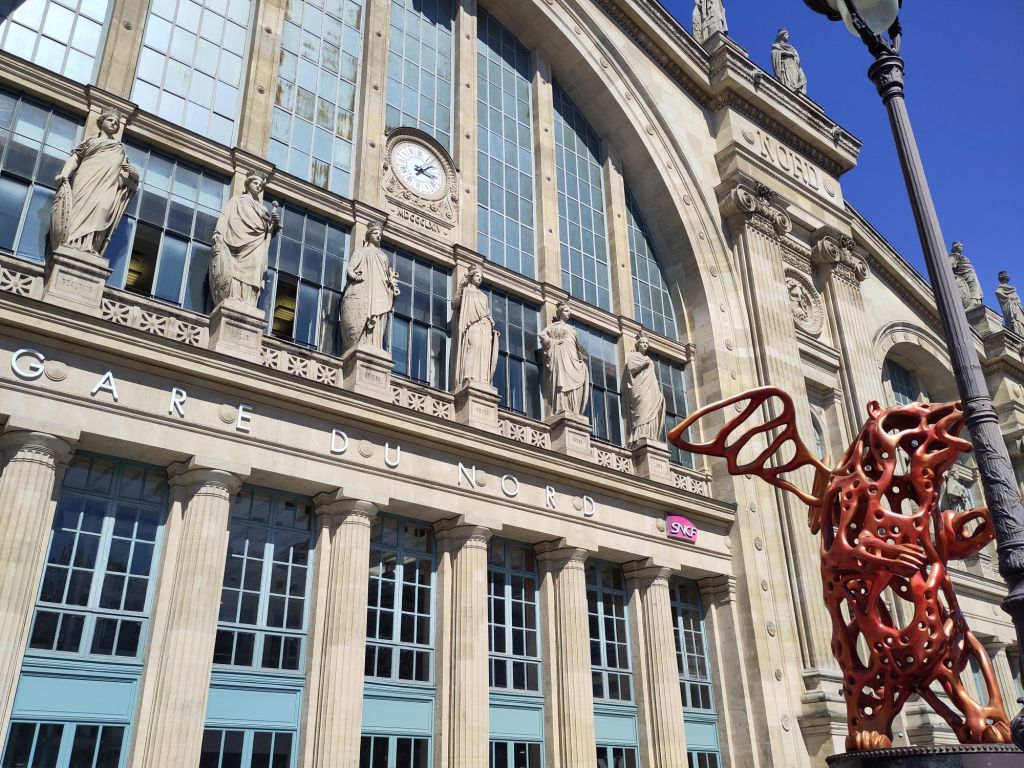
I arrived in Paris – my first time as a tourist, even if it was only for an afternoon before leaving early the following morning. The sun was shining and it was spring time so I shouldered my pack and walked very gently downhill towards the Seine. Downhill? Yes, Paris is at the very centre of yet another basin called the Paris Basin. There were no big holes in the ground on my route to see what lay under the tarmac and concrete but apparently it is clay and sandstone which sits on top of my favourite (Upper Cretaceous) chalk 🙂
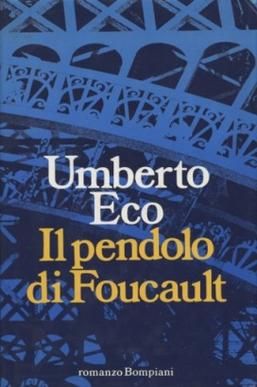
The Paris Basin, with the Pays D’Auge of Normandy in the west and the Vosges hills in the east: WikipediaFirst Italian edition of the novel by Umberto Eco
Many years ago I read (in English translation) Foucault’s Pendulum and thoroughly enjoyed it. The title refers to the first person (a Frenchman) to prove beyond doubt that the Earth rotates on it’s own axis. Therefore the sun is the centre and it is our planet which rotates. The idea is ancient and in the Middle Ages and Renaissance controversial. Even flat-earthers today struggle with the idea.
If I jump up and down I land on the same spot. If I run 100 metres due East I would cover the distance in the same time as when I run 100 metres due West (assuming there is no wind to slow me down or that I was not exhausted after running 100 metres). It doesn’t feel like I am moving through space due to the spin of the Earth at about 1,000 miles per hour. Nor that I am rotating around the Sun at approximately 66,000 miles per hour. It is hard to imagine, yet alone to believe.
It was in 1850 that Léon Foucault proved – for the first time in history – that the Earth spins on its own axis, by swinging a very heavy weight backwards and forwards on a very long wire, which was free to rotate in all directions. To keep the story simple I will say that as the pendulum rotates back and forth, the earth underneath it is also rotating, more or less giving it a little sideways push, such that each swing traces a slight anti-clockwise loop. The reality is a lot more complicated and is something I do not fully understand – but at least I have now experienced Foucault’s proof!
Galileo Galilei was the first person to study the physics of a pendulum. His disciple, Vincenzo Viviani, in 1661 also studied the motion of pendulums. Apparently he observed its tendency to veer to the side but, unlike Foucault, he failed to understand its significance. Hanging the pendulum with two ropes prevented the ‘problem’.
There are two locations in Paris today to see Foucault’s Pendulum in action. The Pantheon (it was expensive and you have to pre-book online which I struggled to do) and my retrospective favourite and the setting for Umberto Eco’s novel, the atmospheric Musée des Arts et Métiers. If only I had enough time and energy to write more about the Priory building in which this pendulum is housed. For those interested I can only refer you to the above Wikipedia links for both the novel, the man and the museum.
If you do visit, spend time mindfully watching it slowly, inexorably, swing backwards and forwards. The end of its swing is marked by a very large circle, conveniently divided up into segments. Each segment bears a letter of the name of the museum. When I arrived it swung over the ‘M’ of [Musée des Art et] Métiers. After about half an hour of mesmeric watching it had passed on over the ‘é’ and reached the ‘t’. At this point I remembered something of the deep and meaningful significance of the letter ‘T’. It was a sign. Umberto Eco was a semiotician – the study of signs in terms of meaning. The letter ‘T’ is both in the word ‘tea’ and also in ‘toilet’. Their tea shop was already closed but the latter was thankfully available 🙂
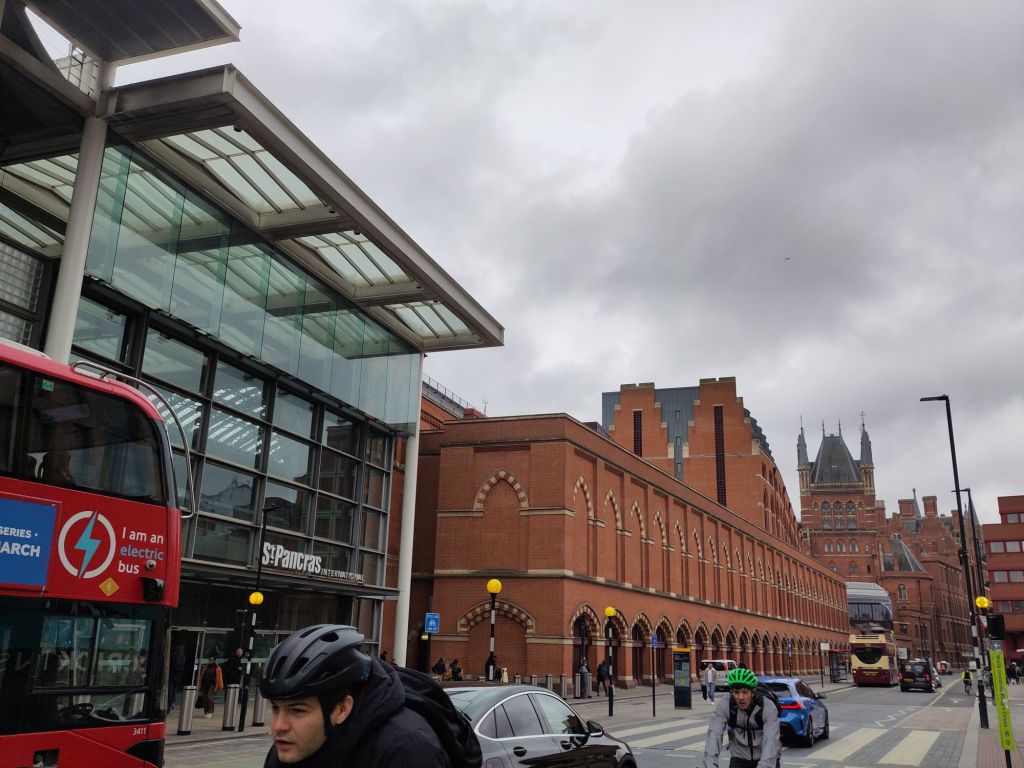
I don’t know if any readers have travelled by Eurostar train from St Pancras International to France. My experience was perhaps a useful one. It helped me on my way to becoming a vegan – I now have a better idea of what it is like being treated like cattle. The staff were polite and well meaning but they had a job to do – herding us through customs and onto the train.
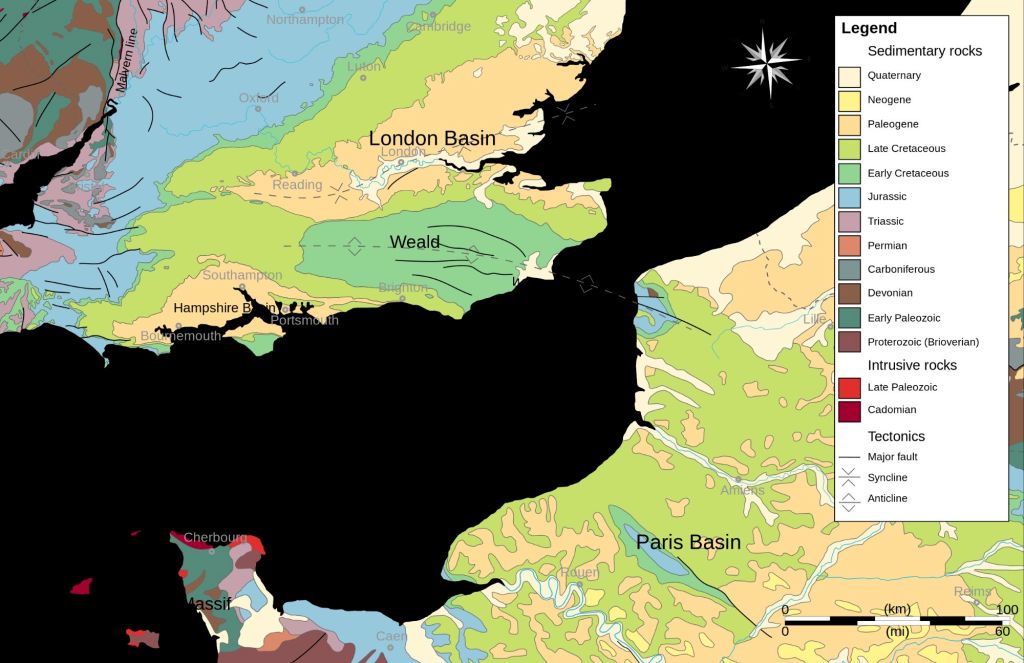
London Basin and the Weald-Artois anticline (upside-down pudding basin): (Wikipedia)
Once we got going I could think more about the geology of our journey. London is famous for its clay, which sits on top of – you guessed it – chalk! London clay fills a basin. My earlier train from Brighton to London passed through strata that had been lifted up like an up-turned pudding basin. They then dipped downwards to form a basin called the London Basin, with chalk underneath and filled with clay – like a lid-less pie.
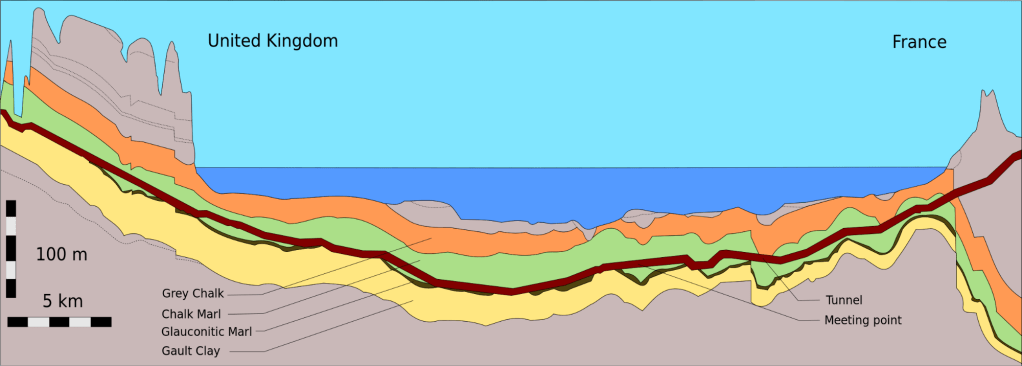
Cross section through geology of the Channel Tunnel: Wikipedia
Approaching Folkestone (on the boundary between the white – chalk – cliffs of Dover and the Wealden sandstones and clays) the train dipped down and disappeared underground. For most passengers this, the longest undersea tunnel in the world, is a just a boring journey in a plastic and metal box on wheels in the dark. If only they knew!
The Channel (La Manche) is – like London – sits on top of a basin filled with sea water instead of clay. Chalk is a relatively soft rock, but it contains a very hard glassy mineral called flint (a variety of quartz). This would have damaged their drilling machines. Fortunately for the engineers the very lowest layers of chalk are flint free.
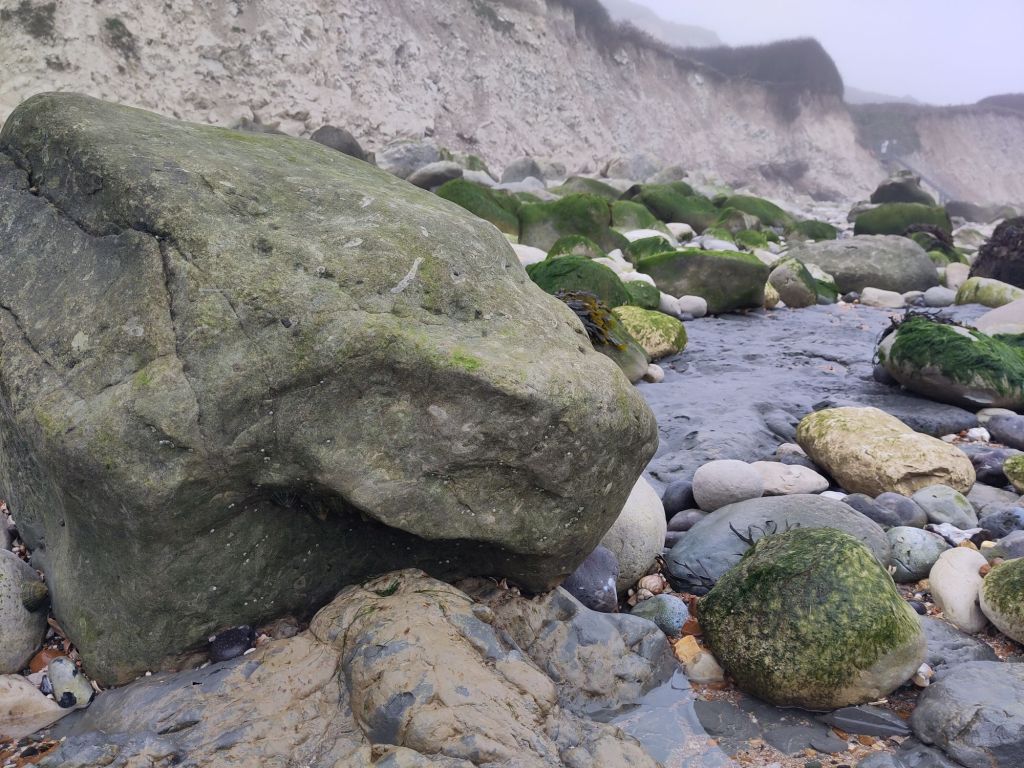
The beach at Cow Gap between Beachy Head and Eastbourne: (my photo).
These lowest layers of chalk are exposed to view at Cow Gap, which I recently visited (two excellent guides to its geology and fossils are here and here). The shiny grey coloured rock in my photograph is the underlying gault clay. The green(ish) coloured boulder is upper greensand sandstone which is missing further east near Folkestone. It is replaced by glauconitic marl. Chalk marl and the grey chalk can be seen in the my photo in the cliffs behind.
Because these layers have been disturbed by tectonic forces (directly experienced by us as earthquakes) they are not horizontal. Nor do they gently rise and fall like the contours of a wide shallow bowl. I wasn’t able to feel it, but our journey under the channel was in actuality more like a gentle rollercoaster – forced to follow wherever the geological strata took us.
I wish they had a three-dimensional geological map showing us our progress 🙂
It’s a shame I struggled with my packing, leaving me sleep deprived as well as behind in my planning and research. I might have taken more photos out of the train window to share here. Hooray for Wikipedia!
A journey for me is a multidimensional entity. Every railway cutting gave clues to a story told by the rocks. The white chalk of the South Downs (coloured lime green in the picture above) can sometimes be seen. Scientists have found that it is more than 66 million years old. I will be telling more about it later.
Where the chalk is covered by vegetation, careful observation reveals plants that only grow in alkaline chalky soils, such as wild clematis.
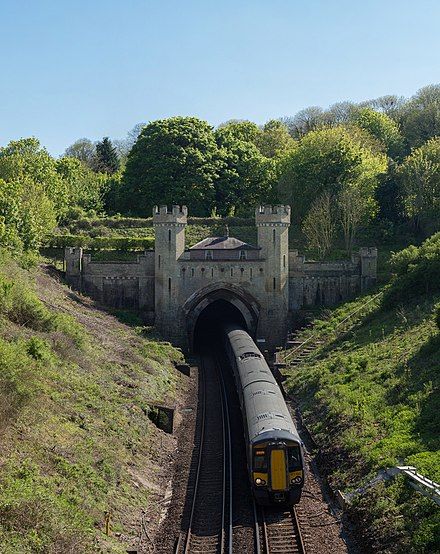
Emerging out of the long dark Clayton tunnel, the vegetation changes. Young shoots of acid loving bracken could be seen emerging from amongst other fresh green spring growths. The sandstones and clays of the Kent and Sussex Weald are of older rocks which in Brighton are hidden deep under the chalk.
The train sped past Gatwick (after letting people off and on) then before we got to Croydon, suddenly the white chalk was back!
Geologists have measured the angles to the horizontal of each of these strata wherever they can be seen. They have also identified fossils which are unique to all of the different layers. This has proven that the South and North Downs were one and the same layer of chalk.
Chalk formed during the Upper Cretaceous in hot tropical seas. It is made from the dead chalky shells of tiny sea creatures, their remains falling like snow to the seafloor. But something happened about 30 million years ago to lift up the sea floor. The chalk sea floor between Brighton and London was somehow lifted up, like a giant soufflé, and collapsed in the middle! The eroded middle resulted in the uncovering of the older layers underneath.
To learn more about the origins of our South Down soufflé is the purpose of my study trip. Of which more tomorrow!
Brighton Station marks the beginning of another epic adventure for me to learn more about the origins of the beautiful chalk South Downs. They are the birthplace of both of my parents, as well as of my sister and myself. We are all children of chalk and flint.
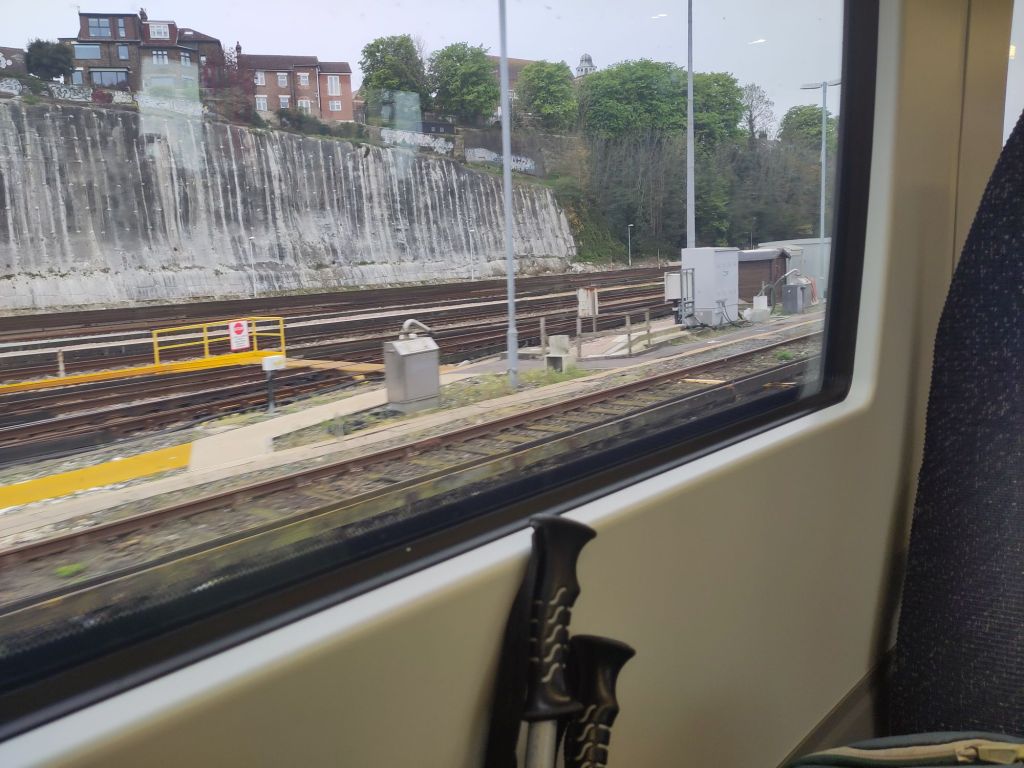
Behind the concrete covered railway cutting is Brighton’s chalk bedrock!
Meanwhile, I am loaded with yet another ridiculously heavy rucksack, a sore back and lots of anxiety. But I am also full of high hopes and a light heart. I am off on one of my most epic adventures in many a decade!
I didn’t get much sleep last night, and had to wake early. So you will have to wait to discover more whilst I have my second breakfast and a snooze! Hopefully I’ll be back here later this afternoon.
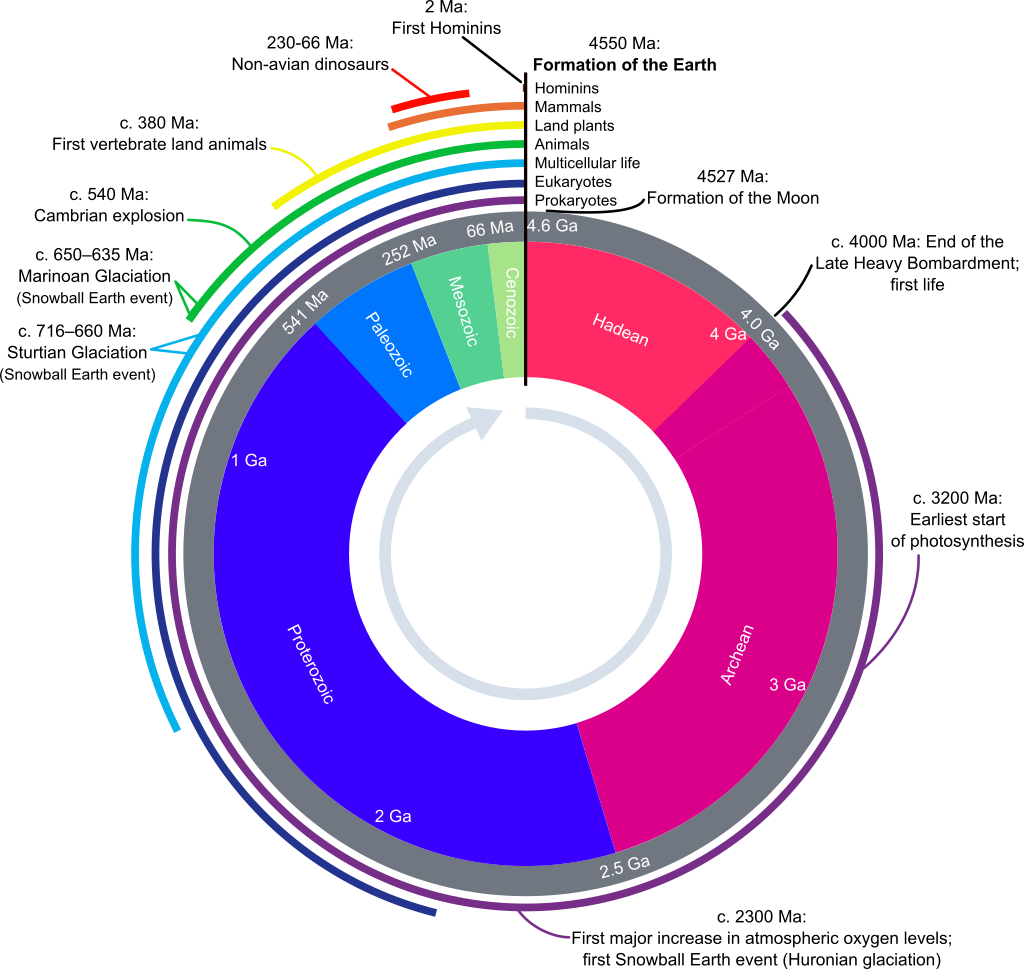
The geological clock: a projection of Earth’s 4500 million year history on a clock; (“Ma” = a million years (Megayear) ago; “Ga” = a billion years (Gigayear) ago; Prokaryotes = relatively simple, single celled organisms without a nucleus, such as bacteria; Eukaryotes = more complex organisms whose cells contain a nucleus). From Woudloper. Derivative work: Hardwigg, Public domain, via Wikimedia Commons.
The history of our Earth is a long and complex one. I am trying to understand at least some of it, in particular those aspects that lead to a better understanding of the chalk South Downs.
First let us get a quick overview of the Earth’s four eons (the biggest units of geological time). Unlike recent posts, I have tried to be short and to the point, with links to relevant Wikipedia pages for those who want to know more. Further details are intended to be given in future posts. I will also be returning to insights gained from the Gaia theory, but not just yet.
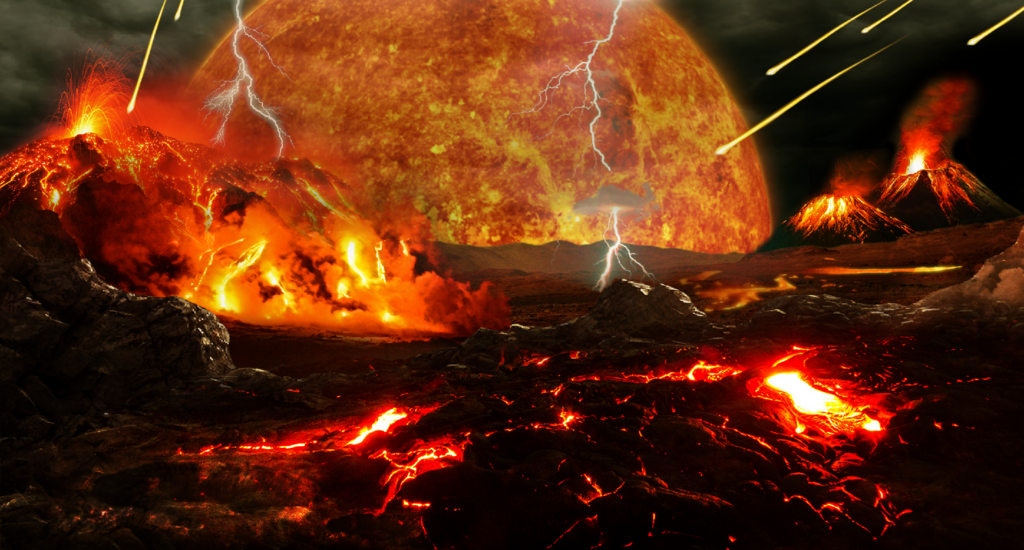
This marks the oldest (earliest) stage of our history.
The name Hadean comes from the Greek God of the underworld, Hades and relates to its early hellish conditions.
Starts with our planet’s formation;
No rocks survive on Earth from this time, so a date has been obtained from the oldest meteorites to be found on Earth. Scientists believe that they were first formed at the same time as we did.
Our earliest atmosphere was very thick, and rich in carbon dioxide and methane.
Eventually liquid water condensed from the clouds.
Because atmospheric pressure was much greater than it is now, though the Earth’s temperature was well above the boiling point of water today, the early oceans did not evaporate.
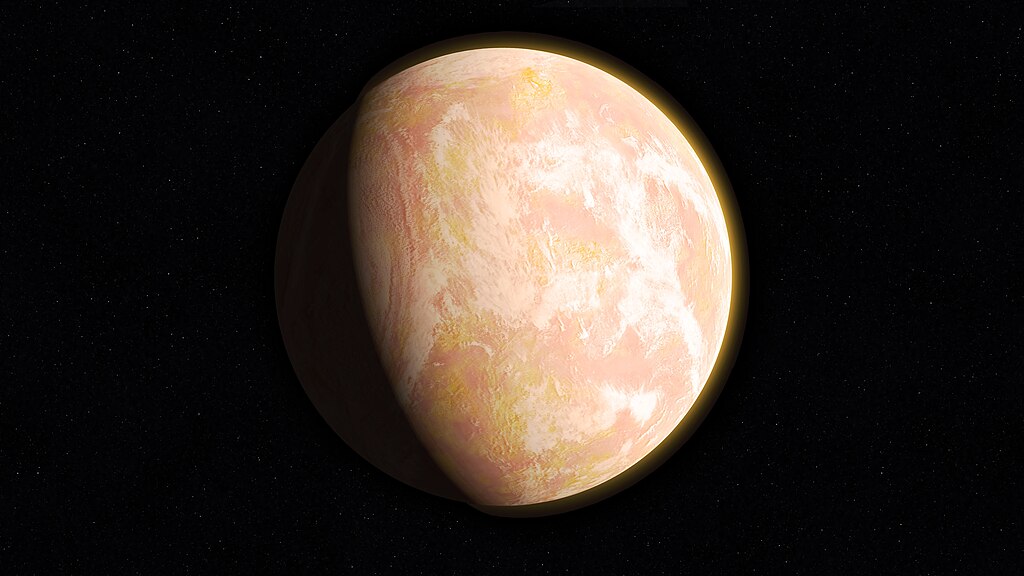
The pale orange dot, an artist’s impression of the early Earth which is believed to have appeared orange through its hazy, methane rich, prebiotic second atmosphere. Earth’s atmosphere at this stage was somewhat comparable to today’s atmosphere of Titan. NASA/Goddard Space Flight Center/Francis Reddy, Public domain, via Wikimedia Commons.
The start of this period is defined by the oldest surviving continental rocks found today on the surface of the Earth.
The Earth’s surface had calmed down sufficiently for continental crust to form, though most the planet was probably under water at this time.
The atmosphere was still high in methane and carbon dioxide, giving the atmosphere an orange colour.
Whilst life may have existed in the Hadean, conditions only became stable enough for it to be sustained during the Archean.
Fossilised bacterial colonies known as stromatolites have been found. For energy they used sulphur instead of oxygen, and had developed an early form of photosynthesis. They emitted a gas which was toxic to all life at this time – oxygen.
Artist’s rendition of a oxinated fully-frozen Snowball Earth with no remaining liquid surface water. Oleg Kuznetsov – 3depix, CC BY-SA 4.0, via Wikimedia Commons.
It is defined by the appearance of bands of rusty red iron rocks – the first clear sign of oxygen in the atmosphere, and known for the first clear fossils of multicellular life.
Named after the Greek words for earlier and life.
More or less three notable periods of time (please note that what follows is a highly simplified account and may not be true in all of its details);
The explosion of life may have been caused by a rise in plate-tectonic activity.
The tectonic activity resulted in mountain building.
Erosion of this new land would have fed life in the sea with valuable mineral nutrients.
Thus fuelling this explosion of life.
However, the planet’s first free oxygen would have destroyed the methane in the atmosphere.
Methane is a powerful greenhouse gas.
Its destruction may have led to a dramatic cooling of the Earth.
Carbon dioxide, when dissolved in water, forms an acid which can react with calcium or magnesium and silicate bearing rocks, with the result that it is converted into limestone. This could have removed this other greenhouse gas from the Earth’s atmosphere.
Removal of these greenhouse gasses would have cooled the planet, triggering (an) ice-age(s) lasting millions of years.
The controversial theory of one or more global ice-ages is known as the Snowball Earth.
During this time dark coloured dust would accumulate on glacier surfaces, which would warm the ice and cause local melting.
Volcanos emit both carbon dioxide and dust. They could have accelerated the melting of the ice.
Boring Billion, a period in the middle of the Proterozoic during which not very much changed;
More or less tectonic stability.
Climatic stasis.
Slow biological evolution.
Low oxygen levels;
As fast as cyanobacteria emitted oxygen, newly exposed rocks on land may have absorbed it.
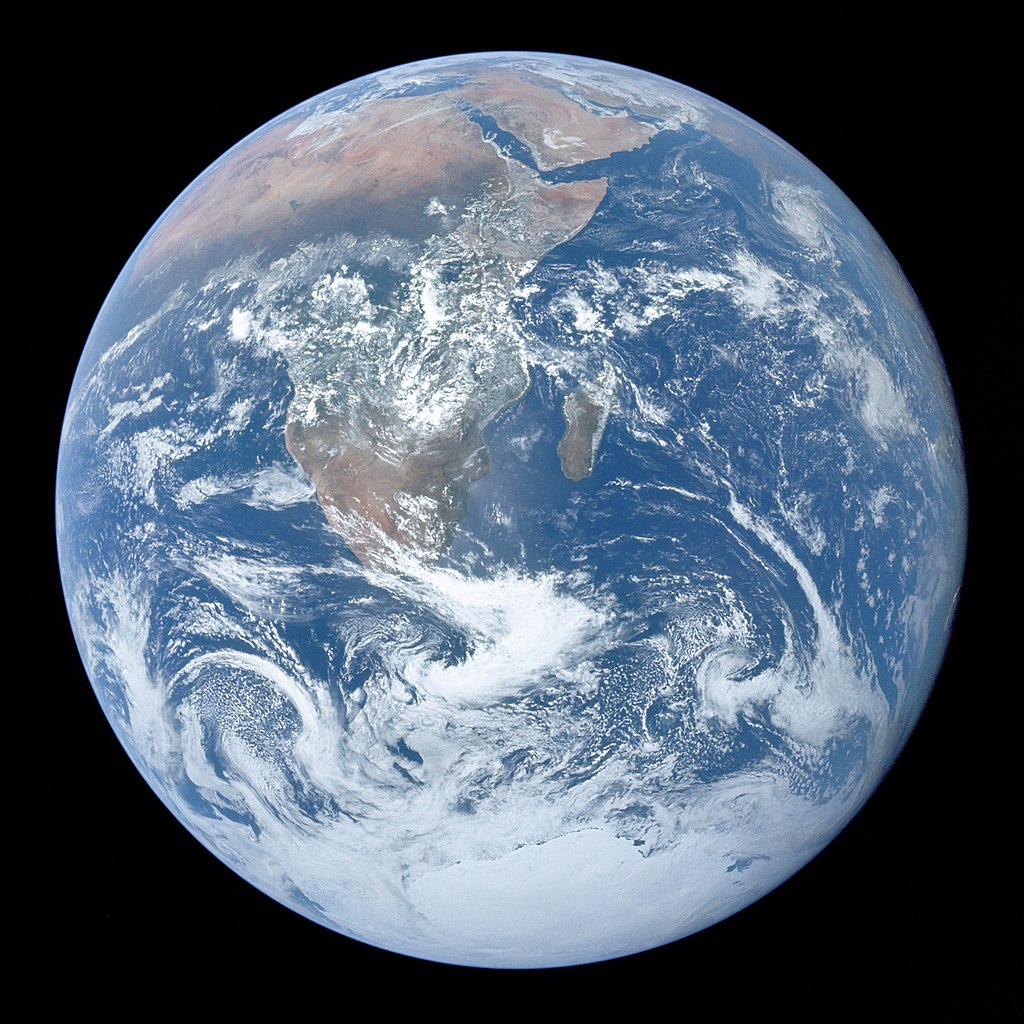
Earth as seen from outer space in an image known as The Blue Marble, taken by the Apollo 17 crew on 7 December 1972. Possibly by Harrison Schmitt, Public domain, via Wikimedia Commons.
The Phanerozoic has just one main characteristic feature – abundant, complex life, despite a number of major extinction events.
Named from the Ancient Greek words for visible life.
The continents drifted apart, then rejoined as the supercontinent Pangea, then separated again to their current positions.
As a result of these tectonic movements, the mountains that exist today were formed.
It is divided into three eras;
Paleozoic
Mesozoic
Cenozoic
All three of these eras played their part in the geological story of the South Downs – which will be explored in a new post.
After my previous post about Gaia, I was asked by a friend if I minded getting splinters from sitting on the fence! As usual, I had left it up to my readers to choose for themselves what to think – which is how it ought to be – but without saying what I believe.
The trouble is – I am confused!
You are aware of only one unrest; Oh, never learn to know the other! Two souls, alas, are dwelling in my breast, And one is striving to forsake its brother. Unto the world in grossly loving zest, With clinging tendrils, one adheres; The other rises forcibly in quest Of rarefied ancestral spheres. If there be spirits in the air That hold their sway between the earth and sky, Descend out of the golden vapors there And sweep me into iridescent life. Oh, came a magic cloak into my hands To carry me to distant lands, I should not trade it for the choicest gown, Nor for the cloak and garments of the crown.
Goethe’s Faust Part 1
My first love, certainly that of which I was truly conscious, was earthly materialistic science. I didn’t think of it in those terms though. For me it was a quest to mathematize the world – to seek for the mind of a God in which I did not believe.
At the Bottom of the Glass
The first gulp from the glass of natural sciences will turn you into an atheist, but at the bottom of the glass God is waiting for you.
I am also an idealist, a philosopher, always asking questions. I consider that war and strife are not good things. Like my father, I am a pacifist, and as a young man, a devout atheist.
It was only when I was in my mid-twenties that I discovered the limits to analytical logic. In the mid-1980s I became concerned about the state of the environment. So I would have discussions with people about it – I would blind them with logic, with cold, clear facts and inevitably fail to convince them unless they already agreed with me anyway.
A friend bought me a book about the Indian tree-hugging movement, the chipko andalan, that was inspired by Gandhi. The occasion was my birthday, which I was celebrating in a hammock high in the branches of a beautiful horse chestnut tree in Islington, to prevent the tree from being cut down. Each of us was encouraged to use the name ‘chipko‘ to honour the grassroots Himalayan tree-hugging movement. In 1989 such tree campaigns were few and far between, and had yet to be politicised. We had support from the conservative Daily Telegraph, the liberal Guardian, and the socialist Morning Star newspapers. I think if the campaign was either political and/or angry I might not have been involved.
However, on reading about the Gandhian philosophy behind our non-violent protest, from a cold logical perspective, it made little or no sense. But morally, it felt like the right thing to do. It left me both confused and wanting to find out more.
At the heart of the chipko movement was the Gandhian concept of Satyagraha – the force that comes from truth and love. The idea was not to make enemies of those whose actions you do not agree with. The idea was to befriend them, building trust and respect through honesty, openness, and complete transparency about your plans.
Such methods made complete sense to my heart but not to my head – they just felt right. But since I wholeheartedly believed that feelings should have no place in decision making – it meant that everything I believed up until then was wrong, or at least partly wrong. Instead of winning minds, it was hearts as well as minds that were essential to engaging with other humans. I was left in a very confused state.
Gandhi was a pacifist – like both myself and some others that I knew. I understood that pacifism meant not only turning the other cheek, but also being willing to lay down one’s life for one’s beliefs, without trying to physically stop the other person. It meant the opposite of being a coward. Our instincts are either fight or flight, but complete, active – bravely looking the other in the eye – surrender to whatever the other person may choose to do to you, takes courage. But I didn’t want to die! I didn’t believe in an afterlife – a better place where I might go after death. Heaven is very much a place on Earth, if it exists anywhere, right here, right now, however flawed it may be.
So I taught myself to accept death as part of the cycle of life. To try to give my life meaning by doing the right thing as well as I could. By trying to bringing as much light as I could into the lives of others. Needless to say it is not easy. I don’t want to die, but when it happens I hope to be ready.
Lest We Forget
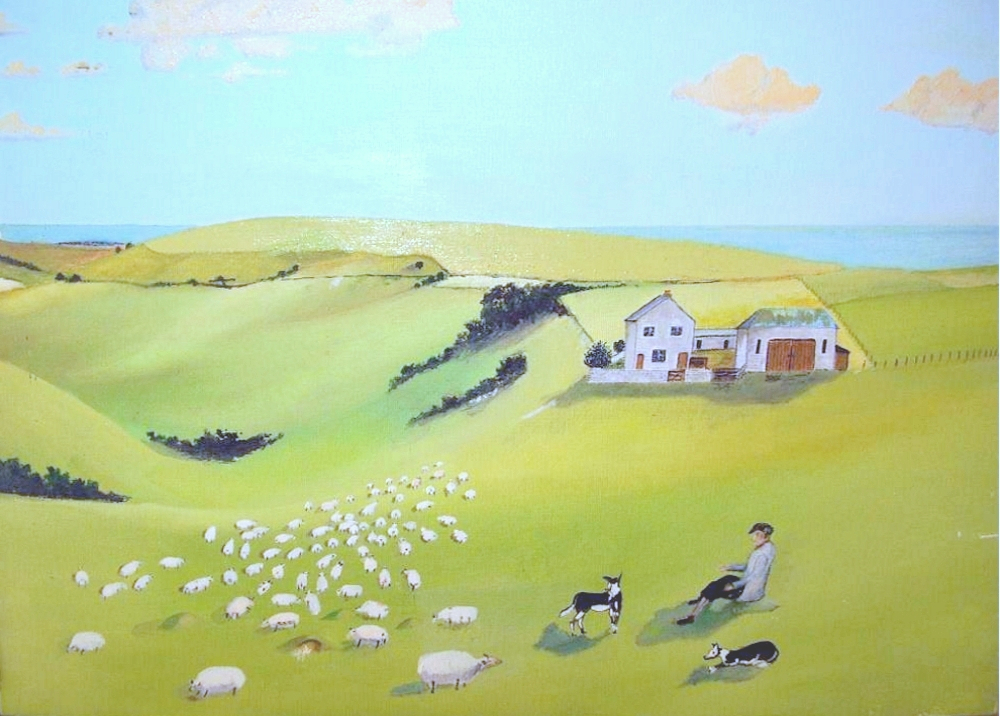
Newmarket Farm by Bob Phipps. Painted from his childhood memories.
In part, that is why I volunteered for this history project. Hardly any one of the people we researched were big important figures in history. Most were farm labourers and their families, forgotten by big histories. Yet every single one, in my opinion, is worth remembering. If it wasn’t for them – or people just like them – we wouldn’t have our daily bread.
What do I believe? I believe in people. We can be lovers or murders, workers or shirkers, bosses or labourers. We are none of us perfect. But we all have something, even in the very worst of us, that is worth saving. At least that is what I believe.
We are all part of Nature. And it can be red in tooth and claw. But even the lowest parasite relies on cooperation with other life-forms to survive. We are dancing on a tightrope stretched between competition and cooperation.
If there is a personal God holding our hand, guiding us on our way, I have yet to knowingly meet such a being. I have met and had long discussions with Christians of at least eight different denominations, with Buddhists from at least two denominations, with Muslims, Baháʼí’s, Wikka, Scientologists and others, and they were all wonderful people. Their faith shone from them as they each, over many years, have tried to convert to me. How could I choose? Every one preached that we should be nice to each other.
But none spoke to me any more than any other.
What did speak to me was the holistic scientific methodology of Goethe (especially as interpreted by Henri Bortoft); the philosophical writings of Rudolf Steiner especially his Philosophy of Freedom (though not his theosophical beliefs); and the holistic interpretations of Plato and Aristotle by writers such as Mary Louise Gill and Joe Sachs (who argue that they both had fundamentally the same philosophical beliefs).
Their views are, philosophically speaking, phenomenological and hermeneutical. But to cut a very, very long story short, the consequence of believing in such ideas as a way of engaging with and understanding the world is that, as Thomas Berry put it:
The universe is a communion of subjects, not a collection of objects. The devastation of the planet can be seen as a direct consequence of the loss of this capacity for human presence to and reciprocity with the nonhuman world. This reached its most decisive moment in the seventeenth-century proposal of René Descartes that the universe is composed simply of “mind and mechanism.” In this single stroke, he devitalized the planet and all its living creatures, with the exception of the human.
The thousandfold voices of the natural world [thus] became inaudible to many humans.
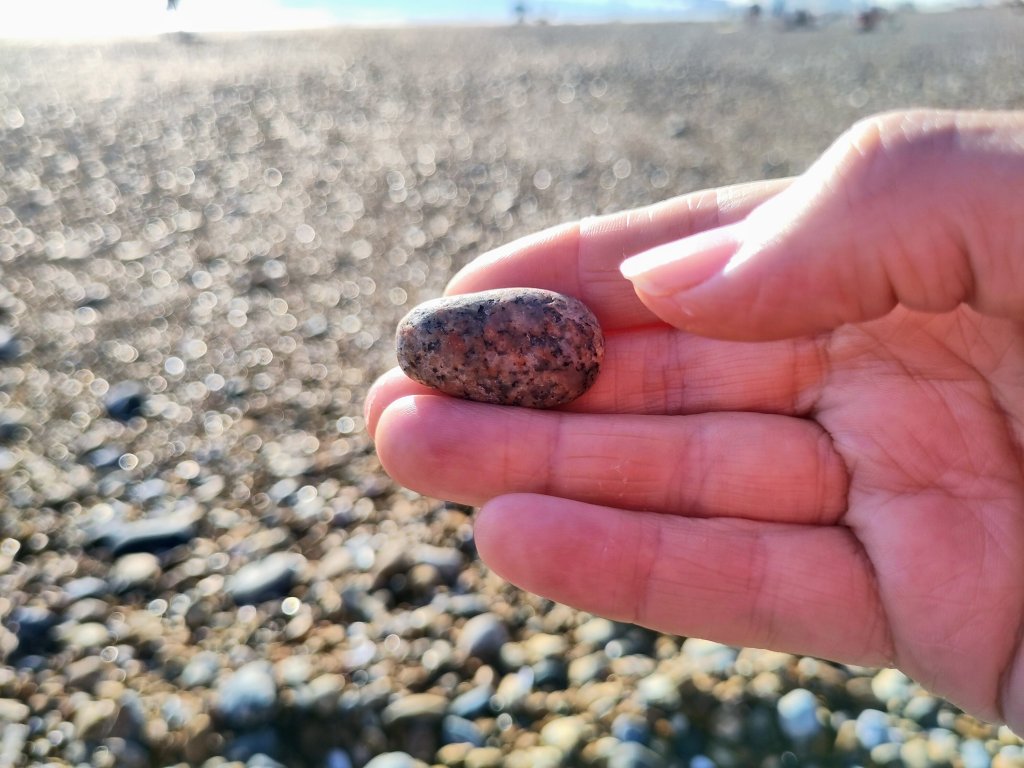
The whole Universe is a communion of subjects – that is what I believe, though I am very hazy about the details – and that includes the little granite pebble I communed with today on Brighton beach.
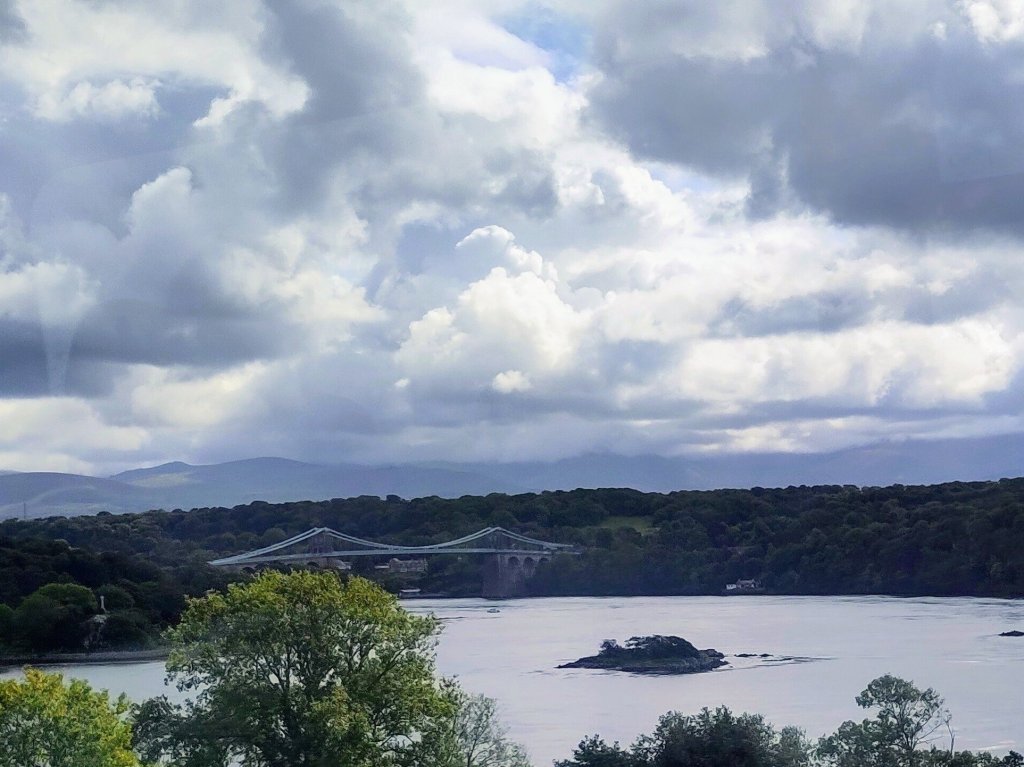
Pont Grog y Borth (Menai Bridge), leaving Anglesey on my way to Brighton.
I struggled to pack and to carry all my camping gear, books and digital mobile phones, along with their charger and cables. This process was not helped by my mind being full of new ideas and wonderful memories. But somehow I managed. And I would even do it all again – camping, public transport, the lot! Pushing oneself to the limits – and surviving – can be life affirming. More than anything else, I find that camping and walking connects me with the Earth 🙂
Gaia – Earth, Physis – Nature
Hail, children of Zeus! Grant lovely song and celebrate the holy race of the deathless gods who are for ever, those that were born of Earth [Gaia] and starry Heaven and gloomy Night and them that briny Sea did rear. Tell how at the first gods and earth came to be, and rivers, and the boundless sea with its raging swell, and the gleaming stars, and the wide heaven above, and the gods who were born of them, givers of good things, and how they divided their wealth, and how they shared their honors amongst them, and also how at the first they took many-folded Olympus. These things declare to me from the beginning, you Muses who dwell in the house of Olympus, and tell me which of them first came to be. In truth at first Chaos came to be, but next wide-bosomed Earth, the ever-sure foundation of all the deathless ones who hold the peaks of snowy Olympus, and dim Tartarus in the depth of the wide-pathed Earth, and Eros (Love), fairest among the deathless gods, who unnerves the limbs and overcomes the mind and wise counsels of all gods and all men within them. From Chaos came forth Erebus and black Night; but of Night were born Aether and Day, whom she conceived and bore from union in love with Erebus. And Earth first bore starry Heaven, equal to herself, to cover her on every side, and to be an ever-sure abiding-place for the blessed gods. And she brought forth long hills, graceful haunts of the goddess Nymphs who dwell amongst the glens of the hills. She bore also the fruitless deep with his raging swell, Pontus, without sweet union of love. But afterwards she lay with Heaven and bore deep-swirling Oceanus, Coeus and Crius and Hyperion and Iapetus, Theia and Rhea, Themis and Mnemosyne and gold-crowned Phoebe and lovely Tethys. After them was born Cronos [Harvest, not Chronos (Time)] the wily, youngest and most terrible of her children, and he hated his lusty sire.
Hesiod [The emphasis is mine, to identify Gods and Goddesses]
In Ancient Greek mythology, Gaia was the Earth and mother of all life. Ge-ology is the logos or study of Ge (Ge is another way of saying Gaia or Earth). As far as the Greeks were concerned, every material object was a living spirit. Our apparently inorganic Earth was a living being, an Earth mother. Personally I like the idea that geology may be considered the study of Mother Earth.
I leave it to my readers to choose whether there may be any truth in such ideas. The Ancient Greek word for Nature was physis. From this we have both physicians and physicists, for they considered life – and people – to be an intrinsic part of physics. At Aberdeen University, where I studied, their physics degree course was still called Natural Philosophy.
Earth Story
BBC Documentary presented by the biologist Professor Aubrey Manning, 1998.
This ground breaking 8 part television series presented for the first time to the general public how the complexities of Earth’s story were beginning to be understood. It
set out to explore a revolution in our understanding of our planet and its relationship to life…
Life has only been possible because of plate tectonics;
Plate tectonics was only possible because of liquid water;
The final episode showed evidence for why:
The survival of liquid water on Earth may not have occurred without life.
UNESCO: International Year of Planet Earth, Meeting, 11 Feb 2004
Aubrey Manning gave the closing speech on behalf of the United Nations at a meeting to rally support for Governments around the world to fund a coordinated research programme into the Earth Sciences.
He said:
“As a biologist I have been made increasingly aware of the interdependence of Earth and life. Water has existed at surface of the Earth for most of its history. Life first ‘took a hand’ in the evolution of the planet with the emergence of the cyanobacteria. In stromatolites, the formations in which we first recognised them as fossils, they survive today on the west coast of Australia. Other forms are still widespread and it was these organisms that first began to use light energy from the sun to make complex molecules and generate that (once) toxic element, oxygen….”
“But life as we generally understand it – multicellular life – really got going perhaps about 700 to 800Ma ago. We first see it in what has become known – slightly misleadingly – as the ‘Cambrian explosion’. Since then, global tectonics have had a major effect on its development….”
“With his concept of Gaia, James Lovelock recognises that, interacting with life, many planetary processes are homeostatic in their outcome. Unlike some of his more mystical disciples, he knows the Earth is not ‘alive’, but such processes are like those of a living organism. Hence the planet is certainly resilient, and as Lovelock points out, nothing humans can do will affect Gaia’s ultimate fate. What we can influence is the more pressing question (for us) of whether the human race can continue to inhabit Earth in a happy and constructive way.”
“Here surely is a unifying cause that can help us to lift our eyes from the pressing demands of the everyday. They must receive our attention but not, surely, our whole attention. We must, as a species, address broader horizons. The International Year of Planet Earth is of fundamental importance because it will appeal to everyone’s enlightened self-interest.”
“For those who would argue that everything has a price – then the economic value of the services provided by our planet – clean water, clean air, fertile soils and so forth – have a clear and quantifiable monetary value. A recent study has calculated that that value is three times the total gross national products of all the nations of the Earth. Our planet will continue to provide this bounty, free, forever – so long as we take care of it.”
“For me, it is, to me, a wonderful thought that so many countries can come together under the umbrella of the United Nations and become involved in this process of encouraging the responsible stewardship of our planet. There are huge educational opportunities here. The work of geoscientists has revealed how our planet ‘works’, and there is much wonderful science to be conveyed here in an approachable way. The general principles are certainly not difficult to understand. It will not be easy to bring home to everyone the importance of our responsibility for our planet.”
“The human race’s ingenuity and intelligence effectively put us in charge. As the International Year’s prospectus ‘The Earth in our hands’ says in its very title. We must recognise this, and restrain our future exploitation of this heritage. But it is quite counterproductive to overemphasize problems. There is so much that is positive to communicate. Good science is both fascinating and effective. It can reduce hazards and suggest solutions. But beyond the science, education about the Earth must help in the appreciation of how beautiful our planet is.”
“All of us … can see how beautiful the world is – and that is the way to involve the public. We must feel for our planet; appreciate its beauty, and feel a personal sense of hurt if it is damaged, or treated unsustainably. Outreach must be a process of engendering love – a love of our common home. Notwithstanding plate tectonics and Gaia, there can surely be no more grand or unifying theory, than that which says we all share a common home.”
“Of course, from time to time, the Earth will continue to deal us some pretty tough cards. There will be other earthquakes and floods and huge eruptions – and we can mitigate the effects of those through better understanding how our planet works. But whatever future trials lie in store, the Earth is our only home and deserves our love….”
The beautiful Isle of Anglesey lies off the west coast of Wales, UK. It is Wales’ largest offshore island (715 sq km) and has over 200 km of spectacular coastline. Known as Ynys Môn in Welsh, around 67,000 people make their home on the Island. The local culture is very distinctive, with around 60% of the population using Welsh as their first language.
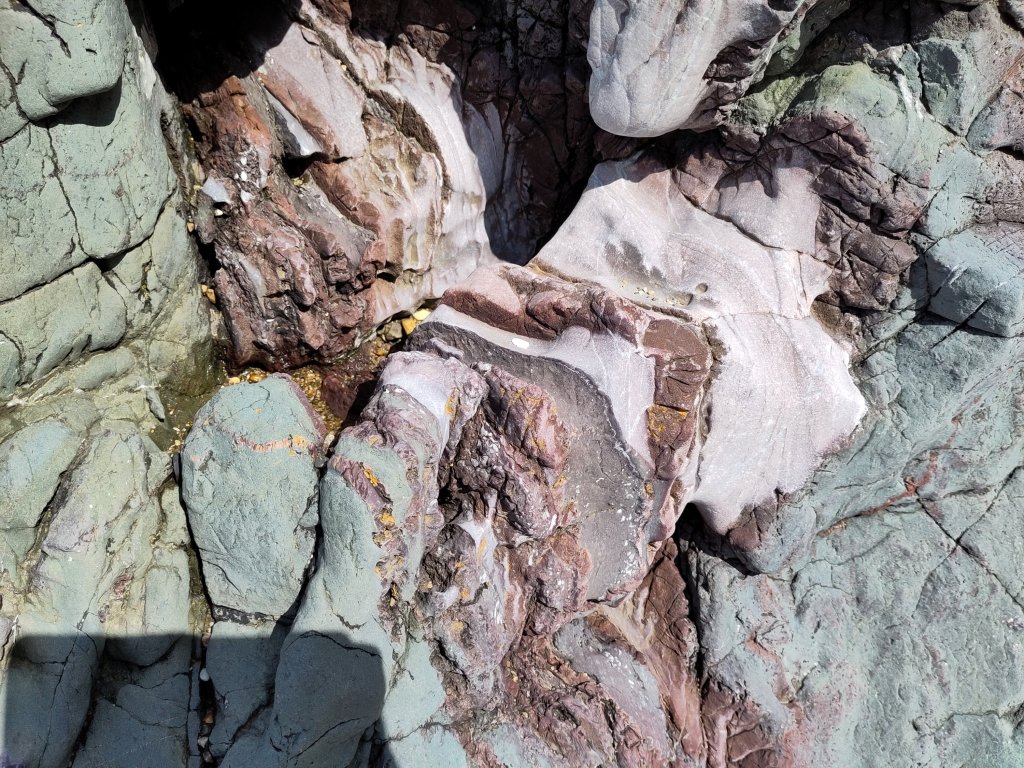
The island is world renowned for its amazing, diverse tectonic geology. South Stack with its world class folding and faulting has been a controversial site for many years, having been first identified as the oldest Precambrian rock then the youngest and now said to be from the Cambrian period. It is a mecca for students and schools who come here to study folding and faulting as well as examining the evidence for the birth of theAtlantic [I didn’t have time to visit]. Llanddwyn Island, on the west Anglesey coast, boasts that it is a small, but complete Oceanic Plate, with the famous Pillow Lavas at its eastern end, derived at a Precambrian constructive plate margin…. Then the world type site for melange is located at the island’s western end, with its jumble of brilliantly-coloured exotic rocks, exhumed from a deep ocean trench at a destructive plate margin. These rocks can explain the history and origin of the Earth.
… Sir Kyffin Williams R.A., whose work is shown in a new gallery dedicated to him [Oriel Ynys Môn, the municipal art gallery and museum]…. was a founder member of the Geopark and its first patron. His great uncle, Sir Andrew Ramsay, was the second Director General of the British Geological Survey of Great Britain and a ‘Father’ of Welsh Geology.
Anglesey, with its amazing tectonic origin, encapsulates the origin of the Earth and its importance within our planetary system.
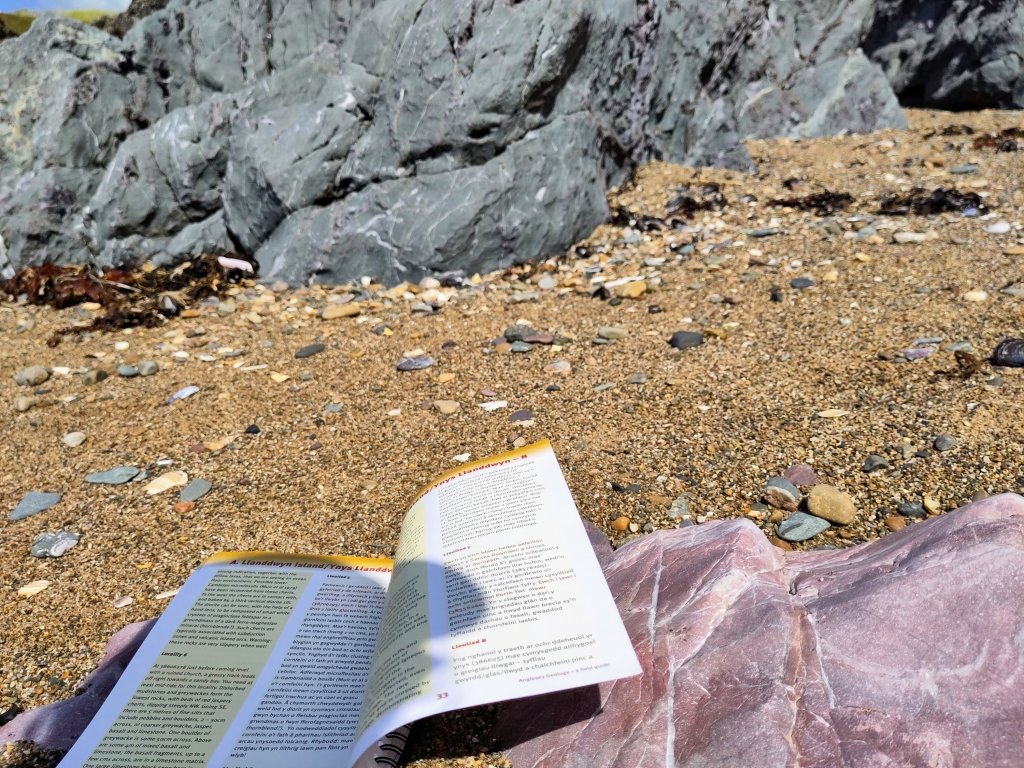
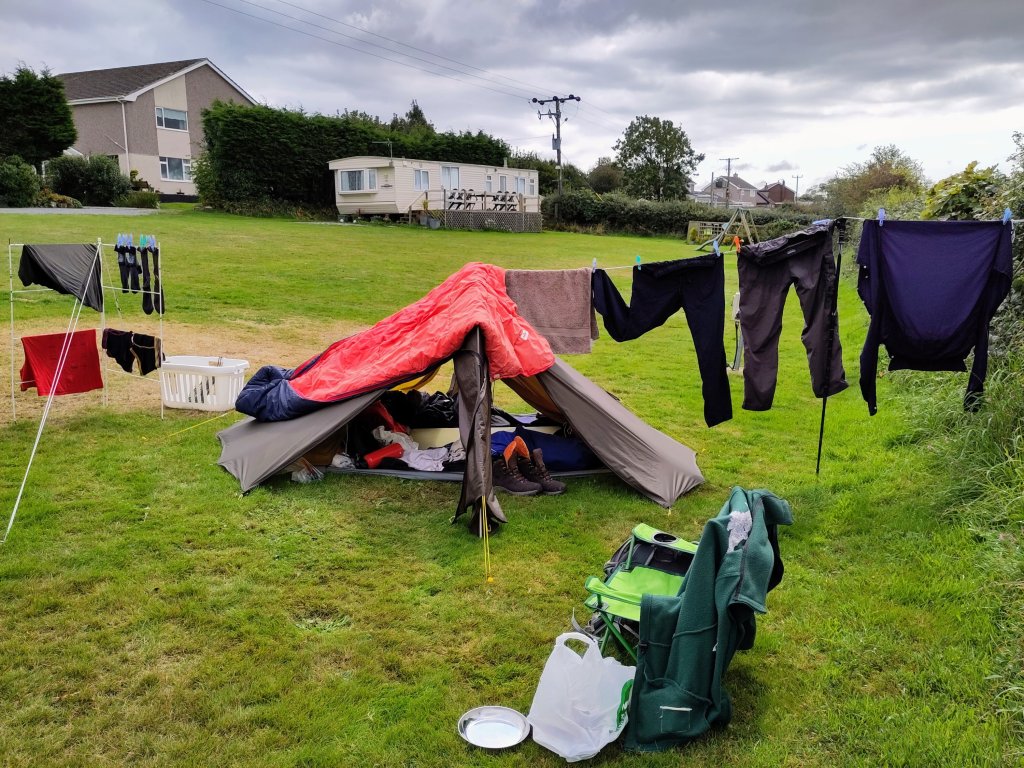
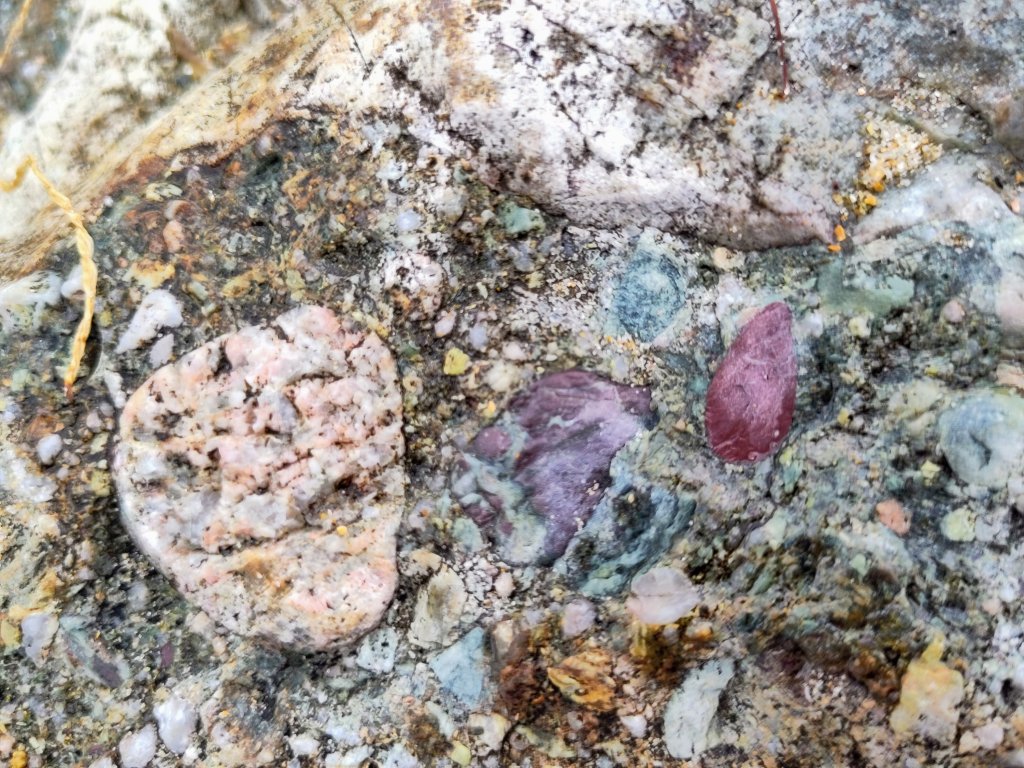
Stromatolite containing(?) limestone LlanbadrigStromatolite containing(?) limestone LlanbadrigLlanddwyn melange on a microplateLlanddwyn melange on a microplateLlanddwyn melange on a microplateCamp life at Caeau Crinion Campsite, Llangefni Serpentine near Y Fali (Valley)Melange with granite, jasper, serpentine and other rocks & minerals, Rhosneigr beachGeomôn UNESCO Geopark
Back in Brighton – Future Geology Explorations
Chalk 🙂
Limestone – of which chalk is a particular example – has proven to be an exceptionally important rock for the history of this planet. It is well worth exploring, for it has very much influenced the character of our South Downs landscape and the lives of those who lived there.
To better understand chalk, I therefore hope to go on geological study trips across the wider Sussex Downs. To better understand how the South Downs were uplifted by the consequences of tectonic activity, I hope to visit Switzerland and Italy which is where the tectonic activity in question actually occurred.
As a result of my findings during my Anglesey trip, I particularly want to deepen my knowledge of limestone both in general and in particular. It is not a coincidence that, when speaking of the greenhouse effect in geological history, it was the chalk cliffs of the South Downs that Professor Aubrey Manning visited. Watch this space!
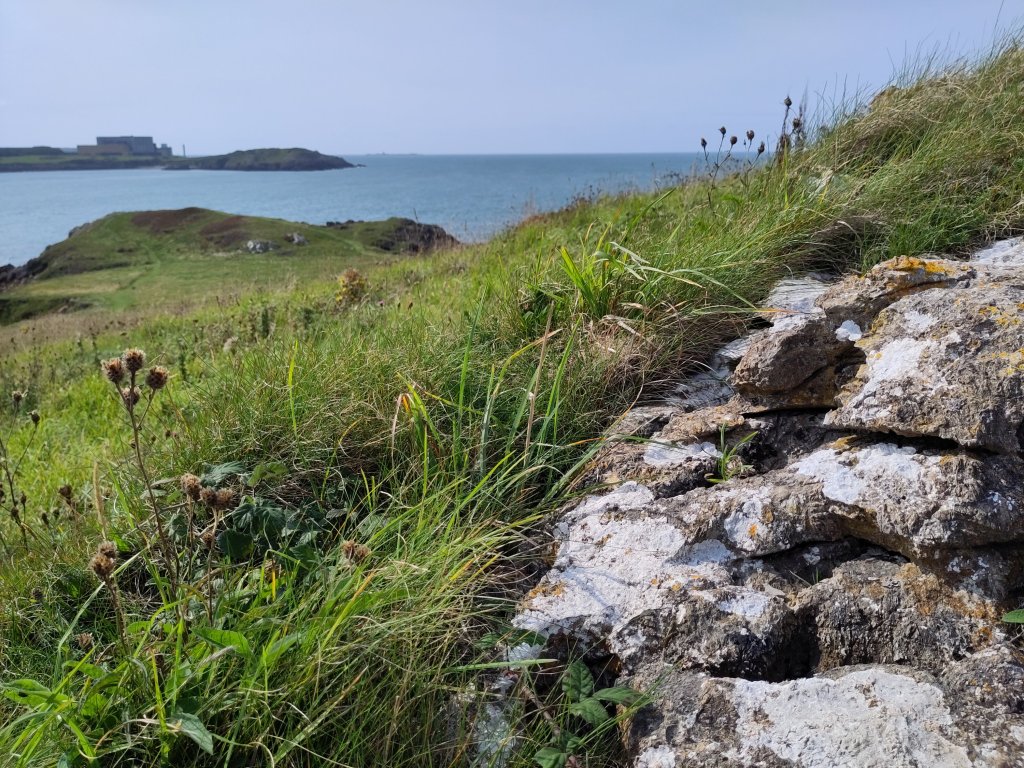
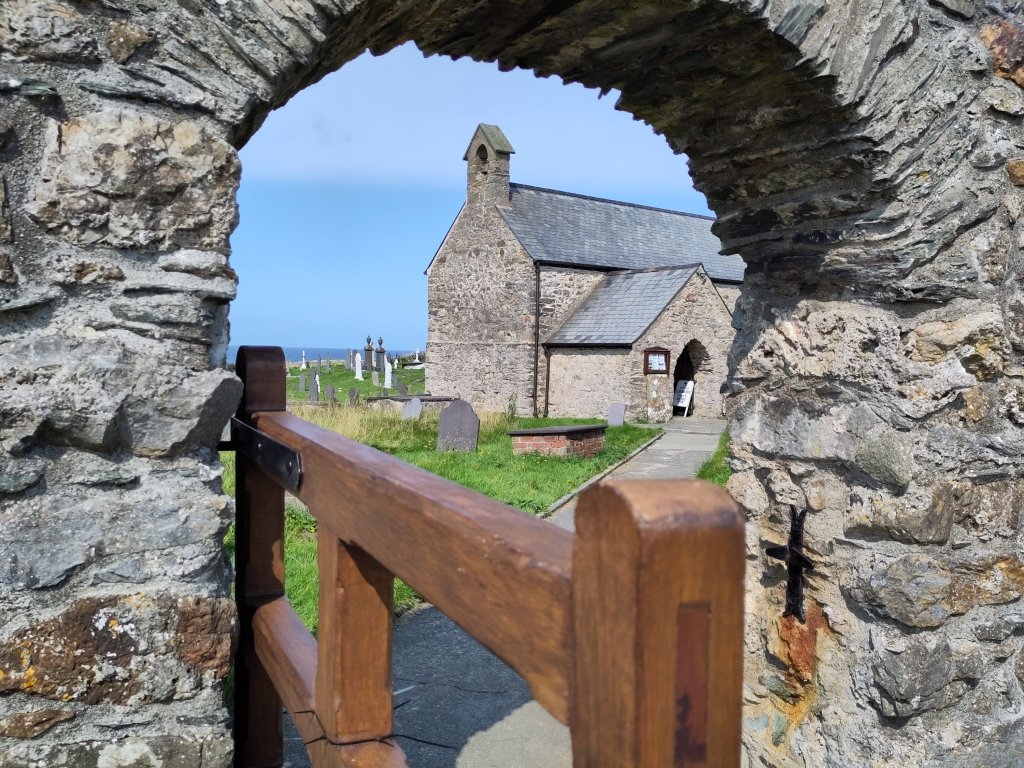
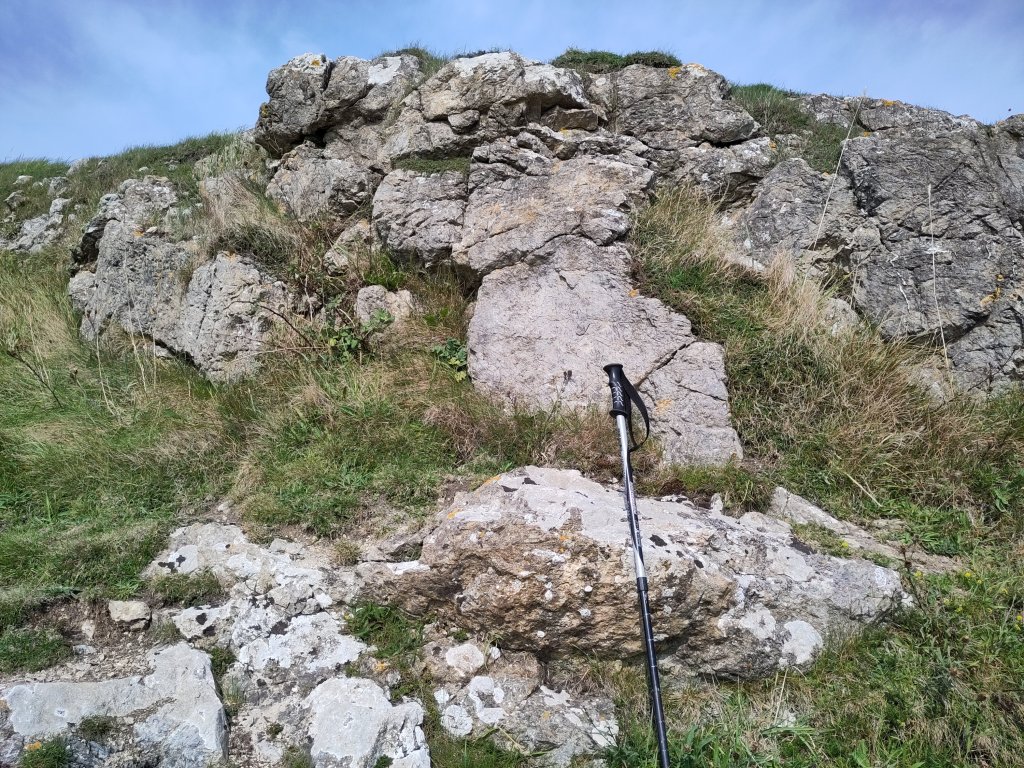
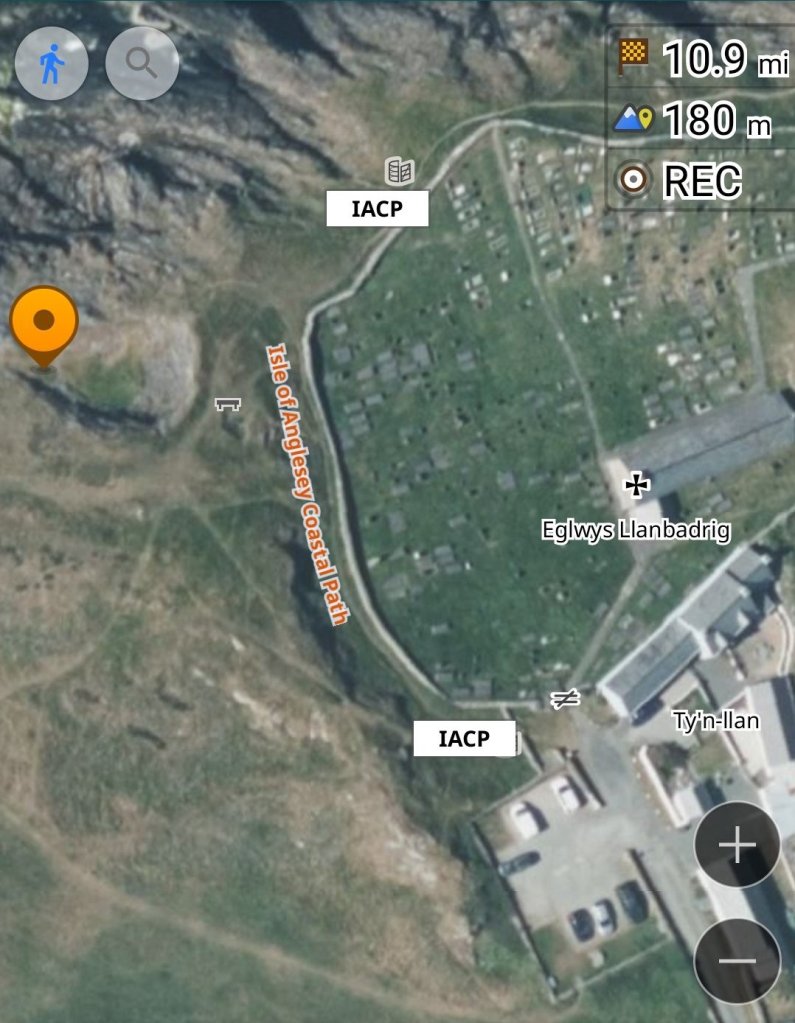
Between the lovely little church of Llanbadrig (which I didn’t have time to visit but is very much worth doing) and the bay of Porth Padrig is a limestone knoll. More or less ignored by tourists, this spot should be a major attraction for it possesses the oldest fossils in England and Wales!
Nevertheless, I failed to find the exact spot where Margaret Wood identified her fossil stromatolite bearing limestone. The limestones in this area vary in textures. I hoped to find one with layers.
The low limestone ridge to the left of the car park was what I explored. The marker pin shows a disused quarry whose vicinity is where I believe the stromatolite bearing limestone was originally identified.
Stromatolites
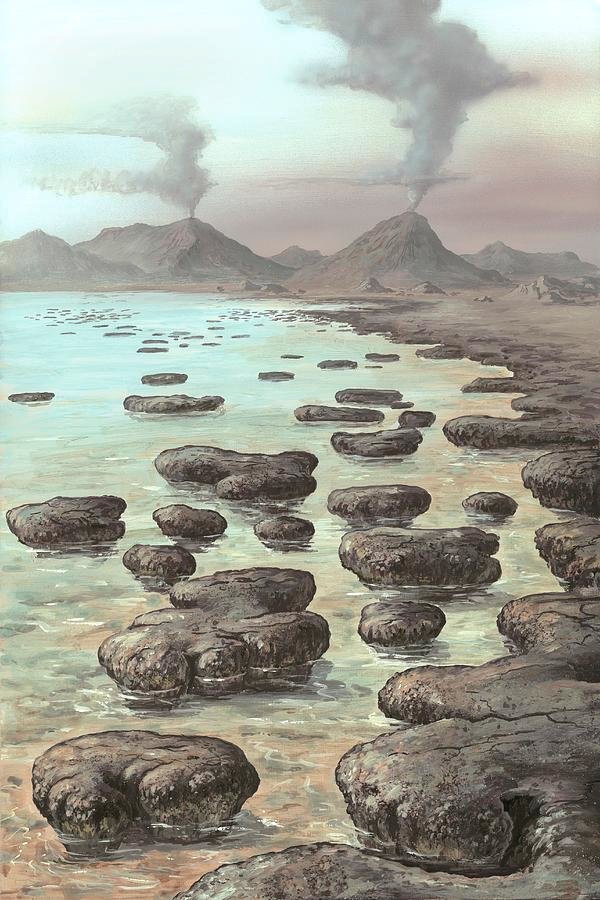
Credit RICHARD BIZLEY / SCIENCE PHOTO LIBRARY Caption Artwork of stromatolites on early Earth. Stromatolites are mineralised microbial communities formed from cyanobacteria (blue-green algae).
I like the above painting. It shows volcanoes in the background. Under their roots, granite would have formed. I imagine this to be a seamount island, similar to that of the Island arc of Hawaii. Except that some 860 million years ago the only life was (more or less) bacterial. Stromatolites survived as fossils because they built up layers of limestone around them, like the rings of a tree, as they grew to form large colonies.
They were the first living organisms to convert the gas carbon dioxide into carbohydrates (for energy and body building) and to give out oxygen. This happened about 2 billion years ago.
Oxygen is a highly reactive, toxic gas! At least it was for early forms of bacteria. To survive they had to develop antioxidants. Eventually they learnt to make active use of it. It is effectively rocket fuel, and enabled complex life to evolve and eventually take over the whole planet.
Meanwhile, for about a billion years, ending at the time of Anglesey’s earliest fossils, not a lot happened in terms of geology or life.
Life requires essential elements to survive. Geological activity is required to erode or explode these elements across the planet to enable life to expand and evolve.
Rodinia Breaks Up
The time period we are looking at is the Tonian (towards the end of the Precambrian). Apparently all the continents were grouped together into a supercontinent called Rodinia.
Anglesey was on a microplate squeezed between Laurentia and Baltica and Amazonia (I think!).
Rifting, such as occurs as a result of an expanding mid-ocean ridge (see Ancient Geology 4.1: Wandering (In)Continents), occurred to break up Rodinia at the same time as Llanbadrig’s stromatolites were preserved, at the end of the ‘boring billion’. Our oldest fossil stromatolites in Anglesey therefore record a transitional period, more or less when their heyday was ending. However, they also mark a time when new forms of life started to develop.
What may enable such energising, life promoting geological rifting is a controversial thing that I explored on my train journey back to Brighton. But that is for another post.
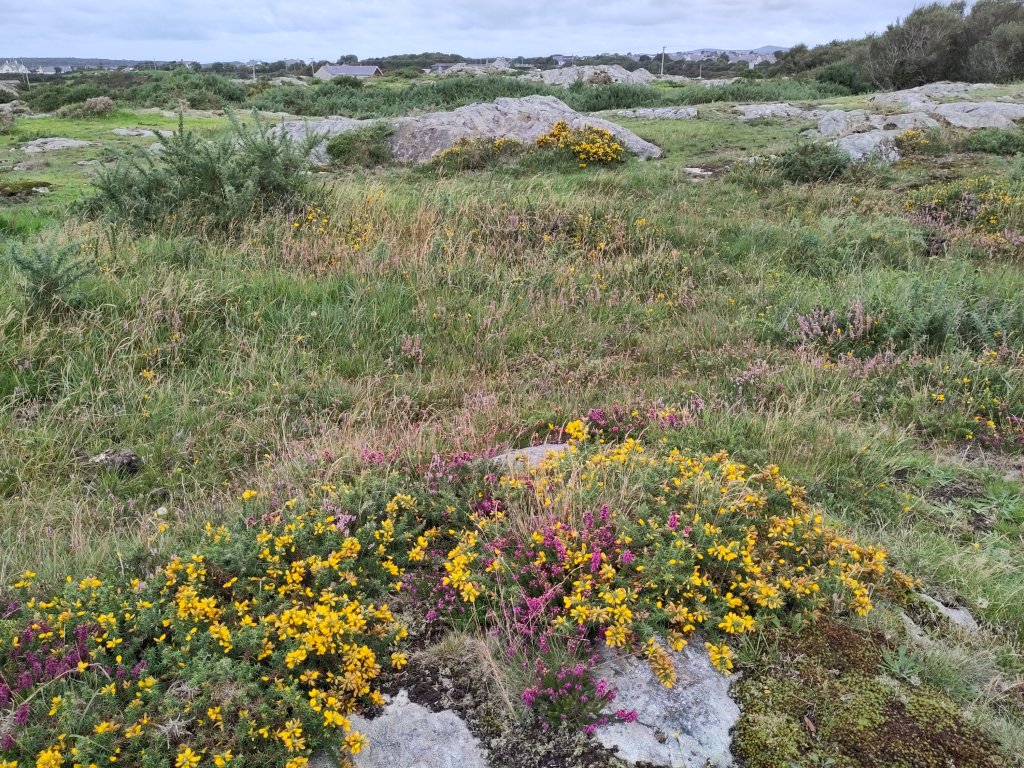
It was a grey day and the landscape matched the mood – bleak and windswept. On my visit to the geology museum in Amlwch I had marked two or three locations on my map, but I couldn’t recall what the rocks were! I hoped they would be granite – the bedrock which sits under the surface geology of most continents.
My first destination was Y Fali (Valley) and crossing some fields on my way to Four Mile Bridge I soon found some rocks!
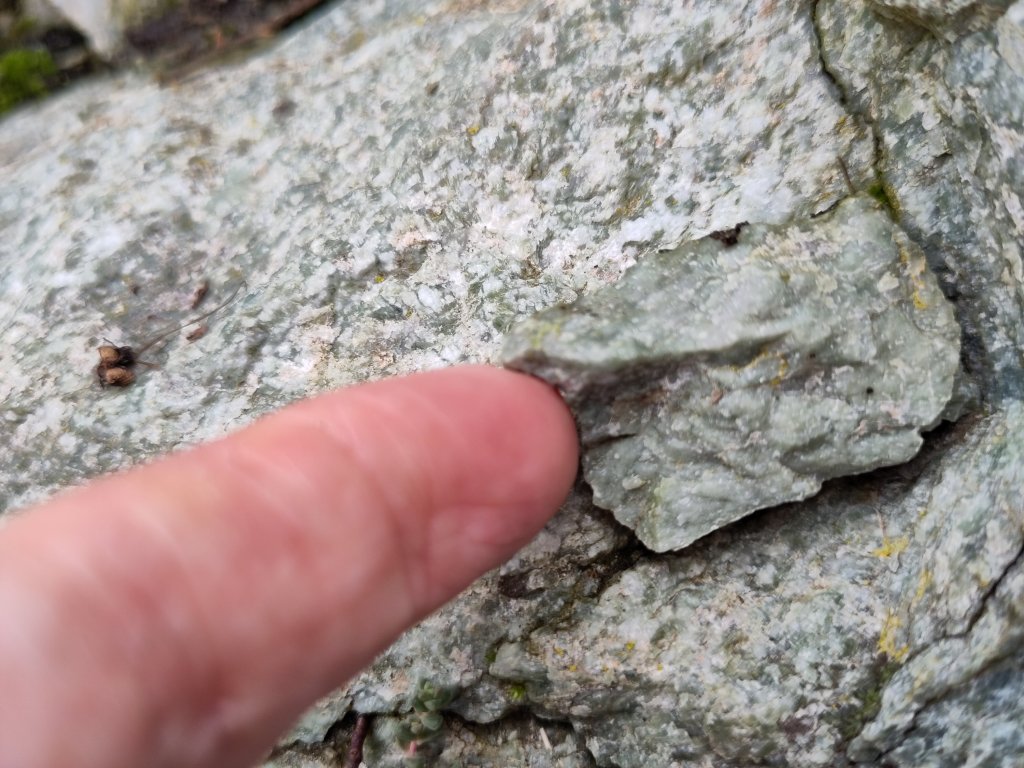
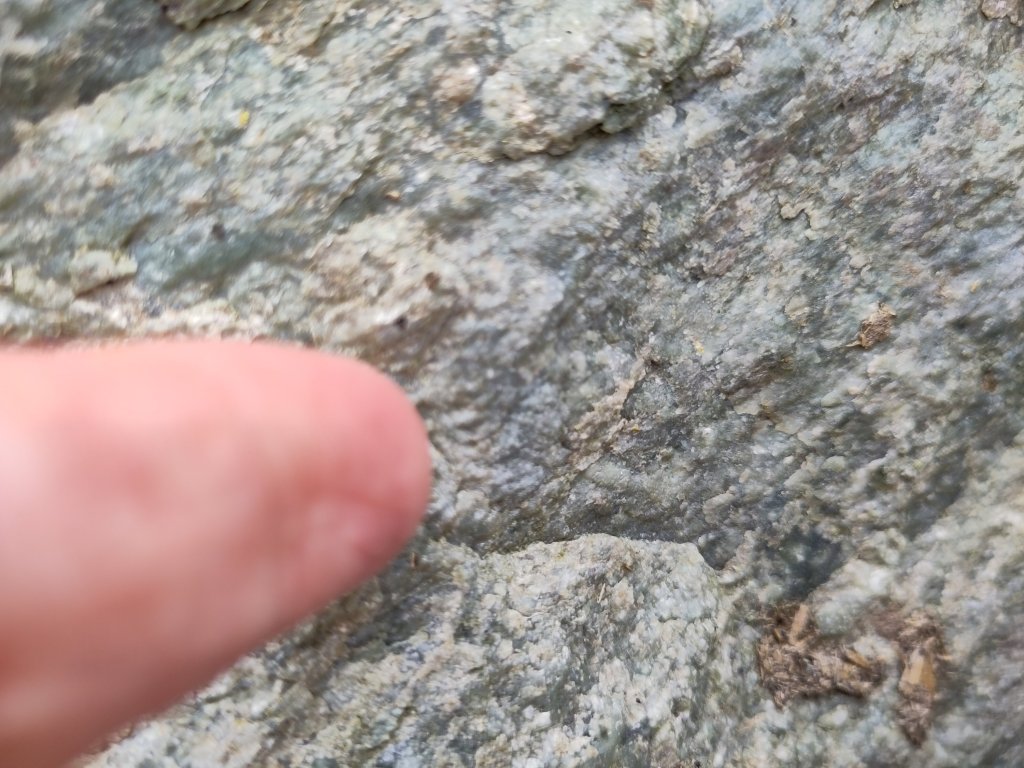
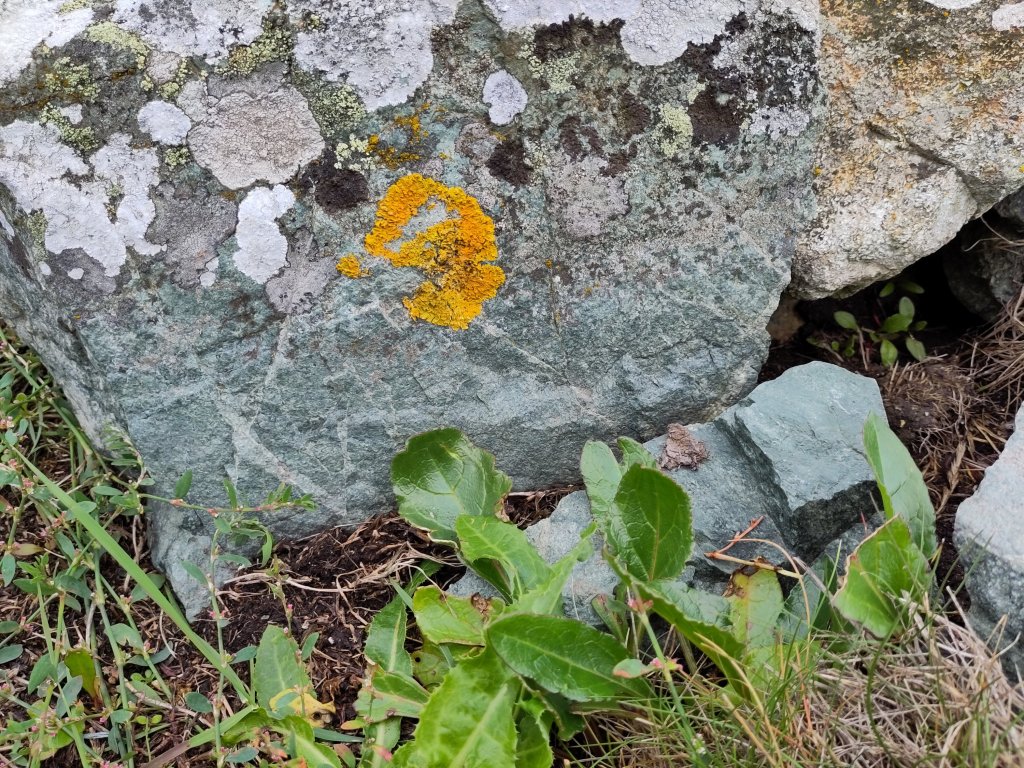
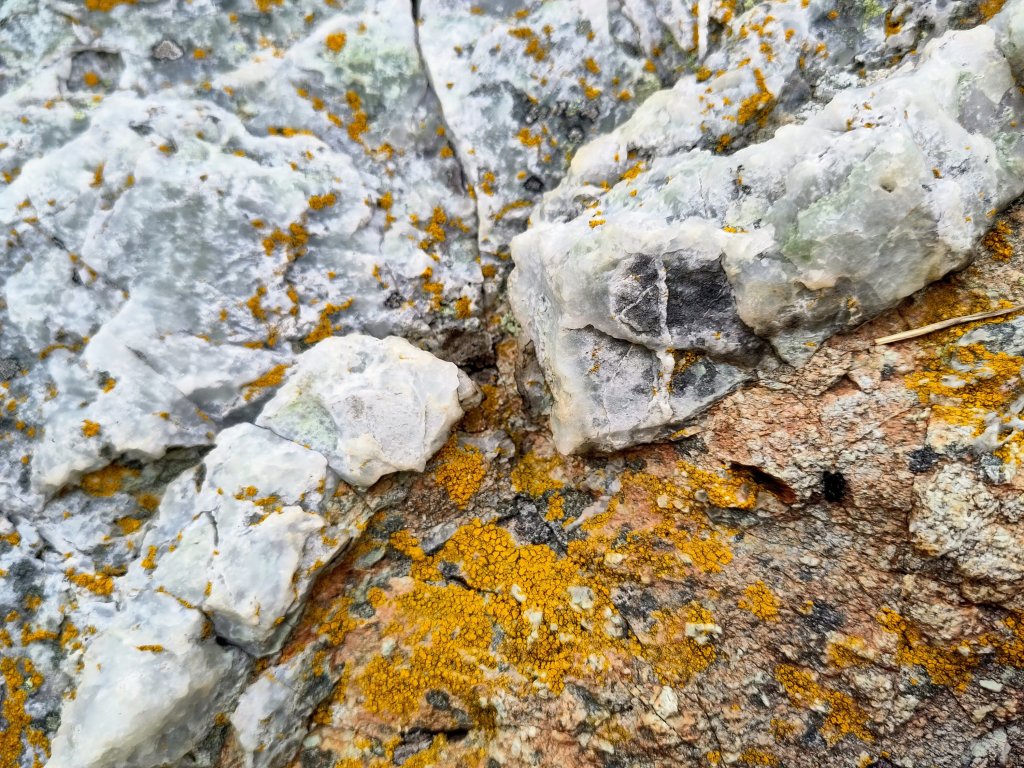
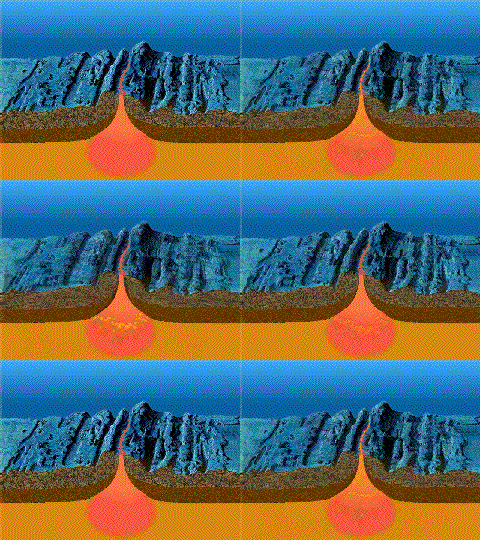
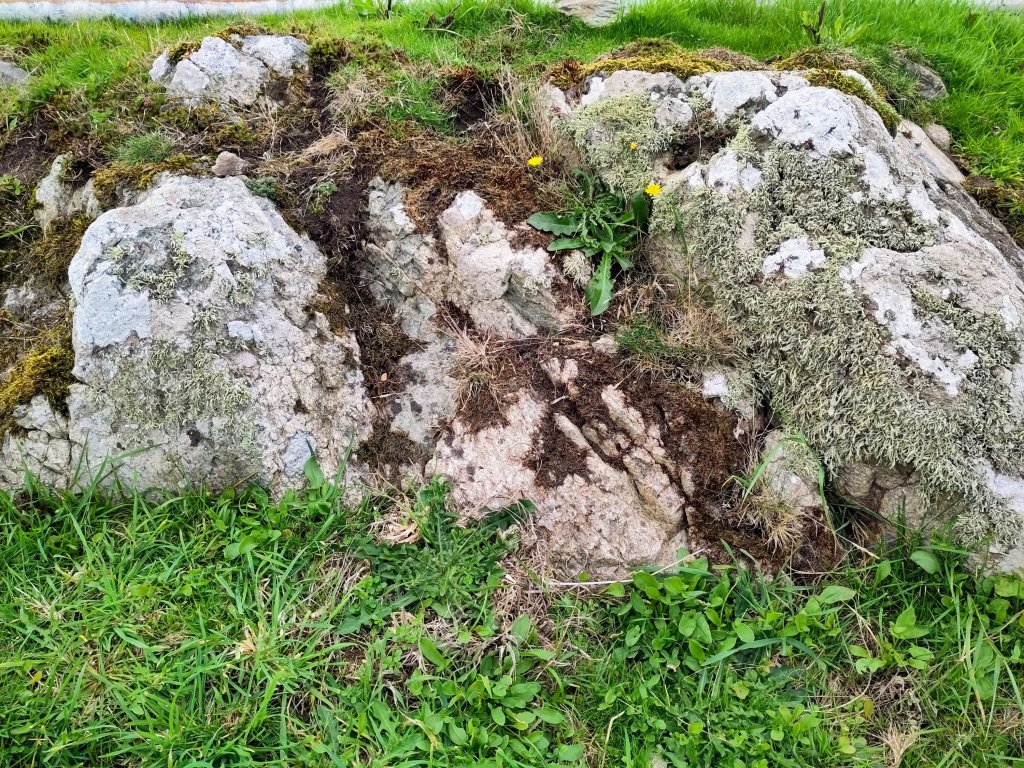
Not granite! It may be – at least some of the green-ish rocks – serpentinite. Serpentine rocks are named after their resemblance to the skin of a beautiful green coloured snake. It, apparently, is formed at mid-ocean ridges and in the forearc mantle of subduction zones. Which is exciting!
So pillow lava basalt and serpentine may both come from the same source, or from…
Forearc Mantle
A forearc is the area above the point where the oceanic crust is subducted, before it reaches temperatures sufficient to start melting the rocks. The latter region generates a ridge, or arc, of volcanoes. The forearc, in front of the mountainous volcanic arc, appears to be the favoured region for the formation of serpentinite rocks.
So, according to Hattori and Guillot, under great pressures, but low temperatures, blueschist (such as under the Marquess of Anglesey’s Column), as well as greenschist and amphibolite (which are supposed to in this area), are full of water as they are drawn (or pushed) down below. However, when the water is squeezed out, the minerals recombine to form serpentine.
However – and this is the exciting bit – the water reduces the melting point of the basaltic rocks causing them to become molten lava. Further squeezing forces the lava to burst forth as an active volcano. But if the molten lava doesn’t erupt, but cools and solidifies underground very slowly it can form …
Granite
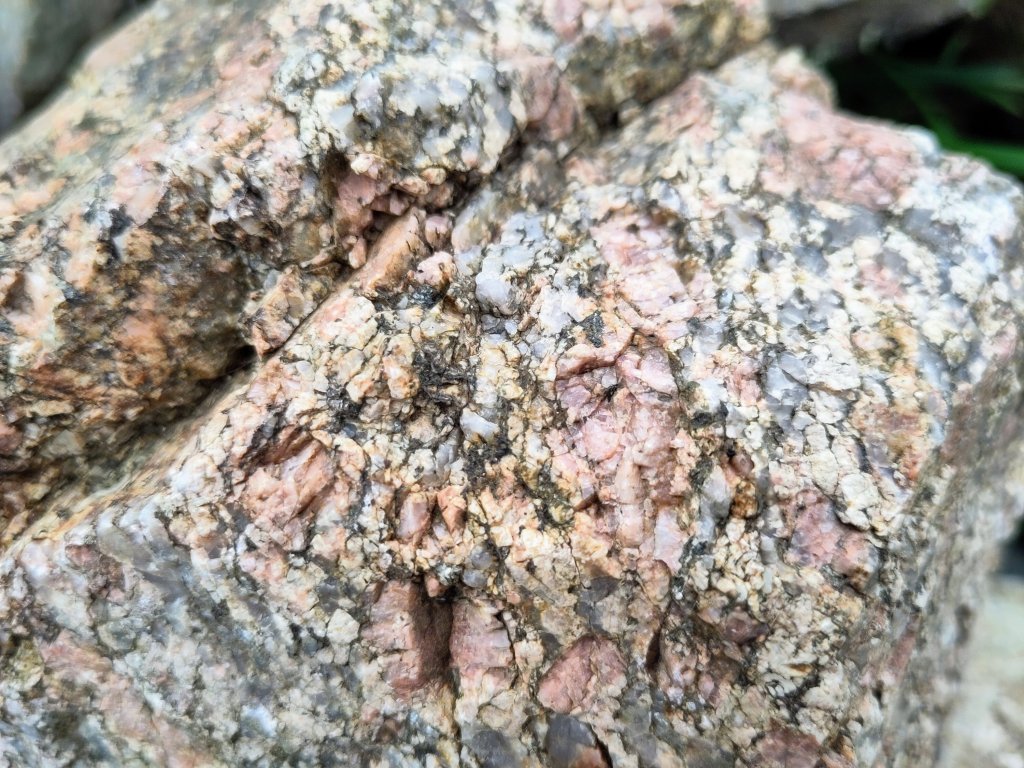
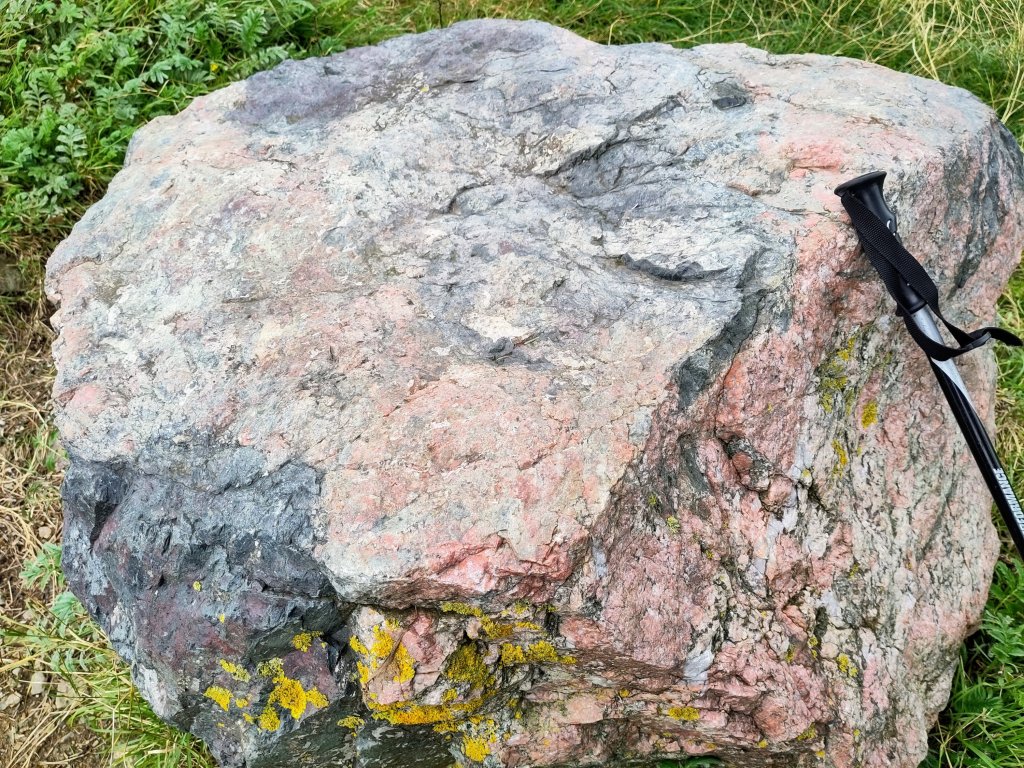
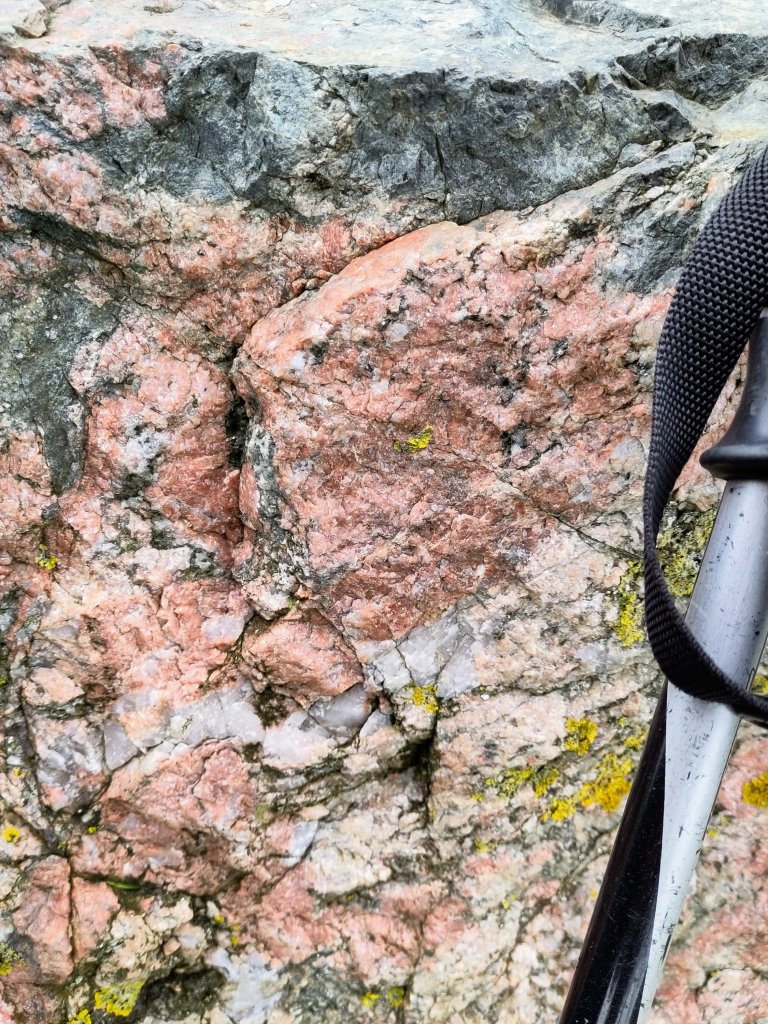
Granite!!Pink granite next to serpentine(?)
The serpentine has an almost soapy texture. The granite is rough, with big crystals of salmon pink alkaline feldspar. The white inclusions are quartz. I didn’t see any black shiny specks of mica.
Oops! Nearly forgot mantle plumes. In the middle of the Pacific Ocean today are many volcanic islands – such as Hawaii – that are not anywhere near any active tectonic areas. In mid-tropical ocean environments coral reefs can form around them. Britain’s oldest fossils – possibly formed on just such a tropical island.