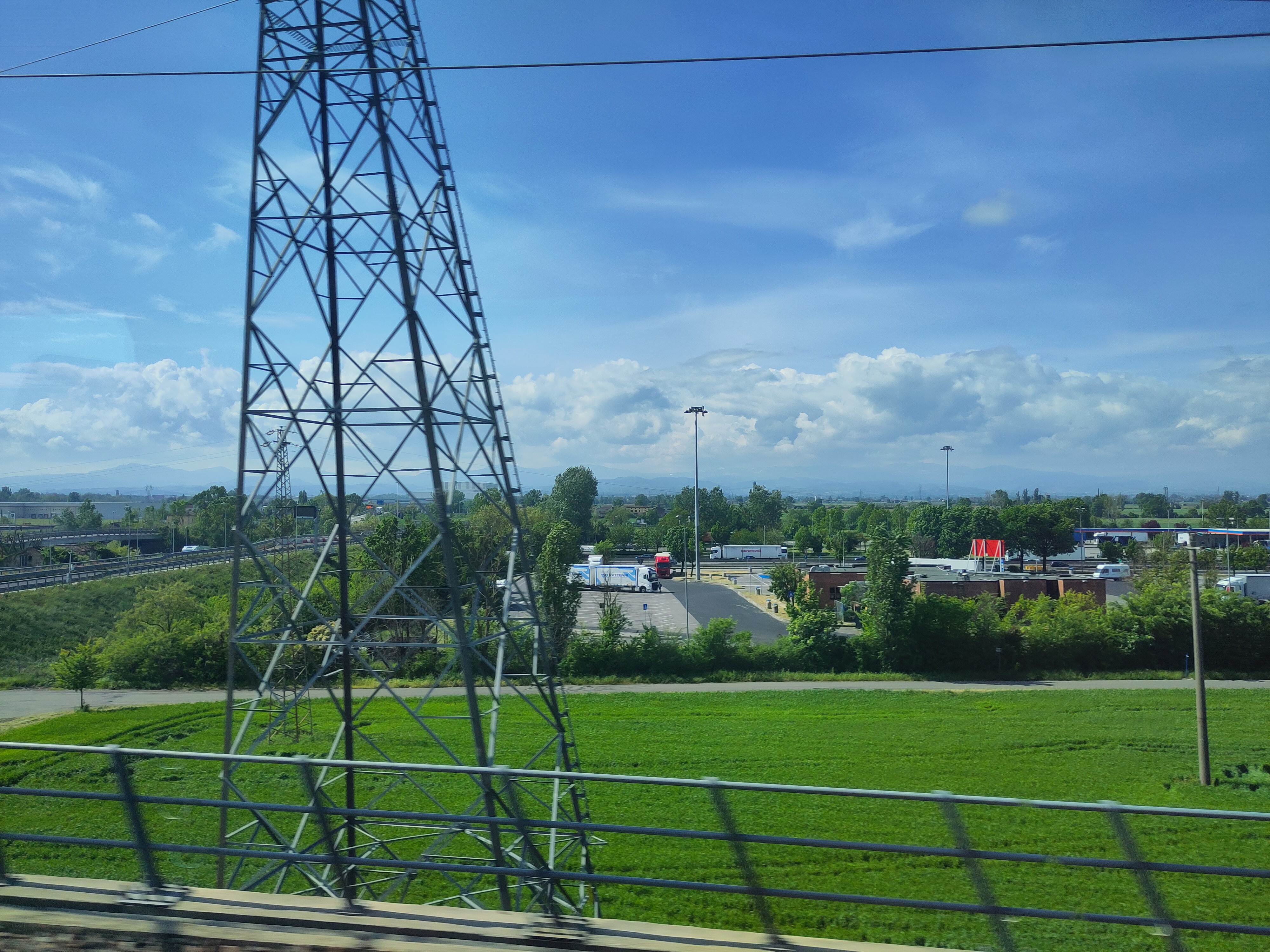
On the next leg of my epic journey through France, Switzerland and Italy, I travelled south-east, leaving the Alps behind. My train crossed the flat plain of the Po Valley which is situated on top of a micro-tectonic plate called the Adriatic or Apulian plate. It wraps itself around the limestone mountain backbone of Italy – the Apennines.
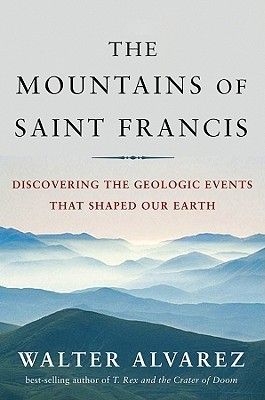
Originally my plan was to understand the geology and formation of the chalk South Downs by developing an understanding of the Italian limestone mountains of the Umbria–Marche, as written about in the book by Walter Alvarez, The Mountains of Saint Francis: The Geologic Events that Shaped Our Earth. The book is an excellent introduction to geology.
Chalk is a very pure form of limestone. The Umbria-Marche limestone Apennines are better studied by geologists. A very simplistic reason for the uplifting of the South Downs – to form the beautiful rounded hills that I grew up with – was the collision of Italy (which more than 30 million years ago was a peninsula of Africa) with Europe, which resulted in the uplifting of the Alps. The ripples of this collision spread out as far as England, lifting the Downs up out of the sea (if my very limited understanding is correct!).
So my plan was to visit as many of the sites as I could which were written about in this book. I wanted to directly experience and share what I could of his teachings, especially those aspects which might help me better understand the story of the formation of the chalk South Downs.
Mentioned almost in passing in the book was a reference to a small but important geological study centre called Coldigioco which Walter Alvarez had helped create with help from his former PhD student Alessandro Montanari. So, after making initial plans, I emailed Dr Montanari if I could visit his geological ‘observatory’ for a night on my return journey to England. He replied that I should stay for at least 3 days and that he would be happy to be my personal tour guide to the geological sites of the area!
Next stop, therefore, was the Osservatorio Geologico di Coldigioco! This was by way of a train to Ancona, and another to Castelplanio, where I was met by Sandro Montanari. We drove through beautiful green farmland with lots of hedges and woodlands, all bursting into full leaf. The low hills we drove through at the feet of the Apennines were, I was told, the remains of a series of terraces which had formed during the many warm and cold periods of the ice age. After passing through the village of Frontale (near Apiro), which is dominated by a mountain called Monte San Vicino, we soon arrived at Coldigioco.

<- Chalk 7
 Newmarket Hill

One reply on “Limestone: 1. First Glimpse of the Mountains of St Francis”
[…] Chalk 6 | Limestone 1 […]