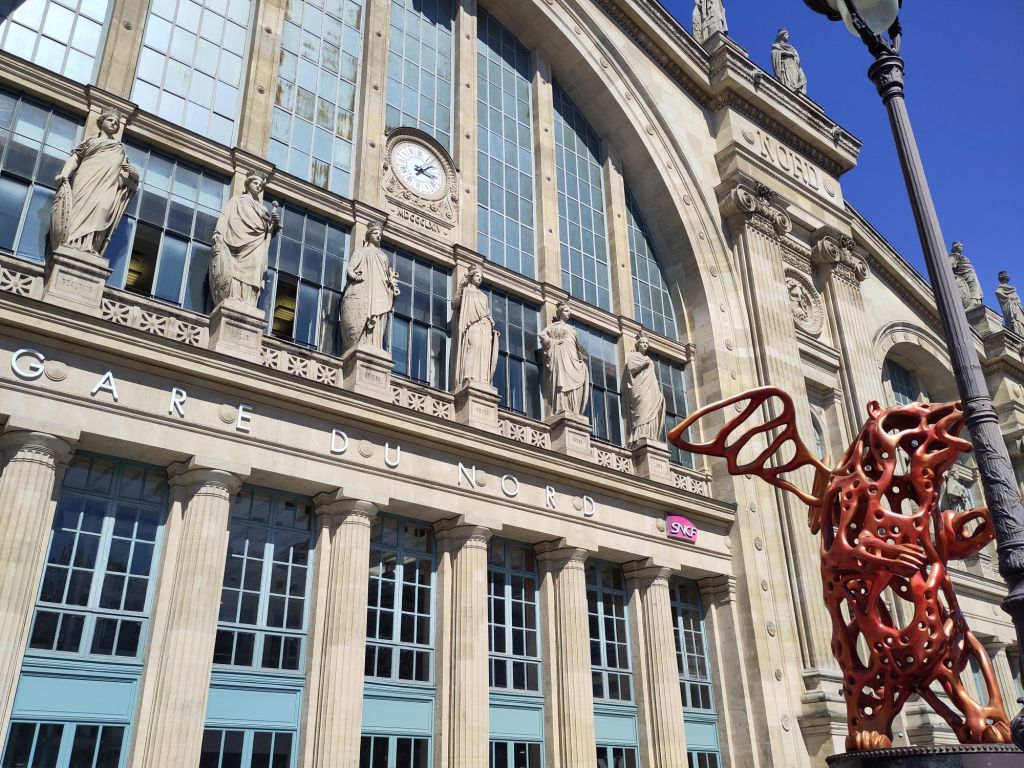
I arrived in Paris – my first time as a tourist, even if it was only for an afternoon before leaving early the following morning. The sun was shining and it was spring time so I shouldered my pack and walked very gently downhill towards the Seine. Downhill? Yes, Paris is at the very centre of yet another basin called the Paris Basin. There were no big holes in the ground on my route to see what lay under the tarmac and concrete but apparently it is clay and sandstone which sits on top of my favourite (Upper Cretaceous) chalk 🙂

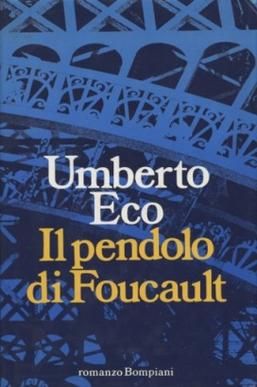
Many years ago I read (in English translation) Foucault’s Pendulum and thoroughly enjoyed it. The title refers to the first person (a Frenchman) to prove beyond doubt that the Earth rotates on it’s own axis. Therefore the sun is the centre and it is our planet which rotates. The idea is ancient and in the Middle Ages and Renaissance controversial. Even flat-earthers today struggle with the idea.
If I jump up and down I land on the same spot. If I run 100 metres due East I would cover the distance in the same time as when I run 100 metres due West (assuming there is no wind to slow me down or that I was not exhausted after running 100 metres). It doesn’t feel like I am moving through space due to the spin of the Earth at about 1,000 miles per hour. Nor that I am rotating around the Sun at approximately 66,000 miles per hour. It is hard to imagine, yet alone to believe.
It was in 1850 that Léon Foucault proved – for the first time in history – that the Earth spins on its own axis, by swinging a very heavy weight backwards and forwards on a very long wire, which was free to rotate in all directions. To keep the story simple I will say that as the pendulum rotates back and forth, the earth underneath it is also rotating, more or less giving it a little sideways push, such that each swing traces a slight anti-clockwise loop. The reality is a lot more complicated and is something I do not fully understand – but at least I have now experienced Foucault’s proof!
He gave public demonstrations in 1851, first in the Paris Observatory and shortly after in the Panthéon. In 1855 it was put on display in the Musée des Arts et Métiers.
Galileo Galilei was the first person to study the physics of a pendulum. His disciple, Vincenzo Viviani, in 1661 also studied the motion of pendulums. Apparently he observed its tendency to veer to the side but, unlike Foucault, he failed to understand its significance. Hanging the pendulum with two ropes prevented the ‘problem’.
There are two locations in Paris today to see Foucault’s Pendulum in action. The Pantheon (it was expensive and you have to pre-book online which I struggled to do) and my retrospective favourite and the setting for Umberto Eco’s novel, the atmospheric Musée des Arts et Métiers. If only I had enough time and energy to write more about the Priory building in which this pendulum is housed. For those interested I can only refer you to the above Wikipedia links for both the novel, the man and the museum.
If you do visit, spend time mindfully watching it slowly, inexorably, swing backwards and forwards. The end of its swing is marked by a very large circle, conveniently divided up into segments. Each segment bears a letter of the name of the museum. When I arrived it swung over the ‘M’ of [Musée des Art et] Métiers. After about half an hour of mesmeric watching it had passed on over the ‘é’ and reached the ‘t’. At this point I remembered something of the deep and meaningful significance of the letter ‘T’. It was a sign. Umberto Eco was a semiotician – the study of signs in terms of meaning. The letter ‘T’ is both in the word ‘tea’ and also in ‘toilet’. Their tea shop was already closed but the latter was thankfully available 🙂
<- Chalk 3 | Chalk: 5. Alpine Limestone Uplifted ->
 Newmarket Hill
3 replies on “Chalk: 4. Paris Basin and Il pendulo di Foucault”
Thankyou, that was really interesting. I’ll definitely visit next time I’m in Paris.
[…] Chalk 2 | Chalk: 4. Paris Basin and Il pendulo di Foucault […]
[…] the South and North Downs and lowering the London Basin (see Chalk 1, Chalk 2, Chalk 3 and Chalk 4) as well as other ranges of hills and […]