Another hurdle has been cleared! Smiths Gore, who manage Brighton & Hove City Council’s farmland portfolio (including Castle Hill Nature Reserve), have obtained formal permission for me to go ahead with my excavation project.
There is now only one more permission to be obtained – namely that of being able to dig on a nature reserve of European significance. Luckily the reserve manager, Malcolm Emery, is dealing with this on my behalf. Because the site used to be a residence and farmyard, it is an area of high fertility (lots of poo and pee!), and therefore has become colonised by nettles and brambles. In the early 1950’s the area was bulldozed to make the site safe. This has very much reduced the biodiversity and ecological significance of this small corner of the reserve. Therefore further digging should not threaten the nature reserve’s conservation status in any way.
I have also started receiving offers of help from volunteers interested in being involved in an archaeological dig. This is excellent news! I need to decide on a fixed day once a month for volunteer days to be able to happen – sometime in March.
I was on site yesterday and it was good to see it again – without its earlier blanket of snow! I didn’t take any photos, but I did clean up a few fragments of wall that are visible – so it is now easier to show visitors the approximate ground plan.
The next clearance day may possibly be next Thursday – though this hasn’t been confirmed yet – it depends on the forecast, and whether Malcolm Emery has any higher priority jobs that need doing.
It slices through the mat of bramble and nettle roots which cover my archaeological dig site with relative ease. So it is perfect for dealing with the regrowth that will inevitably happen following the initial clearnace work. Cutting back the top growth will result in everything bouncing straight back again – unless I make good use of my Chillington Hoe.
I had never used them before – though I have often seen them on television used by subsistence farmers/ gardeners in Africa. I can now thoroughly recommend them. They were probably second only to the digging stick in the historical development of agricultural tools (http://en.wikipedia.org/wiki/Hoe). They have variously been called Azadas, Badzas, Grape Hoe, Eye Hoe, Jembe, Mamooty, Mattock or Adze (https://www.quickcrop.co.uk/blog/garden-tools-chillington-hoes-or-azadas). The Chillington Tool Company has a history of over a hundred years of being the biggest manufacturer of such tools in the UK – hence their name in English.
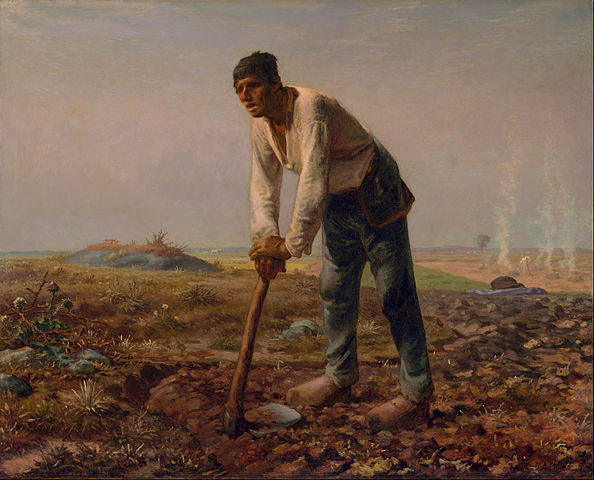
Further research on the Internet produced Millet’s picture of “The Man With the Hoe”.
Millet, Jean-Francois ‘Man with a Hoe’ c.1861; Wikimedia Commons.
This inspired the American poet, Edwin Markham, to write his most famous poem:
The Man with a Hoe
Bowed by the weight of centuries he leans
Upon his hoe and gazes on the ground,
The emptiness of ages in his face,
And on his back, the burden of the world.
Who made him dead to rapture and despair,
A thing that grieves not and that never hopes,
Stolid and stunned, a brother to the ox?
Who loosened and let down this brutal jaw?
Whose was the hand that slanted back this brow?
Whose breath blew out the light within this brain?
Is this the Thing the Lord God made and gave
To have dominion over sea and land;
To trace the stars and search the heavens for power;
To feel the passion of Eternity?
Is this the dream He dreamed who shaped the suns
And marked their ways upon the ancient deep?
Down all the caverns of Hell to their last gulf
There is no shape more terrible than this–
More tongued with cries against the world’s blind greed–
More filled with signs and portents for the soul–
More packed with danger to the universe.
What gulfs between him and the seraphim!
Slave of the wheel of labor, what to him
Are Plato and the swing of the Pleiades?
What the long reaches of the peaks of song,
The rift of dawn, the reddening of the rose?
Through this dread shape the suffering ages look;
Time’s tragedy is in that aching stoop;
Through this dread shape humanity betrayed,
Plundered, profaned and disinherited,
Cries protest to the Powers that made the world,
A protest that is also prophecy.
O masters, lords and rulers in all lands,
Is this the handiwork you give to God,
This monstrous thing distorted and soul-quenched?
How will you ever straighten up this shape;
Touch it again with immortality;
Give back the upward looking and the light;
Rebuild in it the music and the dream;
Make right the immemorial infamies,
Perfidious wrongs, immedicable woes?
O masters, lords and rulers in all lands,
How will the future reckon with this Man?
How answer his brute question in that hour
When whirlwinds of rebellion shake all shores?
How will it be with kingdoms and with kings–
With those who shaped him to the thing he is–
When this dumb Terror shall rise to judge the world,
After the silence of the centuries?
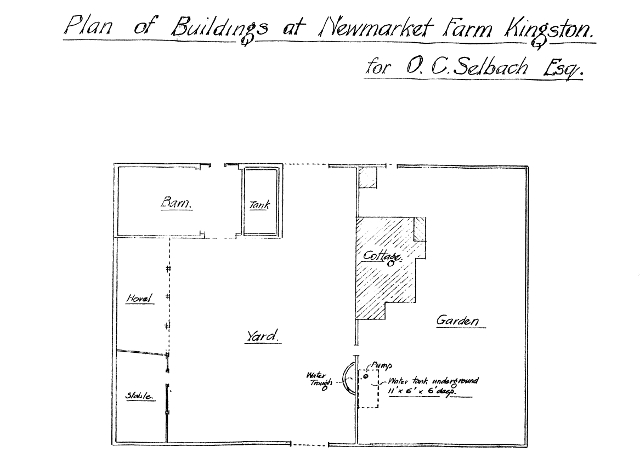
My (nearly) 13 year old niece and my mother, braved the cold to help me find out whether a plan of Newmarket Farm which we had was an accurate representation of the archaeology on the ground. The plan was a copy of the one that was found in documents held in East Sussex Record Office, and was probably drawn in 1921 when Oscar Selbach bought Newmarket Farm.
1921 Selbach plan of Newmarket Farm. From ESRO
The overall aim of the day’s work was to perform (some of) the tasks required to be done before being able to mark the area of the archaeological dig site, approximately 3m beyond the boundaries of the Newmarket Farm site. The extra 3m is to provide public access as well room to place the spoil from the trenches.
The area of the site needs to be marked out before the next date which has been planned for the clearance of the rest of the site.
Based on the dimensions given for the water tank, the scale of the plan has been estimated, and has therefore enabled the lengths of the wall lines to be meassured. My measurements were independently confirmed by my niece.
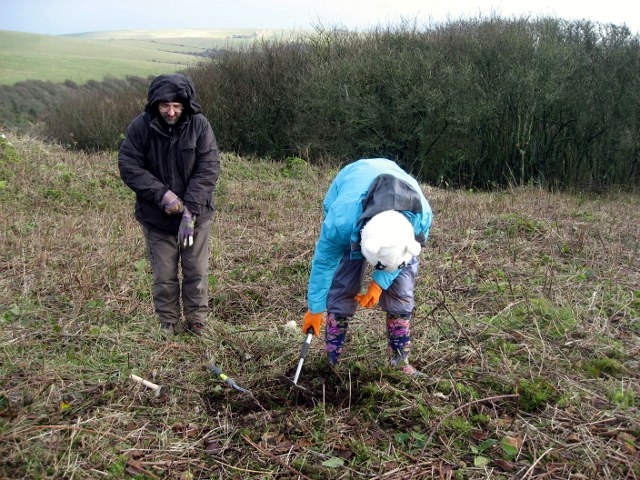
The next objective was to identify two fixed points of archaeology on the ground to check the accuracy of Selbach’s plan. Previous to the site clearance work of the 9th January, only the SE corner (bottom right on the plan) was visible and some isolated portions of the south and east boundary walls. During site clearance a small portion of the wall which divided the garden from the farm-yard was revealed. Therefore our next task was to uncover enough of this wall to be able to estimate where it met the southern boundary wall, somewhere near a small elder bush.
Looking E at my niece & myself finding the wall-line between garden and farm-yard; 13th January 2013.
Did I say that it was cold! Also, almost all of the existing line of the wall was buried under a thick mat of bramble and stinging nettle roots. No wonder Time Team makes it look so easy – they have a mechanical digger to do this part!
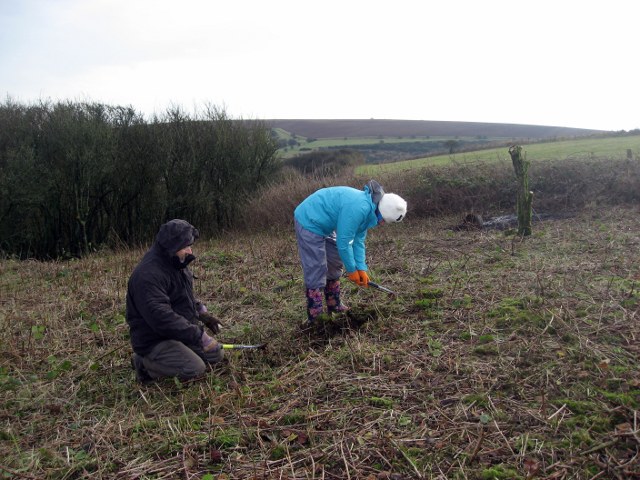
Looking SE at my niece & myself finding the wall-line between garden and farm-yard; 13th January 2013.
But with hard work and perseverance we managed to expose enough of the wall to estimate that it met the southern boundary wall immediately to the east (left) of the elder bush.
Next, Selbach’s plan indicated that the distance from this point to the SE corner of the garden boundary wall was about 52.5 feet. When we meassured this on the ground it was found to be about 52 feet. Therefore we felt able to (provisionally) conclude that Selbach’s plan could be used as a guide to estimating the lengths of the other walls.
Just before we left I quickly measured the distance between the elder and the SW corner of the house, and marked it with a peg. There was no sign of any change in ground level in the vicinity of this point. Selbach’s plan will therefore be very importantant for any future attempts to locate archaeological targets on the ground.